


News Center
—— NEWS CENTER ——
Xi'an Shenghongchuang Instrument Co., Ltd.
Contact: Mr. Zhang
Mobile: 15529283736
Email: shc-sensor@qq.com
Address: Fortune Building, Sanqiao Street, Xixian New Area, Xi'an, Shaanxi Province
When purchasing a corrosion-resistant pressure transmitter, how can you verify the wetted-part materials? Understanding the properties of the medium and the operating conditions helps reduce the risk of corrosion-related failure and incorrect selection.
1. First, identify which components are in contact with the medium
Do not focus only on the diaphragm material
Wetted-part materials are the materials of components that may come into contact with the measured medium during normal operation, cleaning, or abnormal operating conditions. The long-term service life of a pressure transmitter depends on the compatibility of the entire wetted system, not just the name of a single material.
Common wetted parts include the isolation diaphragm, process connection, seals, gaskets, and any welds or diaphragm assemblies that may contact the medium. For sanitary, flanged, or capillary-type products, also verify the materials of components such as the diaphragm flange based on the specific design.
When purchasing, ask the supplier for a list of wetted parts, material grades, and structural drawings. Distinguish components that actually contact the medium from materials used only for the housing or terminal box. For applications involving safety or critical production, also specify material certificates, traceability, and acceptance methods.
2. Screen candidate materials based on the medium and operating conditions
The name of the medium is only a starting point for selection
The corrosiveness of the same medium can vary significantly with changes in concentration, temperature, and impurities. When requesting a quotation, provide the medium’s composition and concentration range, operating temperature, maximum temperature, operating pressure, and any potential pressure fluctuations.
For example, media containing chlorides may cause pitting or crevice corrosion in some stainless steels. Oxidizing impurities in acidic media may also change the range of conditions for which a material is suitable. Chemicals used during shutdown, cleaning, and disinfection should also be included in the review.
The materials below are for preliminary discussion only and should not be treated as a general corrosion-resistance guarantee for any specific medium. The final selection should be jointly confirmed by the user and supplier based on the actual concentration, temperature, pressure, and material compatibility data.
Sealing materials and connection design are equally important
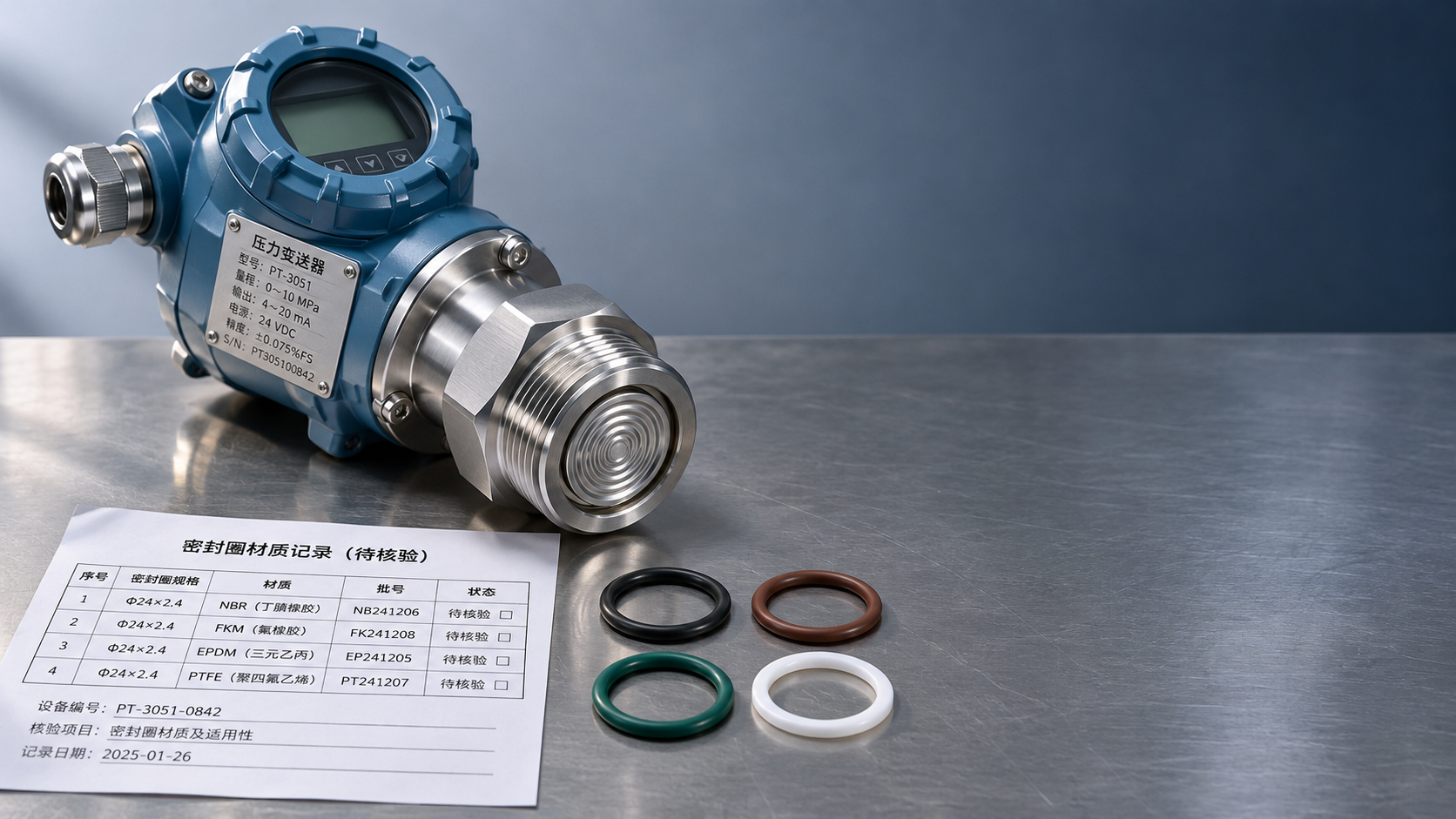
Even if the diaphragm passes a corrosion-resistance assessment, a seal may still fail due to swelling, hardening, or permeation. Fluoroelastomer, EPDM, and PTFE each have their own application limits. Select the material according to the specific medium and temperature; do not rely solely on the description “acid- and alkali-resistant.”
The process connection also affects corrosion risk. Threaded, flanged, flush-diaphragm, or diaphragm-seal designs should be selected according to the medium’s tendency to crystallize, form scale, or adhere, as well as cleaning requirements. Gaps and dead zones where liquid can collect should be carefully assessed during the design stage.
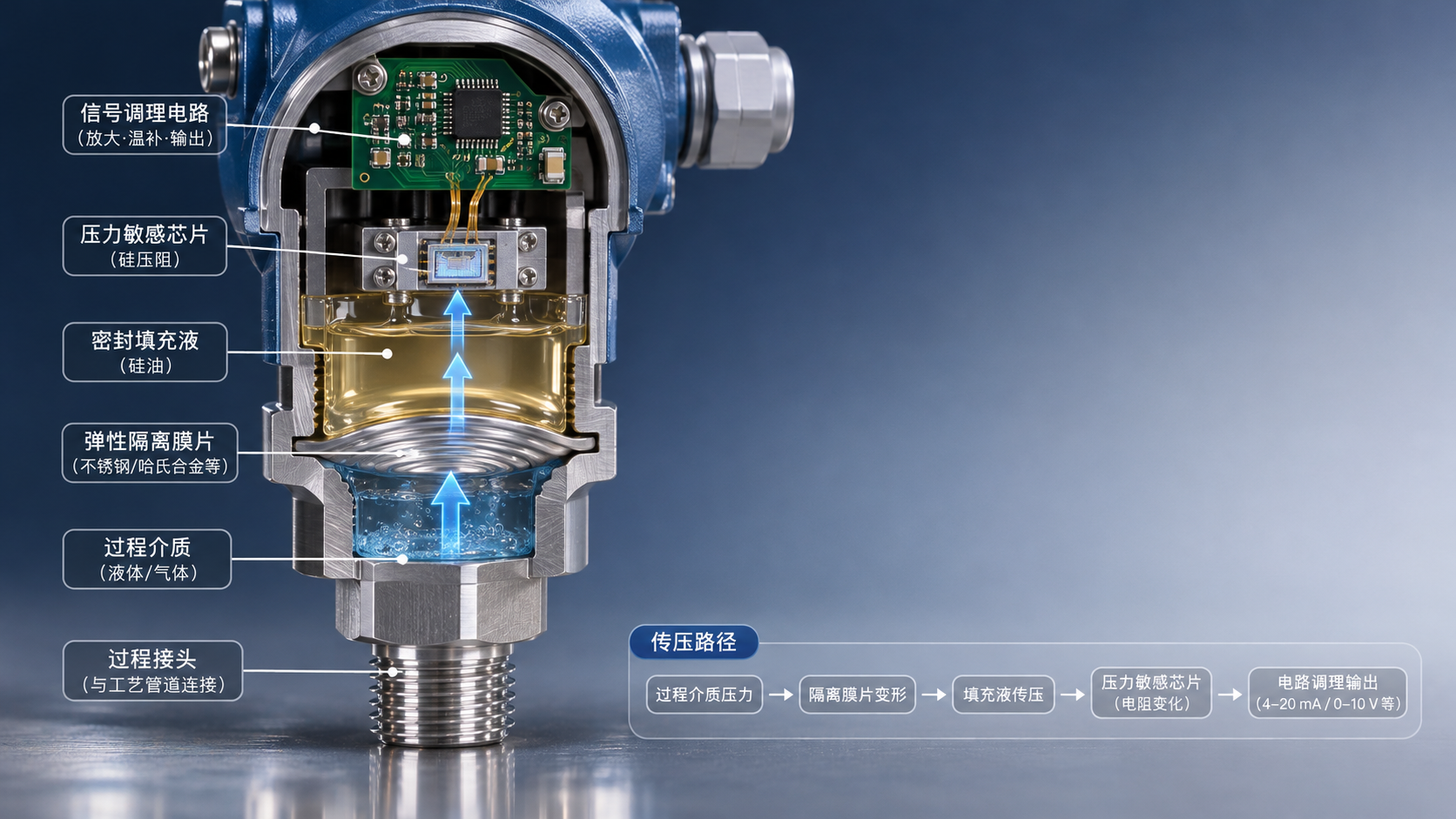
For high-temperature, vacuum, or wide temperature-fluctuation applications, ask the supplier to verify that the diaphragm seal assembly, fill fluid, and installation method meet the measurement requirements. Fill fluid is generally not a wetted material under normal conditions, but compatibility and contamination risks in the event of diaphragm damage still need to be assessed.
3. Make material requirements actionable through documentation and verification
Turn verbal descriptions into an acceptance checklist
The purchasing documents should list the material grades of the diaphragm, process connection, seals, and any other parts that may contact the medium, and specify the applicable medium, concentration, and temperature range. Vague descriptions such as “corrosion-resistant material” or “special alloy” are not sufficient as acceptance criteria.
The supplier’s selection documents should correspond to the actual ordered model and design. For custom products, specify the wetted parts, connection dimensions, pressure rating, and the approval process for changes to critical materials in the drawings or technical agreement.
Material certificates, factory inspection records, and any required third-party testing can be specified according to project risk. For applications with severe consequences of corrosion, complex media, or insufficient reliable application data, consider conducting corrosion tests under representative operating conditions and assessing service life in conjunction with the inspection schedule.
How to use test results
The test medium should, as far as possible, reflect the actual concentration, temperature, and contact time, while also accounting for startup and shutdown, cleaning, and media mixing. Short-term immersion test results under a single set of conditions cannot be directly equated with the long-term service life of the complete instrument.
In addition to surface corrosion, inspect for changes in seals, weld condition, and diaphragm integrity. Where necessary, assess the impact of corrosion on measurement and safety by checking pressure readings, zero-point changes, and leakage.
After commissioning, keep inspection records and set inspection intervals according to on-site risk. If leakage, abnormal readings, or persistent zero-point drift is detected, isolate the instrument and investigate promptly. Disassembly and maintenance involving hazardous media must follow site safety procedures.
4. Select components as part of the complete measurement system
Verify wetted parts separately for pressure and flow measurement points
Chemical and environmental protection sites often monitor both pipeline pressure and flow. The measurement principles and wetted-part designs of these two types of instruments differ, so the material verification for a pressure transmitter cannot be used in place of selecting the flowmeter lining, electrodes, and seals.
For example, the FEM2000 Chinese-made in-line intelligent electromagnetic flowmeter measures the volumetric flow of conductive liquids and can also measure some corrosive liquids and homogeneous liquid-solid suspensions. The required conductivity of the applicable medium is greater than 5 μS/cm. The lining and electrode materials still need to be confirmed according to operating conditions.
The flowmeter provides an RS-485 communication interface and supports configurations related to HART and MODBUS communications. When ordering, verify the specific version and its compatibility with the control system. For the pressure measurement point, also confirm the range, accuracy, output signal, power supply, and protection requirements to avoid focusing only on corrosion resistance while overlooking system compatibility.
Prepare operating-condition data before requesting a quotation
Xi'an Shenghongchuang Instrumentation Co., Ltd. provides industrial measurement and control products and technical services for pressure, level, differential pressure, and flow applications. Standard selections and custom designs can be discussed based on measurement-point requirements. For complex corrosive conditions, the confirmed technical agreement and product configuration should take precedence.
When submitting a request, it is advisable to provide at least the medium name and composition, concentration range, operating and cleaning temperatures, pressure range, connection type, and required output signal. If safety or quality traceability is required, also specify the required supporting documents.
To verify the wetted-part materials of a corrosion-resistant pressure transmitter, submit the operating-condition data above and any existing connection drawings to the technical team. Review the diaphragm, connection, and seals item by item, and confirm the material list and acceptance requirements before placing the order.
Related Recommendations
 How should mounting connections and safety margins be determined for a high-pressure transmitter used in ultra-high-pressure equipment?
 How an Oil-Filled Pressure Transmitter Works: Pressure Transfer Through the Isolation Diaphragm and Fill Fluid
 Ceramic-Core vs. Oil-Filled Pressure Transmitters: How to Choose Based on Corrosion Resistance and Overload Capacity
 How should the wetted parts of a 316L pressure transmitter be inspected for corrosive media?