


News Center
—— NEWS CENTER ——
Xi'an Shenghongchuang Instrument Co., Ltd.
Contact: Mr. Zhang
Mobile: 15529283736
Email: shc-sensor@qq.com
Address: Fortune Building, Sanqiao Street, Xixian New Area, Xi'an, Shaanxi Province
When dealing with corrosive media and pressure surges, how should you choose between a ceramic-sensing-element pressure transmitter and an oil-filled sensing element? The key is not simply deciding which is more durable, but checking the wetted materials, pressure limits, and actual operating conditions. Selection should account for normal measurement as well as abnormal conditions that may occur during startup and shutdown, blockage, or cleaning.
I. Start with the design: How the two sensing elements contact the medium
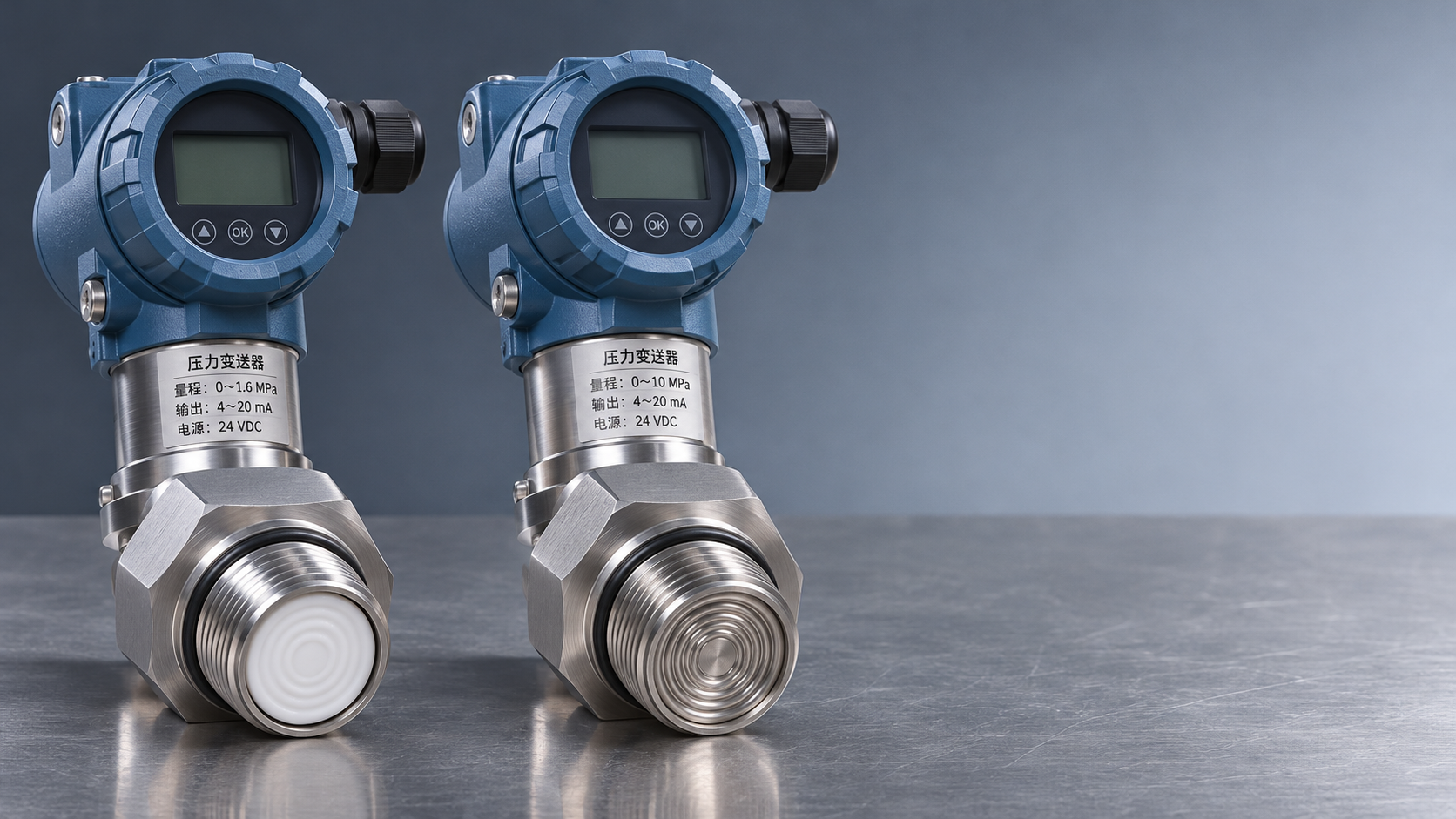
Ceramic sensing elements typically measure pressure through deformation of a ceramic diaphragm. Some products use a dry design, in which the process medium acts directly on the ceramic diaphragm and pressure is transmitted without an internal fill fluid. The specific sensing principle and packaging method vary by product, so performance cannot be judged by the word “ceramic” alone.
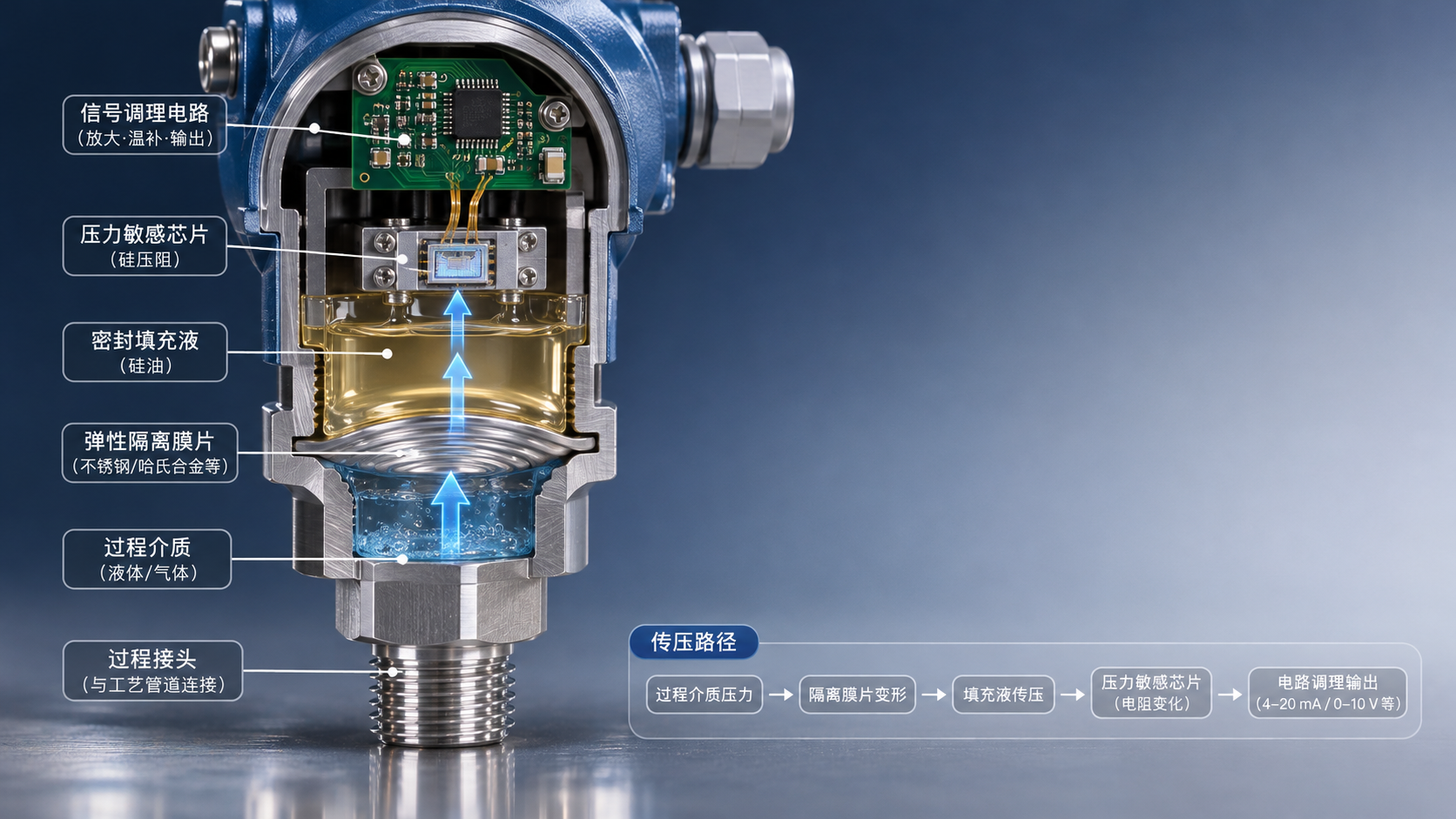
An oil-filled sensing element typically consists of a metal isolation diaphragm, an internal fill fluid, and a sensing element. Pressure from the medium first acts on the isolation diaphragm and is then transmitted through the fill fluid to the sensing element. Common isolation diaphragm materials include stainless steel; other suitable materials may also be selected based on the medium.
It is important to distinguish between the sensing element material and all the wetted materials in the complete transmitter. The process connection, welds, seals, and any other parts that may contact the medium can also affect corrosion resistance and service life.
II. Corrosion resistance: Check the entire wetted path
A corrosion-resistant ceramic diaphragm does not mean the entire unit is suitable for every medium
Ceramic materials are compatible with some acids, alkalis, and corrosive liquids, so ceramic-sensing-element pressure transmitters are often considered for applications where corrosion of wetted surfaces is a concern. For applications where contact between the process medium and fill fluid is not desired, a dry ceramic design may also be evaluated first.
However, performance varies with the ceramic material, medium concentration, and temperature. Some media may corrode the ceramic or other wetted parts, so conclusions should not be based on the medium name alone. Complete medium information should be provided, especially for high-temperature, mixed-liquid, or long-term immersion applications.
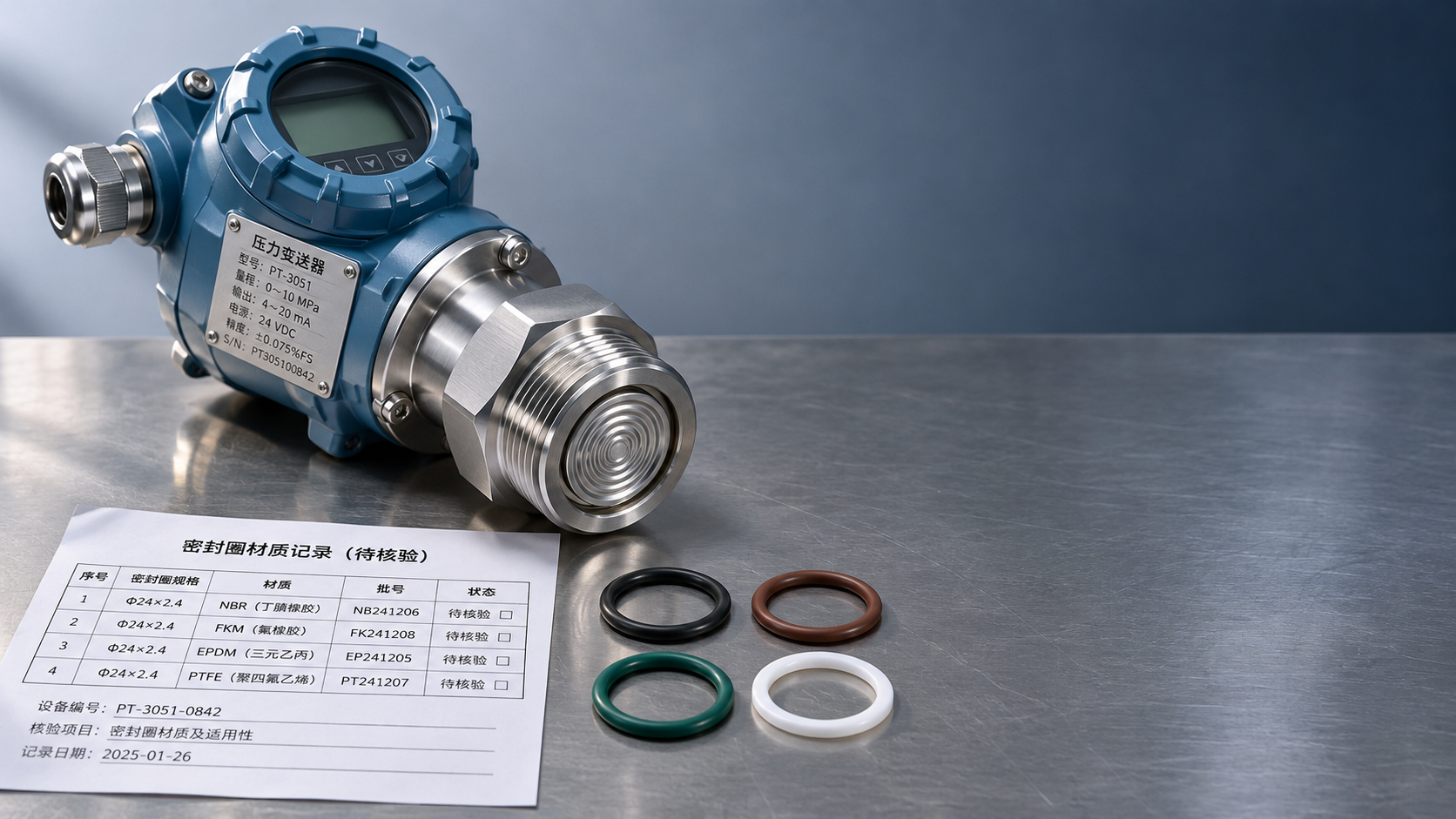
Seals are often an overlooked component. Even if the ceramic diaphragm can withstand corrosion from the medium, the sealing material may swell, harden, or leak. If the process connection is in direct contact with the medium, its material and corrosion resistance must also be checked.
The corrosion resistance of an oil-filled sensing element depends on its isolation design
Oil-filled sensing elements are not limited to ordinary water or oil applications. The wetted isolation diaphragm and process connection can be made of suitable materials according to the product design. For chemical media, compatibility should be confirmed using material compatibility information provided by the manufacturer.
Mechanical protection of the isolation diaphragm must also be considered. Particulate media, erosion from high flow velocity, or contact with hard objects during cleaning may damage the diaphragm. If the diaphragm fails, fill fluid may leak, affecting measurement or contaminating the process medium.
For food, pharmaceutical, or other contamination-sensitive applications, clarify whether fill fluid is permitted, whether it is compatible with the process, and what the consequences of isolation failure could be. Compliance with hygienic requirements must also be verified against the specific product’s materials, construction, and supporting documentation.
III. Overload capacity: Do not rely solely on advertised multiples
Overload pressure generally refers to the pressure a device can withstand under specified conditions without permanent performance changes beyond those permitted by the manufacturer. Proof or burst pressure refers to a pressure limit at which structural failure may occur. The two terms have different meanings; the product documentation’s definitions and test conditions should be used for actual assessment.
For example, if a transmitter with a range of 0–1 MPa is specified by the manufacturer to have an allowable overload of twice full scale, the corresponding value is typically 2 MPa. However, the basis for the multiple, pressure type, and applicable conditions must be confirmed. Even if the burst pressure is higher, it must not be treated as a pressure suitable for continuous operation.
Some ceramic-sensing-element models have high overload capacity, but this is not guaranteed for all ceramic products. Oil-filled sensing elements also come with different overload designs. Comparisons should be based on the specifications of specific models with the same range and pressure type, rather than on the sensing-element category alone.
Distinguish static overload from transient pressure surges
Starting or stopping a pump, rapidly closing a valve, or a sudden obstruction in a pipeline can produce brief pressure peaks. A normal average pressure reading on the control system does not mean the sensor has not been exposed to higher transient pressures.
Suppose the normal operating pressure in a pipeline is 0.6 MPa, while measured startup and shutdown peaks reach 1.5 MPa. The range should not be selected based only on 0.6 MPa. The maximum operating pressure, allowable overload pressure, and the manufacturer’s guidance on pulsation or shock must also be checked.
For applications involving frequent pressure shocks, consider evaluating a pulsation dampener, damping device, or suitable adjustments to the startup and shutdown sequence based on site conditions. Damping measures may affect pressure response time and may also fail due to particulate blockage, so they should be assessed alongside measurement requirements.
IV. Determine the solution based on site conditions
Corrosive liquids and particulate media
When conveying acids, alkalis, or other corrosive liquids, first assess the compatibility of the ceramic diaphragm with the medium, then check the seals and process connection. If the isolation diaphragm material of an oil-filled sensing element is also suitable, the options can be compared based on range, lead time, and maintenance requirements.
For particulate media such as slurry or ore pulp, consider not only corrosion but also wear, sedimentation, and blockage. The choice of a flush diaphragm design, installation location, and whether flushing is required should be determined based on particle size, flow velocity, and pipe layout.
If flow of a conductive liquid also needs to be monitored on site, consider using a China-made DNLDE Inline Intelligent Electromagnetic Flow Meter based on the pipeline conditions. This product measures the volumetric flow of conductive liquids. The published specification requires a medium conductivity greater than 5 μS/cm. For corrosive media, the wetted materials, including the lining and electrodes, must still be checked.
Pulsating pressure and temperature variation
For hydraulic equipment, pump outlets, and pipelines with frequent startup and shutdown, first collect data on pressure peaks and pulsation, then compare the overload parameters of the candidate models. If the peak pressure at the site cannot be determined accurately, it should be measured or verified with the equipment supplier rather than estimated based on experience alone.
Temperature variations also affect selection. Separately confirm the medium temperature, ambient temperature, and the manufacturer’s specified compensated temperature range. For oil-filled designs, also check the suitability of the fill fluid and isolation assembly at the relevant temperatures.
If the installation is near a high-temperature pipeline or vibrating equipment, cooling, vibration isolation, and pressure tapping arrangements may be evaluated. However, these measures may also introduce risks of blockage, response lag, or leakage. The final solution should be based on site safety requirements and actual measurement needs.
V. Confirm requirements and discuss technical details before purchasing
Provide complete operating-condition information
When submitting a request for model selection, it is recommended to provide the medium name and concentration, normal and maximum temperatures, operating pressure range, possible peak pressure, and pressure type. Mixed media, cleaning fluids, or equipment with periodic changes in operating conditions should also be specified.
Then check the range, accuracy class, overload pressure, wetted materials, process connection, power supply, and output signal. For explosion-proof, hygienic, or other industry-specific requirements, confirm that the specific model has the applicable certification or supporting documentation; do not rely on the product category as a substitute for verification.
Xi'an Shenghongchuang Instrumentation Co., Ltd. provides model selection consultation and technical services for pressure transmitters and related industrial measurement and control products. To compare ceramic-sensing-element and oil-filled options, contact the technical team and provide the medium, temperature, pressure range, and connection requirements so that a suitable configuration for the application can be confirmed.
Related Recommendations
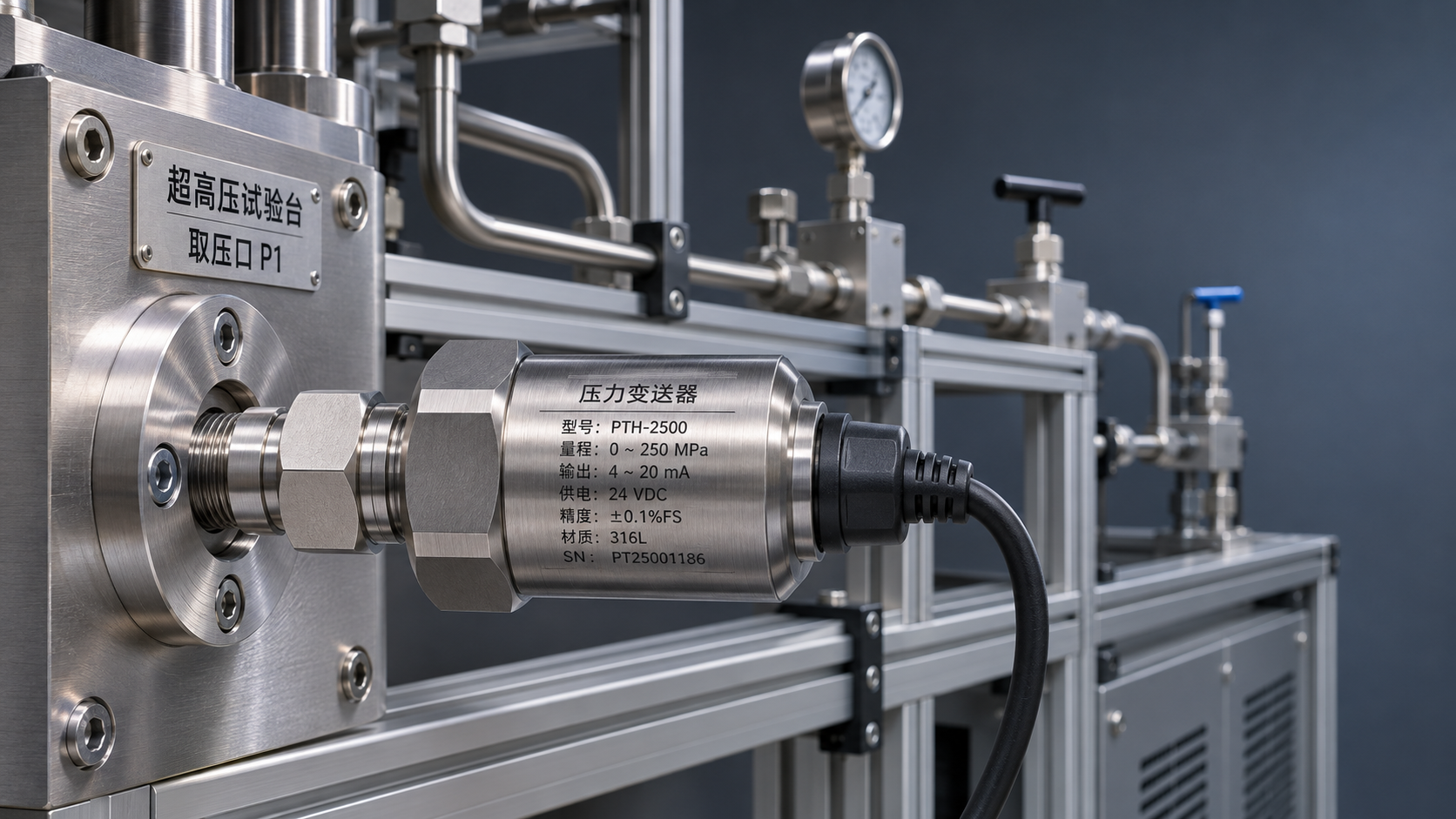
 How should mounting connections and safety margins be determined for a high-pressure transmitter used in ultra-high-pressure equipment?
 How an Oil-Filled Pressure Transmitter Works: Pressure Transfer Through the Isolation Diaphragm and Fill Fluid
 Ceramic-Core vs. Oil-Filled Pressure Transmitters: How to Choose Based on Corrosion Resistance and Overload Capacity
 How should the wetted parts of a 316L pressure transmitter be inspected for corrosive media?