


News Center
—— NEWS CENTER ——
Xi'an Shenghongchuang Instrument Co., Ltd.
Contact: Mr. Zhang
Mobile: 15529283736
Email: shc-sensor@qq.com
Address: Fortune Building, Sanqiao Street, Xixian New Area, Xi'an, Shaanxi Province
When a 316L pressure transmitter is used with corrosive media, the materials of its wetted parts and the reliability of its seals are directly related to operational safety. Acceptance should not be based solely on the product name or housing markings. Instead, it should cover the actual media, all wetted materials, manufacturing records, seal tests, and installation conditions to produce traceable inspection findings.
1. First Confirm the Media and Wetted Boundaries
Prepare a Complete List of Operating Conditions
Before acceptance, process, equipment, and safety management personnel should jointly confirm the media name, concentration, normal and maximum temperatures, operating pressure, pressure fluctuations, flow rate, and impurity content. For mixed media, the main components should also be listed to avoid assessing corrosion resistance based on only one chemical.
For media containing chloride ions, also consider chloride concentration, pH, oxidizing properties, deposits, and the condition of any residual liquid after shutdown. 316L offers good corrosion resistance, but is not suitable for every strong-acid, chloride-containing, or high-temperature application. The risks of pitting corrosion, crevice corrosion, and stress corrosion must be assessed in light of the specific conditions.
The operating conditions list should also cover startup, cleaning, purging, and shutdown. For example, if the production medium differs from the cleaning fluid, or if the cleaning temperature is higher than the normal operating temperature, material compatibility must be checked separately for each condition.
Identify Which Parts Are Actually Wetted
Require the supplier to provide a list of wetted parts or a sectional drawing identifying the materials of the isolation diaphragm, process connection, flange, vent and drain components, seals, welds, and any optional diaphragm seals. Do not assume that a “316L pressure transmitter” has 316L material for every wetted part.
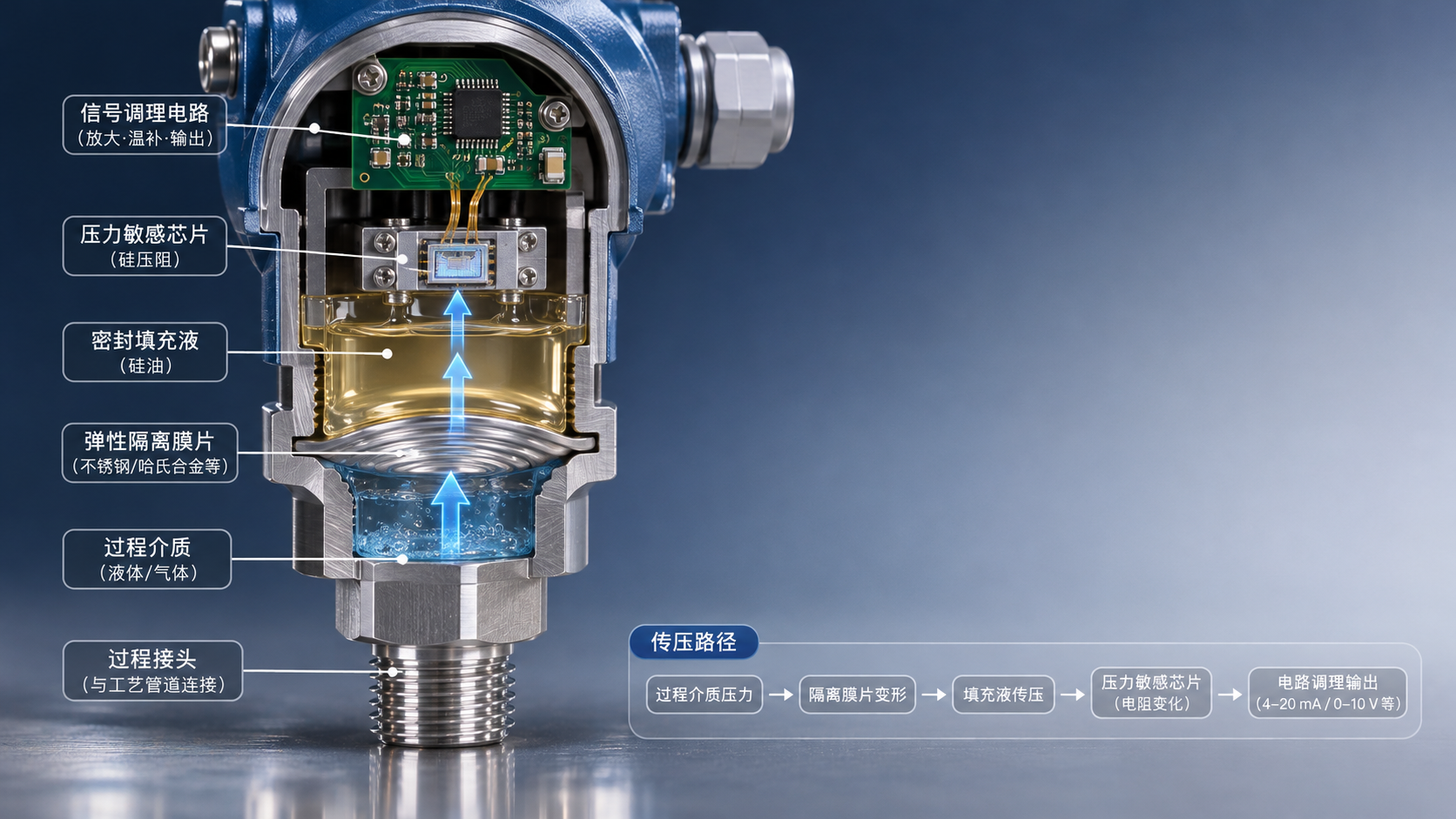
Also distinguish between wetted and non-wetted materials. Whether the housing, fasteners, or coatings contact the medium depends on the design and potential leakage scenarios. Fill fluids such as silicone oil are generally not wetted parts under normal conditions, but may enter the process side if the isolation diaphragm fails; assess this in light of contamination risks.
For flange-mounted or remote-seal configurations, or assemblies with a valve manifold, include the associated gaskets, capillary connections, and manifold flow paths in the boundary. Clarify which parts are supplied by the transmitter supplier and which are purchased separately on site.
2. Verify That Material Certificates Match the Actual Parts
Trace Documentation to Specific Parts
Procurement documents should specify the material grades, applicable standards, supply condition, and required documentation for wetted parts. Upon delivery, check the model, configuration code, parts list, and batch markings against the order. If there is any discrepancy, quarantine the item for review rather than approving it based on appearance.
Material certificates should be traceable to the relevant material batches or parts. Check the chemical composition, inspection results, and supplier information. For diaphragms, welded assemblies, and externally sourced seals, confirm whether the supplier can provide traceability records corresponding to their manufacturing processes.
If a material is identified as “316 stainless steel,” do not assume that it is 316L. When the order specifies 316L, verify the specific grade and applicable standard, and confirm that all specified parts, including diaphragms and connections, meet the requirements.
Conduct Material Retesting When Necessary
For high-risk media or critical measurement points, material retesting may be arranged in accordance with the procurement technical agreement. Portable spectroscopic analysis is suitable for on-site screening of some alloying elements, but commonly used methods may not reliably distinguish 316 from 316L based on carbon content.
When a low-carbon grade must be verified, refer to traceable material certificates and, if necessary, use an appropriate laboratory method to test the carbon content. Diaphragms are thin, and sampling or testing may damage the device; the location, method, and responsibilities should be agreed in advance.
Passing an alloy composition test does not guarantee corrosion resistance in the field. Welding, surface processing, and operating conditions all affect performance. For special applications, corrosion testing may be arranged by materials specialists in accordance with applicable standards or agreements.
3. Inspect the Sealing Design and Pressure-Bearing Reliability
Match Seal Materials to Both the Medium and Temperature
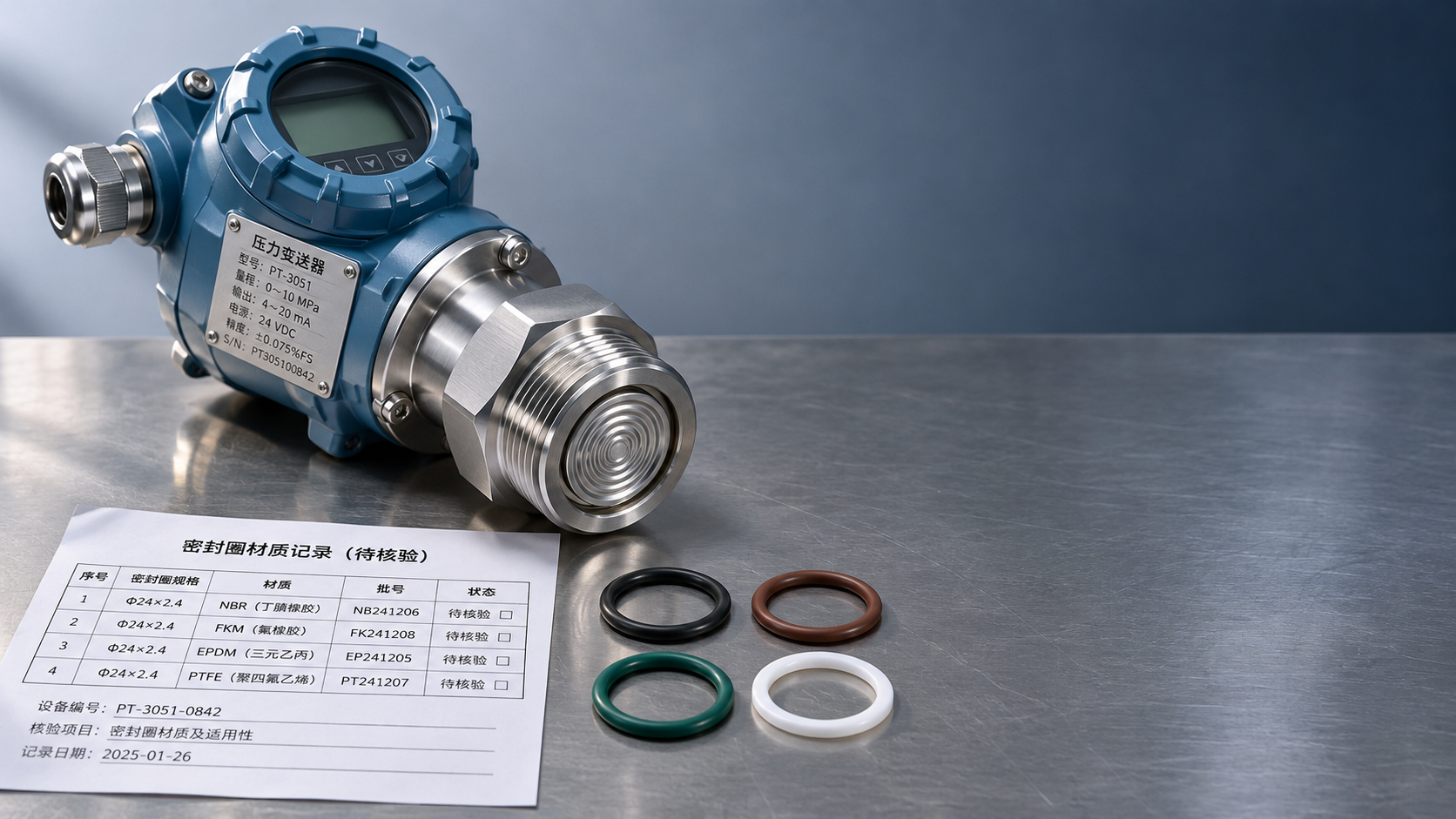
Fluoroelastomer, nitrile rubber, and ethylene-propylene materials each have their own range of applications. Their specific performance is also affected by formulation, concentration, temperature, and contact time. During acceptance, verify the seal material markings and the supplier’s compatibility data; do not rely solely on color or name.
Check sealing surfaces for scratches, indentations, embedded particles, and obvious deformation. Check seals for cracks, nicks, or signs of aging. During on-site assembly, the storage life and cleanliness of the seals, as well as lubricant and tightening requirements, should comply with the supplier’s instructions and project specifications.
For volatile, toxic, or leak-prohibited media, specify the allowable leakage rate, test medium, test pressure, and pressure-hold time during procurement. A routine visual inspection cannot replace targeted seal verification.
Conduct Tests According to the Approved Procedure
Pressure and sealing tests should be performed in accordance with applicable standards, equipment ratings, and a test procedure approved by both parties. Distinguish between the requirements for housing pressure tests, process connection seal tests, and differential-pressure measuring chambers.
For differential pressure transmitters, also verify the allowable static pressure on both sides, the single-side overpressure limit, and the pressurization sequence. Do not treat the pressure capacity of one component as the allowable operating pressure of the entire instrument, or use the maximum pressure listed in a catalog directly as the on-site test pressure.
The test medium should be compatible with the equipment materials and subsequent process. After testing, drain, dry, or protect the equipment as required. Each test record should include at least the equipment ID, test conditions, leak detection method, results, and personnel sign-off. Equipment with unresolved issues must not be put into service.
4. Cross-Check the Model Configuration and On-Site Installation
Do Not Treat Series Specifications as the Actual Configuration
For example, the documentation for the Domestic Capacitive Pressure Transmitter PDS464 High-Accuracy Smart Differential Pressure Transmitter lists 316 stainless steel, Hastelloy C, Monel, and several sealing materials, and covers multiple ranges. At the time of ordering, confirm each selected wetted material and its applicable parts. Do not interpret the material list as a fixed configuration for every unit.
The series documentation lists a two-wire 4–20mA output with a superimposed HART digital signal; the range for Range 3 is 0–0.2 to 6.0kPa, and for Range 8 is 0–1.6 to 10MPa. The specific range and configuration should be based on the order, nameplate, and confirmed technical documents. The measurement range does not replace verification of the allowable static pressure.
The documentation lists a medium temperature range of -40~100℃, but the applicable ranges for the selected seals, diaphragm assembly, and process medium may be narrower. Use the confirmed limits for the complete wetted-material combination. For hazardous areas, also verify the actual explosion-protection certificate, equipment markings, and installation-area requirements.
Complete Installation Checks and Documentation Before Commissioning
Before installation, confirm the process connection specifications, sealing method, installation orientation, and valve manifold connections. Prevent piping stress from acting directly on the instrument. For differential-pressure measurement points, verify the high- and low-pressure sides and impulse line routing to prevent measurement errors caused by reversed connections, liquid accumulation, or residual material.
Before commissioning, check the zero point and output in accordance with site procedures, and establish isolation, discharge, and personal protection measures based on the hazards of the medium. During operation, set inspection intervals according to corrosion risks, the consequences of leakage, and maintenance records. Monitor for changes such as seepage, zero drift, and blockage.
Acceptance records should include the operating conditions list, wetted parts list, material certificates, test records, calibration records, and the disposition of nonconformities. Xi’an Shenghongchuang Instrumentation Co., Ltd. can provide selection and technical services based on project requirements. Before procurement or acceptance, it is recommended that you submit the media composition, concentration, temperature and pressure ranges, and connection requirements, and confirm the specific configuration before establishing the acceptance criteria.
Related Recommendations
 How should mounting connections and safety margins be determined for a high-pressure transmitter used in ultra-high-pressure equipment?
 How an Oil-Filled Pressure Transmitter Works: Pressure Transfer Through the Isolation Diaphragm and Fill Fluid
 Ceramic-Core vs. Oil-Filled Pressure Transmitters: How to Choose Based on Corrosion Resistance and Overload Capacity
 How should the wetted parts of a 316L pressure transmitter be inspected for corrosive media?