


News Center
—— NEWS CENTER ——
Xi'an Shenghongchuang Instrument Co., Ltd.
Contact: Mr. Zhang
Mobile: 15529283736
Email: shc-sensor@qq.com
Address: Fortune Building, Sanqiao Street, Xixian New Area, Xi'an, Shaanxi Province
When selecting a medium-temperature pressure transmitter, do not confuse the process medium temperature with the ambient temperature. Distinguishing where each temperature is measured and its allowable range helps assess equipment suitability and operational stability.
I. What Do Medium Temperature and Ambient Temperature Refer To?
Process Medium Temperature: The Fluid in Contact with the Pressure Port
Process medium temperature is the temperature of the gas or liquid being measured by the pressure transmitter at the measurement point. For example, if the device is installed on a hot-water pipeline, the actual temperature of the hot water at the pressure port is what matters—not just the set temperature at the boiler or heat exchanger outlet.
Heat from the medium is transferred through the pressure port, diaphragm, and metal structure. If the temperature exceeds the product’s allowable range, it may affect the operating condition of the sensing element, sealing materials, and internal electronic components, and in severe cases may damage the instrument.
When selecting a product, provide both the normal operating temperature and the highest and lowest temperatures that may occur during startup, shutdown, cleaning, and abnormal operating conditions. Whether short-term temperature peaks can be tolerated should be confirmed in the product’s technical documentation or with the manufacturer.
Ambient Temperature: The Air Around the Instrument
Ambient temperature is the temperature of the air around the pressure transmitter housing and electrical connections. It is not the same parameter as the temperature of the medium inside the pipeline, and the two may differ significantly.
For example, a pipeline indoors may carry hot water at 80℃ while the air around the instrument is at 35℃. The first value is used to check the allowable medium temperature; the second is used to check the allowable ambient temperature. Heat transferred from the pipeline to the instrument must also be considered.
For outdoor installations, summer sunlight, low winter temperatures, heat buildup inside enclosed housings, and heat from nearby equipment may cause the actual temperature around the instrument to differ from the local weather temperature. The temperature in a weather forecast should not be used as a direct substitute.
II. How to Check Temperature Parameters for Medium-Temperature Applications
Do Not Rely on the “Medium-Temperature” Label Alone
“Medium-temperature pressure transmitter” is generally used to describe products suitable for certain temperature conditions, but manufacturers may use this term differently depending on the manufacturer and product design. For actual selection, refer to the temperature parameters for the specific model and configuration.
The allowable medium temperature and allowable ambient temperature must each meet the application requirements. Even if the medium temperature is within range, the entire configuration cannot be assumed suitable if the instrument is installed inside a high-temperature enclosure.
Temperature parameters should also be interpreted in light of the installation method. Some solutions use heat-dissipating structures or impulse devices to handle higher-temperature media. The stated temperature may apply only to a specific structure and installation condition, and should not be applied directly to a standard direct-mount model.
Distinguish Compensation Temperature from Storage Temperature
The compensation temperature range is the temperature interval within which the manufacturer compensates for output errors caused by temperature changes and specifies the relevant performance. It is not the upper limit for medium temperature, nor does it mean there is no temperature error within that range.
Storage temperature applies to storage conditions when the equipment is not powered or operating; it cannot replace the allowable operating ambient temperature. If the selection documentation lists only the storage temperature, confirm the operating ambient temperature with the manufacturer.
For applications with high accuracy requirements, also check the temperature-effect specifications and their applicable conditions, and include temperature-induced additional error along with the basic accuracy in the measurement error budget.
III. Assessing Suitability Based on Product Parameters
Check the Temperature First, Then Select the Range and Signal
The product documentation for the LPB8300 General-Purpose Pressure Transmitter Made in China for Water, Oil, and Gas Pressure Measurement lists a medium temperature range of -20~+85℃ and selectable pressure ranges from -0.1 to 100MPa. When placing an order, confirm the complete parameters for the selected range, connection, and configuration.
The product documentation also mentions customized solutions for higher temperatures, but this does not mean that the standard configuration can be used directly with a 400℃ medium. If the site temperature exceeds +85℃, provide the operating conditions and ask the manufacturer to confirm whether a specialized structure is required and what limitations apply.
The product documentation specifies a storage temperature of 0~50℃ but does not state the allowable operating ambient temperature or compensation temperature range for the corresponding configuration. Before using the product outdoors, in an enclosed equipment cabinet, or in other locations with large temperature variations, confirm these parameters with the manufacturer. Do not use the storage temperature as a substitute.
Temperature Is Not the Only Factor in Medium Compatibility
The conditions for measuring water, oil, and gas pressures differ. The product documentation states that its sensor diaphragm is made of 316L stainless steel and is suitable for gases and liquids compatible with this material. The wetted materials of the connection, seals, and other components must also be checked for the specific application.
The medium’s concentration, temperature, and impurities may affect the risk of corrosion or blockage. For steam, corrosive liquids, particle-laden media, and viscous media, provide the manufacturer with the specific composition and operating conditions before confirming the suitable design.
Pressure overload capacity should also be verified against the data for the specific model. The commonly cited industry overload capacity of twice the full scale should not be assumed to be guaranteed for every configuration. If water hammer or frequent pressure surges are present, protective measures should be assessed separately.
IV. Managing Temperature Risks at the Installation Site
Determine the Installation Plan Based on Heat Sources and Available Space
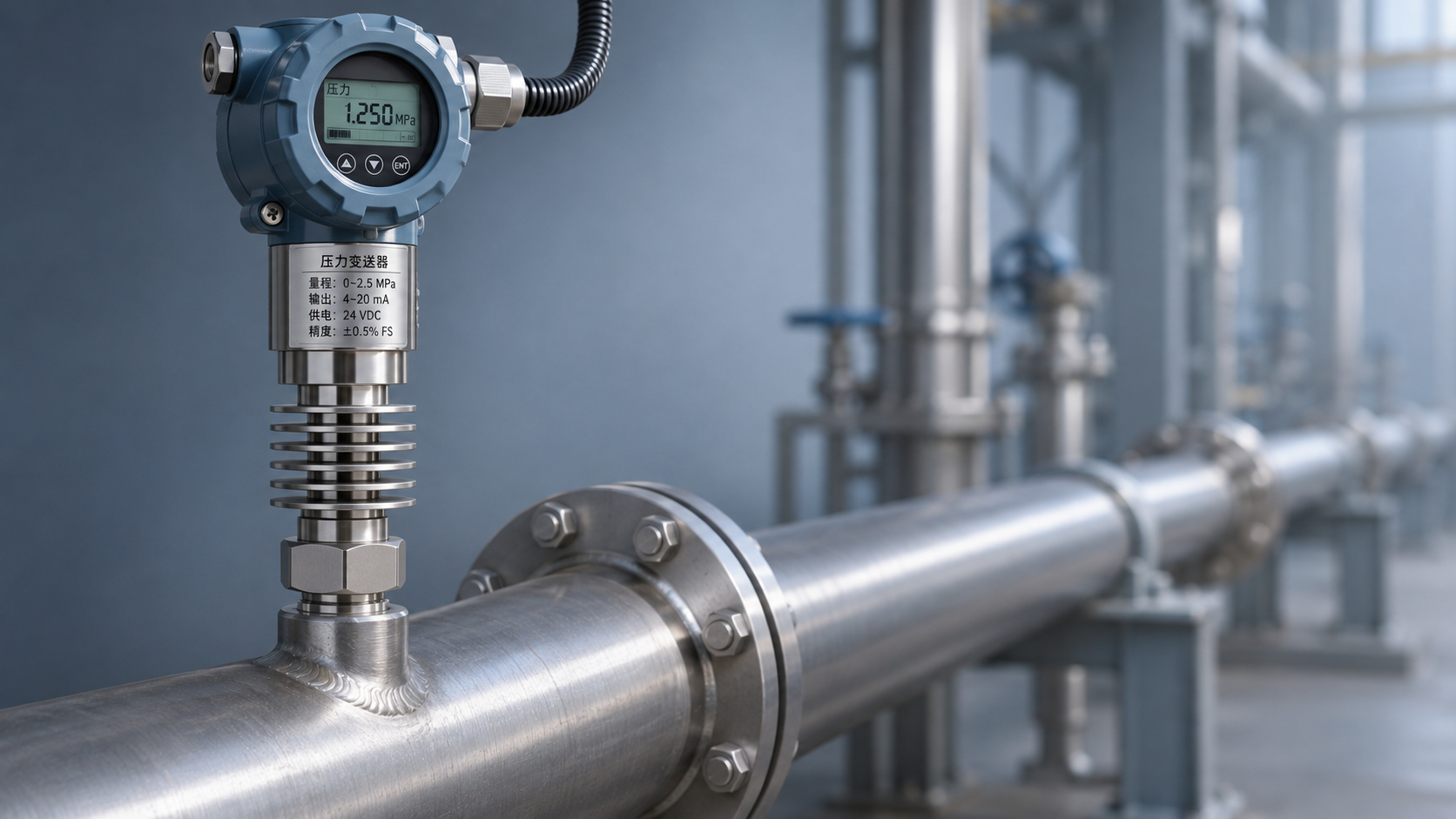
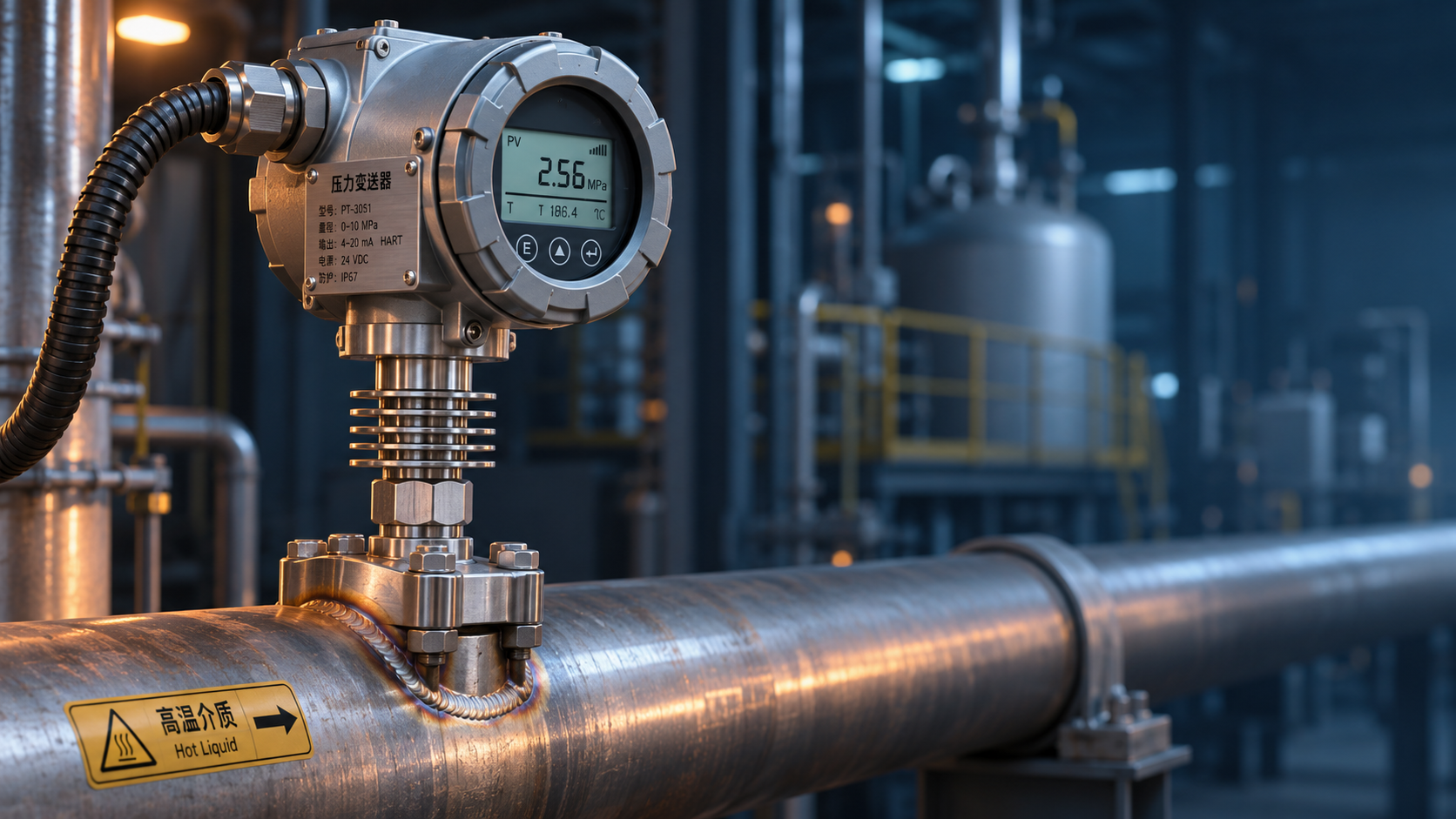
When a transmitter is mounted directly on a hot pipeline, heat transfer from the pipeline may raise the local instrument temperature even if the surrounding air is not hot. If space allows, discuss options with the manufacturer, such as a heat-dissipating structure, an impulse line, or installation away from the heat source.
Different cooling methods have different application conditions. An impulse line may introduce the risk of blockage or leakage, change the response, or cause liquid-column effects. For steam applications, condensation and impulse-line layout must be designed in accordance with process requirements and should not be copied without consideration.
For outdoor equipment, sunshades, rain protection, or insulation may be used depending on site conditions, while avoiding persistent heat buildup inside enclosed housings. Wiring methods and protection requirements should also be suited to the humidity, cleaning methods, and installation location.
Recheck Actual Operating Conditions Before Commissioning
After selecting the equipment, it is advisable to check the medium temperature and the temperature around the instrument during representative operating stages, paying particular attention to changes after the equipment has reached a stable operating temperature, during hot summer conditions, and during cleaning.
If the site temperature is close to the product limit, reassess the measurement point location, heat dissipation conditions, and abnormal operating conditions. Do not disregard the long-term effects of temperature just because the equipment operates normally during a brief trial run. The measurement location should also correspond to the manufacturer’s definition of the specified parameter.
When selecting a product, provide Xi'an Shenghongchuang Instrumentation Co., Ltd. with the medium name, normal and limit temperatures, ambient temperature, operating and peak pressures, connection specifications, output signal, and installation photos. Technical personnel can then check suitability for the specific configuration.
Related Recommendations
 How to Calculate Power and Signal Compatibility When Connecting a 24 V Pressure Transmitter to a PLC
 Heat-Dissipating Pressure Transmitters vs. Isolation and Cooling Solutions: How to Choose for High-Temperature Pressure Measurement
 Compensation Principles and Temperature Drift Parameters of Temperature-Compensated Pressure Transmitters
 Selecting a High-Temperature Liquid Pressure Transmitter: How to Determine Temperature, Sealing, and Range