


News Center
—— NEWS CENTER ——
Xi'an Shenghongchuang Instrument Co., Ltd.
Contact: Mr. Zhang
Mobile: 15529283736
Email: shc-sensor@qq.com
Address: Fortune Building, Sanqiao Street, Xixian New Area, Xi'an, Shaanxi Province
Selecting a pressure transmitter for high-temperature liquids requires balancing the medium temperature, seal compatibility, and pressure range. Only by matching the instrument to the operating conditions can measurement stability and operational safety be ensured. When selecting a model, consider not only the medium’s normal temperature and operating pressure, but also conditions such as start-up and shutdown, cleaning, abnormal temperature increases, and pressure surges. Avoid making a decision based on a single parameter alone.
I. Determine the temperature limits first, then select the measurement structure
1. Distinguish medium temperature from instrument operating temperature
The medium temperature is the actual temperature of the liquid near the pressure tapping point; it should not be treated as equivalent to the equipment’s set temperature. Pipe insulation, changes in flow rate, equipment start-up and shutdown, and cleaning can all cause the temperature at the tapping point to vary. When selecting a model, provide the normal temperature, maximum temperature, and duration at the maximum temperature.
Pressure transmitters also have temperature limits for the sensing element, ambient conditions, and electronic circuitry. Heat from a high-temperature medium can be transferred through the process connection, impulse line, and mounting bracket. Even if the electronic housing is away from the liquid, it may still overheat due to conduction or radiation.
The temperature compensation range and the allowable medium temperature are not the same. The former relates to measurement performance under specified conditions; the latter determines whether the product can be used at that temperature. Check the specifications for the specific model, and understand how temperature changes affect the zero point and span.
2. Select a cooling or isolation method based on operating conditions
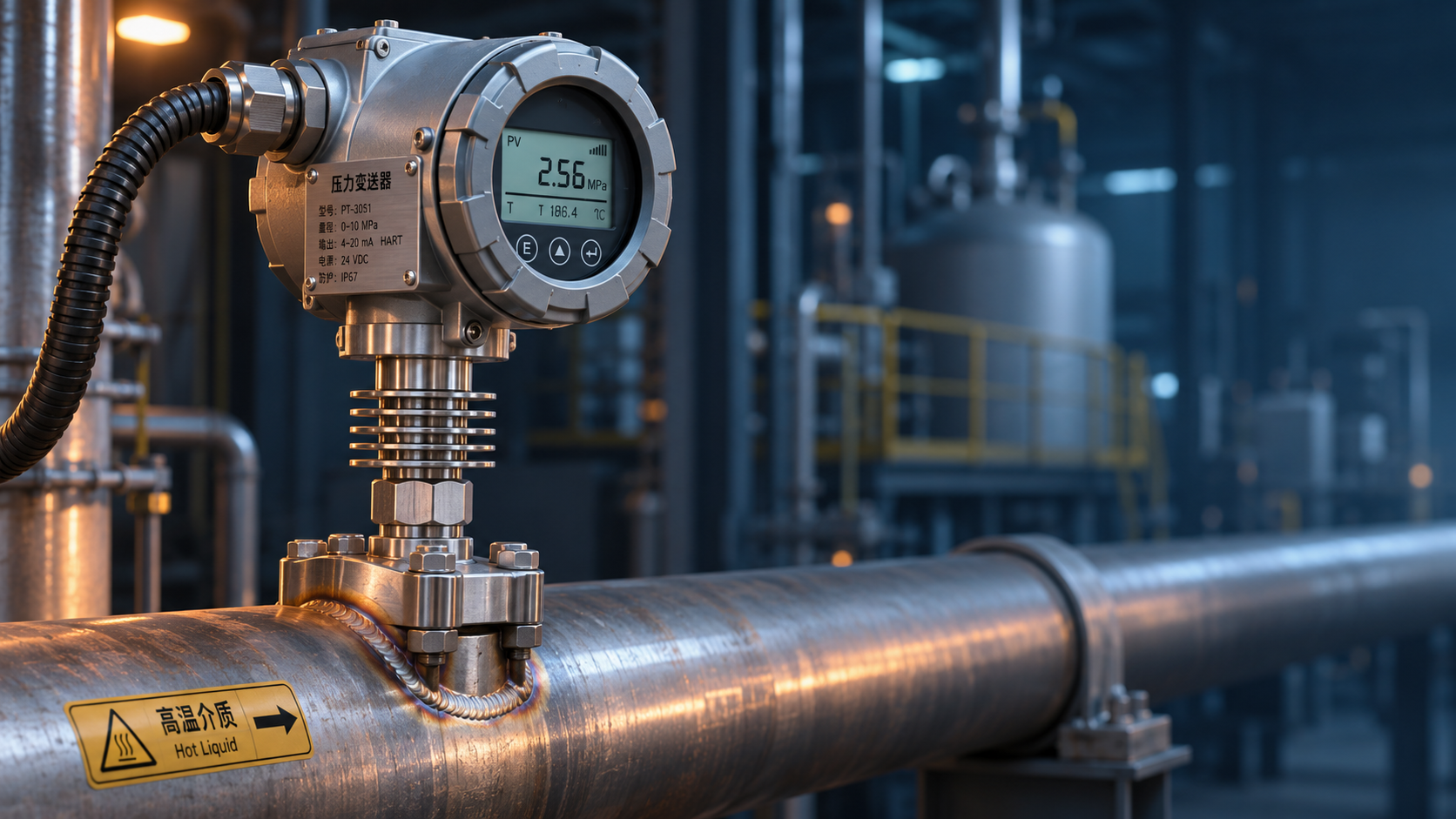
When the medium temperature exceeds the allowable range of a standard transmitter, consider a heat-dissipation structure, an impulse line, or a diaphragm seal system, depending on the operating conditions. The temperature reduction achievable should be determined based on the actual installation conditions and validation results. Do not assume that the instrument will remain within its temperature limits simply by adding a section of pipe.
When using an impulse line, consider the risk of liquid solidification, crystallization, blockage, and gas entrapment. For viscous, crystallizing, or particle-laden liquids, a structure such as a remote diaphragm seal may make it easier to isolate the medium. However, check the diaphragm material, fill fluid, response time, and the effects of ambient temperature.
For example, if a liquid normally operates at 120℃ and reaches 150℃ during cleaning, evaluate the entire measurement system for 150℃ and the duration at that temperature, rather than selecting a model based only on 120℃. If sudden temperature increases or alternating hot and cold conditions are possible, also confirm that the connections, welds, and seals can withstand thermal cycling.
II. Consider temperature, pressure, and medium together when selecting seals
1. Check all materials in contact with the medium
Seal reliability depends not only on the sealing ring, but also on the diaphragm, process connection, welds, and any other materials that may contact the medium. Before selecting a model, provide the liquid name, concentration, water content, and information about impurities, and indicate whether corrosion, abrasion, or deposits may occur.
316L stainless steel can be used with some compatible liquids, but it should not be assumed to be suitable for all acids, alkalis, or chloride-containing media. Corrosion behavior may change as temperature rises, so material compatibility should be verified against the actual temperature, concentration, and condition of the medium.
For media such as heat-transfer oil and solvents, also confirm whether the seal material may swell, harden, or lose its elasticity. For flammable, toxic, or otherwise hazardous liquids, assess the risk of leakage and the applicable explosion-proof configuration in line with equipment safety requirements.
2. Match the connection structure to the site interface
Common connection types include threaded and flanged connections. For threaded connections, confirm the thread standard, size, sealing method, and installation space. For flanged connections, check the pressure rating, sealing-face type, and gasket dimensions; nominal diameter alone is not sufficient.
Seals must meet the requirements for maximum temperature, operating pressure, and compatibility with the medium. Materials such as polytetrafluoroethylene and elastomers each have their own conditions of use. Their actual operating limits depend on the formulation, design, and operating conditions, so suitability cannot be determined by the material name alone.
After installation, carry out inspections and tests in accordance with equipment and site procedures. For high-temperature liquid lines, pay particular attention to the condition of the connections after heating. If leakage occurs, isolate, depressurize, and cool the system as required before working on the connection.
III. Determine the range based on both actual pressure and surges
1. Account for normal measurement and pressure peaks
When determining the range, collect data on normal operating pressure, maximum operating pressure, start-up and shutdown pressure, and pressure peaks caused by pump start-up and shutdown or rapid valve operation. In addition to the upper pressure limit, specify whether the required measurement is gauge pressure, absolute pressure, or compound pressure that includes negative pressure.
If the range is too narrow, pressure peaks may overload the instrument. If it is too wide, the normal operating range will occupy too small a proportion of the full scale, making it harder to achieve the desired effective measurement capability. Select a range based on pressure records, allowable error, and instrument specifications rather than applying a fixed multiplier.
For example, if the stable operating pressure is about 0.8MPa and verification confirms that the maximum pressure does not exceed 1.2MPa, you can further assess whether a 1.6MPa range meets the accuracy and peak-pressure requirements. If higher transient surges occur, recalculate the range and, if necessary, use suitable buffering or protection measures.
Range and overload are not the same specification
Full scale is the upper limit of the specified measurement range. Overload pressure is the pressure limit the product can withstand under specified conditions; refer to the manufacturer’s documentation for its precise definition. Overload capacity cannot replace the normal measurement range and does not mean the instrument is suitable for continuous operation under overload conditions.
Note that when accuracy is specified as a percentage of full scale, the relative error may be greater at the normal operating pressure. For example, for an instrument with an accuracy of 0.5%FS and a range of 1.6MPa, the corresponding full-scale error is 0.008MPa. Other effects, such as temperature, should also be included in the actual selection.
For systems with significant pulsation, evaluate damping measures in light of the pressure fluctuation frequency, response requirements, and maintenance conditions. A throttling element may help reduce the effects of surges, but it may also cause response delays or blockage. Select one according to the properties of the liquid.
IV. Confirm operating limits against product specifications
1. Use standard products as a basis for comparison
PA3010 General-Purpose Pressure Transmitter Made in China, for Water, Oil, and Gas Pressure Measurement offers selectable pressure ranges from -0.1 to 100MPa, with options including 0.6MPa, 1.0MPa, 1.6MPa, and 2.5MPa. When selecting a model, confirm the pressure type, range, and connection configuration of the chosen option.
This series offers 4~20mA, 0~20mA, and various voltage output options, with connections including M20×1.5, G1/2, and G1/4. The diffusion silicon sensing element uses a 316L stainless steel diaphragm and is suitable for gases and liquids compatible with this material. Check other wetted parts and sealing materials against the specific configuration.
The product documentation specifies a medium temperature range of -20~+85℃. Therefore, do not use a standard configuration for liquids above 85℃ solely on the basis that a “high-temperature pressure transmitter can be customized.” For conditions beyond this range, confirm the customized structure, allowable temperature, installation method, and actual delivery specifications with technical personnel.
2. Provide complete operating conditions to reduce selection errors
Xi'an Shenghongchuang Instrumentation Co., Ltd. provides sales and technical services for sensors, transmitters, and supporting instruments. Its production base is Shaanxi Qinkong Sensing Technology Co., Ltd. For operating conditions that cannot be directly covered by standard models, a custom solution can be discussed based on site requirements.
Before contacting the supplier, it is advisable to compile the medium name and concentration, normal and maximum temperatures, pressure range and peaks, connection dimensions, power supply and output signal, and any explosion-proof, hygienic, or special material requirements. For systems with large temperature fluctuations or pressure surges, operating records can help with the assessment.
When preparing for model selection, provide the above parameters, together with site installation photos or connection drawings, to the technical team at Xi'an Shenghongchuang. Focus on confirming the wetted materials, sealing method, temperature-resistant structure, and range. Proceed with purchasing and installation only after the specific model and technical requirements have been verified.
Related Recommendations
 How to Calculate Power and Signal Compatibility When Connecting a 24 V Pressure Transmitter to a PLC
 Heat-Dissipating Pressure Transmitters vs. Isolation and Cooling Solutions: How to Choose for High-Temperature Pressure Measurement
 Compensation Principles and Temperature Drift Parameters of Temperature-Compensated Pressure Transmitters
 Selecting a High-Temperature Liquid Pressure Transmitter: How to Determine Temperature, Sealing, and Range