News Center
—— NEWS CENTER ——
Xi'an Shenghongchuang Instrument Co., Ltd.
Contact: Mr. Zhang
Mobile: 15529283736
Email: shc-sensor@qq.com
Address: Fortune Building, Sanqiao Street, Xixian New Area, Xi'an, Shaanxi Province
The constant-pressure water supply system may appear to operate around the water pump, pipe network, and control cabinet, but the component that truly determines whether the pressure signal remains stable is often the front-end constant-pressure water supply pressure transmitter. Once it becomes damp, exposed to dust, corroded, or installed improperly, it may cause data drift and control fluctuations in minor cases, or trigger false alarms and interlock failures in severe cases, directly affecting water supply safety and equipment service life. For site management, protection standards and installation conditions are not secondary considerations, but basic items that must be confirmed together during selection and acceptance.
First, understand its position in the system
The task of a constant-pressure water supply pressure transmitter is to convert pressure changes in a pipeline or water tank into electrical signals readable by the control system. Variable-frequency drive speed regulation, control instrument decisions, and alarm logic triggering usually all depend on this pressure feedback path.
In other words, it is both a measuring element and a key node in the control chain. If a site focuses only on the range and output method while ignoring the protection rating, sealing materials, and installation conditions, subsequent faults will often become concentrated in these areas.
Why have protection standards become an industry focus?
Constant-pressure water supply applications are not all the same. Secondary water supply pump rooms, underground equipment rooms, building mechanical rooms, fire linkage areas, and industrial circulating water systems differ greatly in environmental conditions, but all may involve practical issues such as humidity, condensation, water mist, vibration, and electromagnetic interference.
Many field failures are not caused by failure of the sensing element itself, but by water ingress at wiring terminals, insufficient housing sealing, connector materials that are not resistant to the medium, or non-standard signal cable installation. Although the problem appears to be a transmitter fault, the root cause actually lies in protection design and installation management.
According to practices in the sensor industry, companies with comprehensive R&D and production capabilities usually consider pressure sensors, pressure transmitters, flow meters, temperature and humidity transmitters, and intelligent digital display control instruments as a complete package. Companies such as Xi'an Shenghongchuang Instrumentation Co., Ltd., which have long been engaged in developing various industrial sensing and control products, tend to focus more on system applications rather than examining the parameters of a single device alone.
Which protection standards deserve attention for constant-pressure water supply pressure transmitters?
The IP protection rating is the first threshold
At water supply sites, the most common evaluation indicator is the IP protection rating. IP65, IP67, and IP68 correspond to different levels of dust protection, water-jet protection, and short-term immersion protection, and their applicable environments must not be confused.
If installed in a standard indoor control area without an obvious risk of water accumulation, IP65 can usually meet basic requirements. If located in a damp pump room, equipment shaft, or near a washing area, IP67 or higher is recommended.
The sealing structure cannot be assessed by the housing marking alone
Many people look only at the IP rating on the nameplate while overlooking the cable outlet, connector, pressure port, and diaphragm welds. The actual weak points of a constant-pressure water supply pressure transmitter are often located at these connection points.
During acceptance, attention should be paid to the material of the sealing ring, thread fit accuracy, potting process, and long-term stability after hot-and-cold cycling. For underground pump rooms or high-humidity environments, the sealing of the junction box and cable should also be included in the inspection.
Corrosion resistance determines service life
Water is not always a “clean medium.” Domestic water may contain residual chlorine, while industrial makeup water may contain cleaning agents, chemicals, or trace corrosive components. The external environment may also contain salt spray and acidic or alkaline gases.
Therefore, it is necessary to check whether the wetted-part materials are suitable, such as whether 316L stainless steel and ceramic sensing elements meet the requirements of the site medium. If the environment is clearly corrosive, meeting only conventional pressure measurement requirements is not sufficient.
Electrical protection affects signal reliability
Constant-pressure water supply pressure transmitters often operate in the same environment as variable-frequency drives, control cabinets, and motors. In such cases, in addition to insulation performance, attention should be paid to overvoltage protection, surge protection, and electromagnetic compatibility to prevent signal fluctuations from causing incorrect control decisions.
Especially in areas with frequent thunderstorms or in applications such as outdoor pumping stations, surge protection, proper grounding, and shielded wiring are critical. Many “intermittent faults” are actually caused by external electrical interference rather than the accuracy of the sensor itself.
Installation environment requirements should go beyond merely “being able to install it”
A constant-pressure water supply pressure transmitter being installed in place does not mean it has been installed correctly. What truly affects long-term stability is whether the surrounding environment provides suitable conditions for continuous operation.
Temperature, humidity, and condensation risks
Underground pump rooms experience significant day-night temperature differences, and condensation may easily form on the housing surface during seasonal changes between winter and summer. Condensed water entering the interior along the cable or connector is the starting point of many faults. The installation position should avoid areas subject to continuous dripping, and waterproof cable loops should be properly arranged.
Vibration and water hammer impact
Pulsation and water hammer can easily occur near pump outlets and locations where valves switch rapidly. If a constant-pressure water supply pressure transmitter is directly subjected to high-frequency impacts, zero drift and mechanical fatigue will increase significantly. Where necessary, a buffer tube or damper should be added, or the pressure tapping point should be optimized.
Installation orientation and maintenance space
Installation orientation affects air venting, liquid drainage, and maintenance convenience. The transmitter should not be installed in a narrow dead corner, and the wiring terminal should especially not be left facing upward for long periods in a position where water may accumulate.
Cable routing and grounding
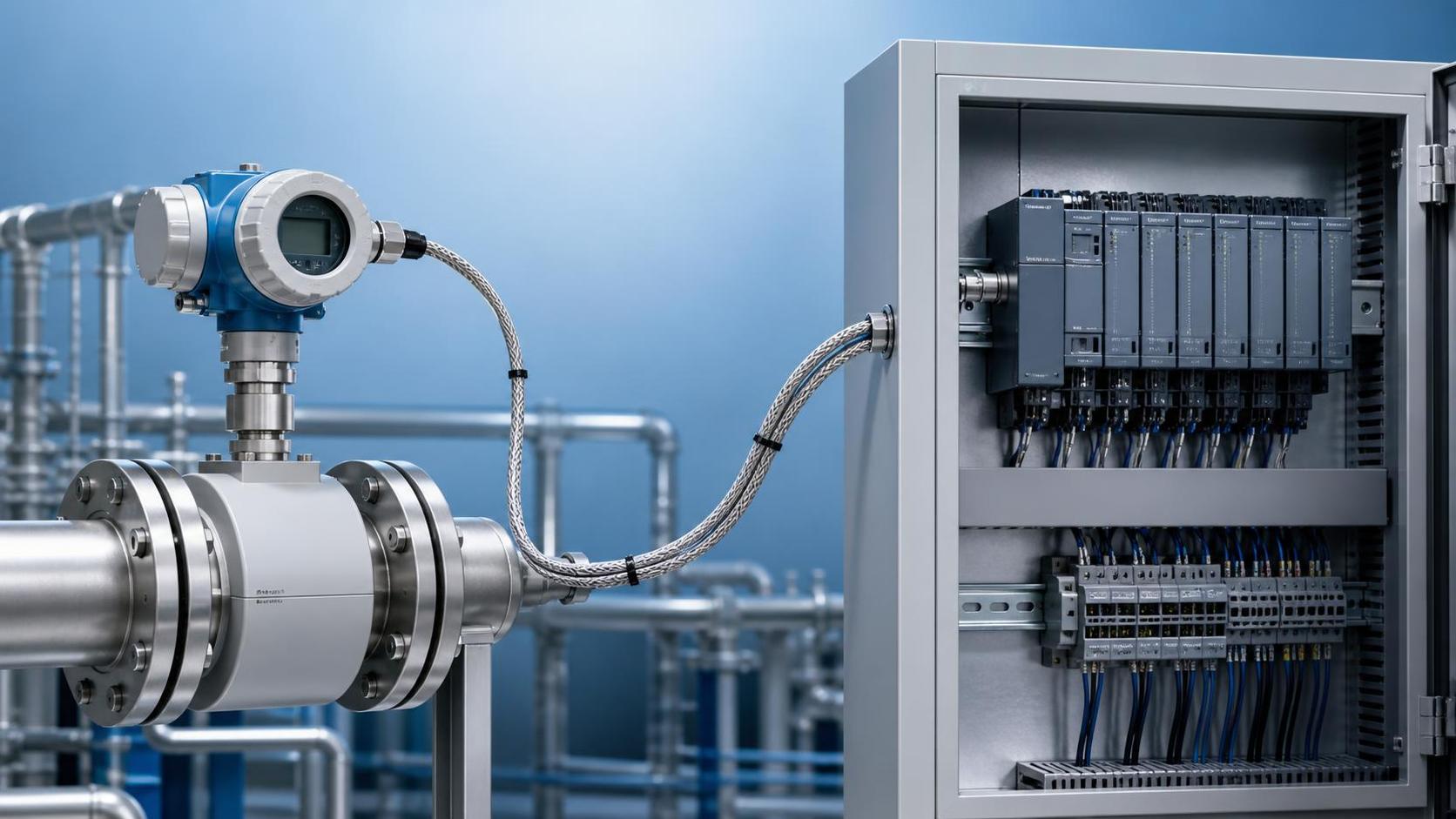
Signal cables should be routed separately from power cables whenever possible, the shielding layer should be grounded according to applicable requirements, and the junction box should be kept dry. For long-distance transmission, power supply stability and voltage drop must also be considered to avoid misidentifying system problems as transmitter inaccuracy.
From the perspective of acceptance and management, which points are more practical?
On-site assessment should not rely solely on catalogs. Moving key checks forward to the four stages of selection, delivery, installation, and integrated commissioning can significantly reduce problems.
- Verify whether the range, output signal, and power supply range are consistent with the control system.
- Confirm that the IP rating corresponds to actual operating conditions rather than merely meeting laboratory conditions.
- Check whether the wetted-part material, thread specification, and sealing material are compatible with the medium.
- Pay attention to interference resistance, surge protection, and insulation parameters, and conduct integrated commissioning when necessary.
- After installation, record the zero point, full-scale value, and steady-state fluctuation value as a baseline for subsequent inspections.
- Establish periodic inspection items, including wiring terminals, sealing points, brackets, and signal waveforms.
If the site is also equipped with flow, temperature and humidity, level, or control instruments, it is recommended to include the sensor chain in the same inspection checklist. This makes it easier to identify the common effects of environmental factors on multiple instruments rather than handling apparent faults one instrument at a time.
When selecting a solution, do not focus only on price
The constant-pressure water supply pressure transmitter is a typical product in which a “small component affects a large system.” The unit price difference may not be significant, but once the selection is unsuitable, the management costs caused by subsequent downtime, repairs, repeated calibration, and false alarms may be much higher.
A more reliable approach is to evaluate the protection rating, material compatibility, electrical compatibility, installation conditions, and maintenance convenience within the same framework. A supply system with integrated experience in pressure, flow, temperature and humidity, and control instruments is usually better able to provide evaluation criteria suited to actual site conditions.
In subsequent work, the environmental characteristics of the existing pump room or water supply station can first be reviewed, followed by a point-by-point check against the protection standards, installation method, and maintenance records of the constant-pressure water supply pressure transmitter. Raising the objective from “usable” to “long-term stable and controllable” is the true management focus for this type of sensor.
Related Recommendations
 How to Select an Industrial Flowmeter in Xi'an Based on Operating Conditions?
 What on-site measurements are Shaanxi portable flowmeters suitable for?
 What Costs Should Be Considered When Purchasing Small Flowmeters in Xi'an?
 How can Shaanxi remote-transmission flowmeters reduce signal transmission errors?