


News Center
—— NEWS CENTER ——
Xi'an Shenghongchuang Instrument Co., Ltd.
Contact: Mr. Zhang
Mobile: 15529283736
Email: shc-sensor@qq.com
Address: Fortune Building, Sanqiao Street, Xixian New Area, Xi'an, Shaanxi Province
Why Does the Installation Location of the Pressure Transmitter Affect Control Performance in a Variable-Frequency Constant-Pressure Water Supply System?
In a variable-frequency constant-pressure water supply system, the constant-pressure water supply pressure transmitter may appear to be merely a measuring point, but it actually determines whether the pressure seen by the controller is accurate.
Once the installation location is improperly selected, the system may experience pressure fluctuations, frequent pump starting and stopping, insufficient terminal water pressure, or even misjudged faults.
Therefore, when considering a constant-pressure water supply pressure transmitter, it is not enough to focus only on range and accuracy. It is also essential to consider where it is installed, what it is close to, and which sources of interference it avoids.
Why Does the Installation Location Directly Change Control Performance?
The core of a variable-frequency constant-pressure water supply system is to regulate the pump speed based on pressure feedback. The more accurate the pressure signal received by the controller, the more precise the output adjustment will be.
If the constant-pressure water supply pressure transmitter is installed in a location subject to significant local disturbances, the pressure it measures is often not the average system pressure, but the instantaneous variation in a particular section of the pipeline.
In this case, the controller treats local fluctuations as overall changes and continuously adjusts the frequency. The result is not greater stability, but a greater tendency to oscillate.
A more obvious sign is the common situation in which “the surface setpoint remains unchanged, while the water outlet condition fluctuates significantly.” In many cases, the problem is not with the variable-frequency drive, but with the measuring point.
Why Is Signal Distortion More Likely When It Is Installed Too Close to the Water Pump?
For wiring convenience, many projects install the constant-pressure water supply pressure transmitter directly near the pump outlet. Although this simplifies construction, the control performance is often unsatisfactory.
The reason is straightforward. The pump outlet is where pressure pulsation is most pronounced. Impeller operation, check-valve action, and start-stop switching can all introduce obvious ripples into the pressure signal.
If the constant-pressure water supply pressure transmitter continuously measures this fluctuating signal, the controller will make frequent fine adjustments, resulting in unstable output and potentially making the equipment appear “busy but inefficient.”
In addition, the pressure at the pump outlet is usually higher than the actual pressure at the remote water consumption point. If the controller focuses only on this point, terminal users may still experience low water pressure.
Why Is the Middle or Downstream Section of the Main Pipe Usually Closer to Actual Demand?
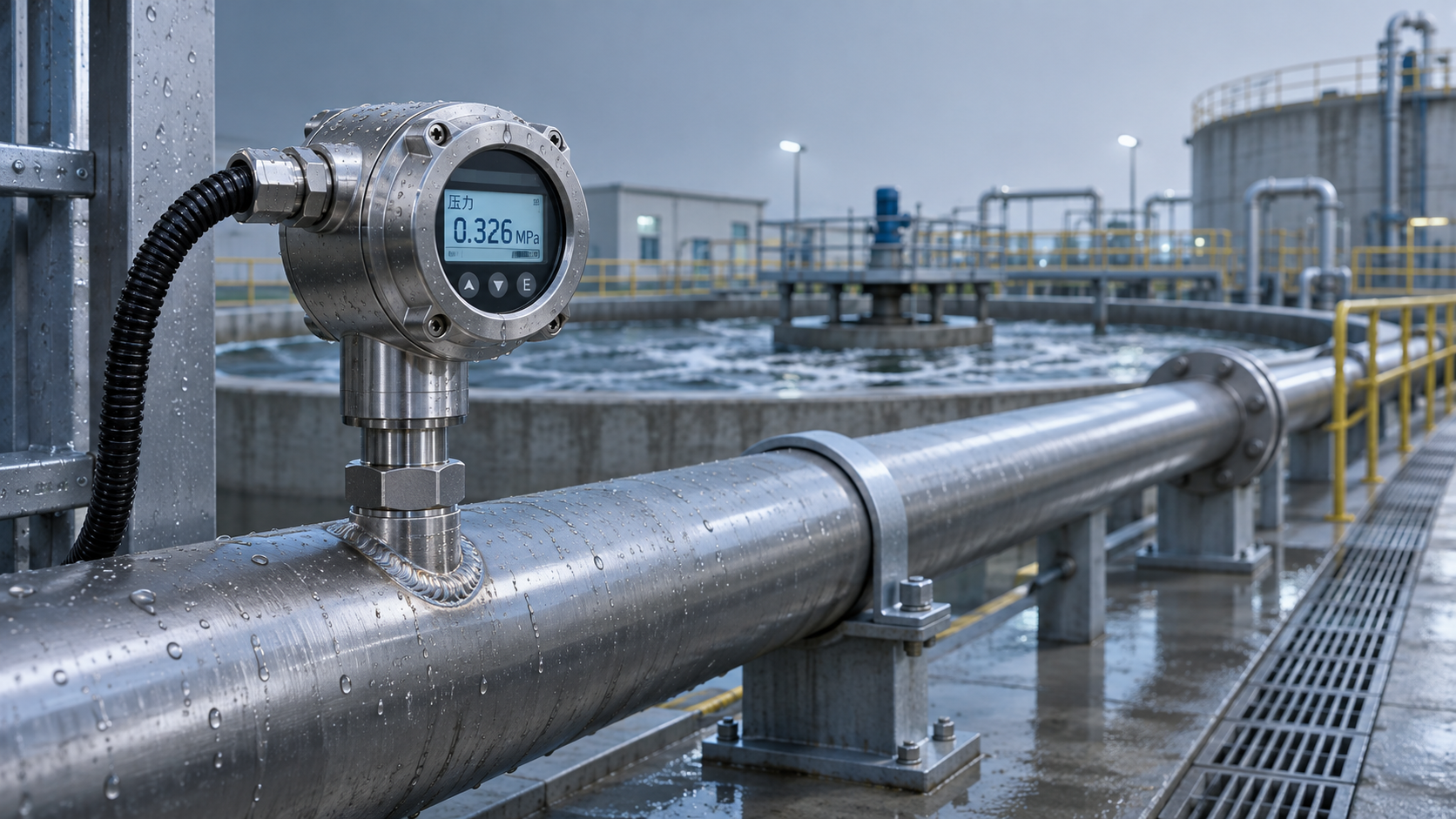
In practical applications, the constant-pressure water supply pressure transmitter is more suitably installed in the middle or downstream section of the outlet main pipe, or near the main water-use branch.
This arrangement has two advantages. First, it avoids the strong pulsations at the pump outlet. Second, it better reflects the pressure condition of the pipe network under actual loads.
For applications such as secondary water supply in buildings, circulating makeup water in factories, and water supply in commercial complexes, the system control objective is not “having pressure at the pump outlet,” but “having sufficient pressure at critical water consumption points.”
Therefore, the installation location of the constant-pressure water supply pressure transmitter should serve terminal demand as much as possible, rather than merely facilitating equipment installation.
What Typical Problems Can Result from an Improper Installation Location?
During on-site troubleshooting, many abnormalities can be traced back to improper installation of the constant-pressure water supply pressure transmitter. Common problems mainly fall into the following categories.
- Large pressure fluctuations, with the pressure oscillating around the setpoint.
- Frequent variable-frequency drive corrections, resulting in increased motor heating.
- Greater overshoot during low-flow conditions at night, leading to high-pressure alarms.
- Insufficient terminal water pressure even though the control interface displays “normal.”
- Sudden pressure changes during multi-pump switching and deteriorated coordination logic.
These problems may appear to be caused by improperly adjusted parameters, but in reality they are often due to the constant-pressure water supply pressure transmitter failing to measure the pressure point that should actually be controlled.
What Signals Can Be Used to Determine Whether the Measuring Point Is Suitable?
If the system is already in operation, immediate modification is not necessarily required. Observing its operating characteristics can often help determine whether the location of the constant-pressure water supply pressure transmitter is appropriate.
- Check whether the trend curve shows high-frequency fluctuations. Frequent fluctuations indicate significant pulsation interference at the measuring point.
- Check whether the terminal user experience is consistent with the interface data. If not, the feedback point may be located too far upstream.
- Check whether significant impact occurs during multi-pump alternation. A large impact may indicate that the measuring point is too close to the equipment.
- Check whether operation is stable under low-flow conditions at night. Instability at low flow often reveals measuring-point problems most clearly.
Based on recent changes in operation and maintenance, more and more projects are paying attention to trend data rather than just the pressure value at a particular moment. This is the right direction.
Besides Location, Installation Details Can Also Amplify or Reduce Errors
Even when the location of the constant-pressure water supply pressure transmitter is correctly selected, installation details must be handled properly; otherwise, control quality will still be compromised.
For example, the pressure tapping point should be away from elbows, valves, and reducers. Flow conditions are complex in these locations, and local impacts can make the signal unstable.
Similarly, the installation branch pipe should not be too long. An excessively long branch pipe causes response lag. The controller may accelerate its adjustment, while the actual signal has not yet caught up.
If there is significant vibration on site, mechanical vibration reduction and electrical shielding should also be implemented. Otherwise, interference entering the signal circuit can likewise affect the output of the constant-pressure water supply pressure transmitter.
The Measuring-Point Approach Should Vary with Different Water Supply Scenarios
Not all systems use the same measuring-point arrangement logic. Depending on the scenario, the installation focus for the constant-pressure water supply pressure transmitter also differs.
For secondary water supply in residential buildings, greater attention is paid to whether terminal pressure is sufficient during peak periods. Therefore, the measuring point must take the most unfavorable point requirements into account.
Industrial water supply systems often focus more on the stability of the inlet pressure of process equipment. In this case, the constant-pressure water supply pressure transmitter should be installed near the branch serving critical water-consuming equipment.
For multi-zone water supply or long-distance water transmission, it is not sufficient to simply install one measuring point. Pressure loss and zone characteristics must be considered comprehensively.
Only by Considering Selection and Installation Together Can Complete Control Performance Be Achieved
In actual applications, the constant-pressure water supply pressure transmitter should not be selected solely according to price or a conventional model. Product selection must be considered together with the installation location.
If the range is too large, small fluctuations cannot be clearly detected. If the range is too small, overload can easily occur. Accuracy, stability, and interference resistance must also be assessed according to the site conditions.
Xi'an Shenghongchuang Instrumentation Co., Ltd. has long served industrial and engineering applications, providing pressure sensors, pressure transmitters, and various sensing and measurement-control products.
For constant-pressure water supply pressure transmitter applications, a truly valuable solution is not merely to install the product, but to coordinate the measuring point, control logic, and on-site operating conditions.
Recommended Sequence for On-Site Optimization
- First verify the current location of the constant-pressure water supply pressure transmitter and confirm whether it is too close to the pump outlet.
- Then compare the control interface data with the actual terminal pressure to determine whether they are consistent.
- Next inspect the area around the pressure tapping point for interference sources such as valves, elbows, and reducers.
- If necessary, move the measuring point to the middle or downstream section of the main pipe and retune the control parameters.
- Finally, observe the operating trends continuously under both peak and low-load conditions.
This approach is usually more effective than repeatedly adjusting PID alone and makes it easier to identify the real cause of unstable control by the constant-pressure water supply pressure transmitter.
Conclusion
Ultimately, the performance of a variable-frequency constant-pressure water supply system depends not on a single parameter, but on whether measurement, judgment, and adjustment are based on actual pressure.
Only when the constant-pressure water supply pressure transmitter is installed in the correct location can the system operate more stably, respond more quickly, and run with greater reliability.
If pressure fluctuations, frequent speed adjustments, or unstable terminal water supply persist on site, checking the measuring-point location first is often more effective than replacing equipment blindly.
Related Recommendations
 Compensation Principles and Temperature Drift Parameters of Temperature-Compensated Pressure Transmitters
 Selecting a High-Temperature Liquid Pressure Transmitter: How to Determine Temperature, Sealing, and Range
 Sewage Containing Sand Easily Clogs Pipes? Installation and Selection Tips for Anti-Clogging Pressure Transmitters
 How Do You Evaluate a High-Stability Pressure Transmitter? Understanding Long-Term Drift and Temperature Effects