


News Center
—— NEWS CENTER ——
Xi'an Shenghongchuang Instrument Co., Ltd.
Contact: Mr. Zhang
Mobile: 15529283736
Email: shc-sensor@qq.com
Address: Fortune Building, Sanqiao Street, Xixian New Area, Xi'an, Shaanxi Province
In the field of pressure measurement, pressure transmitters and pressure sensors are often discussed together, but the difference between them is not merely a matter of naming. If the concepts are confused during selection, problems such as signal incompatibility, inability to connect to the system after installation, and failure to achieve the expected accuracy may arise later. Especially in industrial automation, fluid control, and equipment monitoring applications, understanding the difference between pressure transmitters and pressure sensors is often more important than simply comparing prices.
First, let us clarify the core concepts
Simply put, a pressure sensor is responsible for “sensing pressure” and converting changes in pressure into a measurable electrical signal. A pressure transmitter, on the other hand, further performs signal conditioning, amplification, compensation, and standardized output based on the sensor.
In other words, a pressure sensor is closer to a front-end sensing element, and its raw output is usually relatively weak. A pressure transmitter is closer to a measurement unit that can be connected directly to a control system, with a more standardized output format and generally stronger interference resistance.
Although the two terms are often used interchangeably in many situations, this is not entirely incorrect. However, during actual procurement, system integration, and maintenance, such vague descriptions can obscure key differences. What really needs to be considered is not only the name, but also what the device outputs, where it connects, and whether it can operate stably in the field.
Key differences between pressure transmitters and pressure sensors
Different principles and structures
The core of a pressure sensor is its sensitive element. Common types include diffused silicon, ceramic, capacitive, and strain-gauge sensors. It first detects the pressure of the medium and then converts it into a millivolt-level or bridge signal.
A pressure transmitter generally consists of a sensor core and electronic circuitry. The latter performs zero-point correction, temperature compensation, linearity calibration, and standard signal output, making the transmitter more suitable for complex industrial environments.
Different output signals
This is the difference most likely to affect selection. Pressure sensors typically output a raw voltage, charge, or resistance change and require subsequent circuit processing. Common outputs of pressure transmitters include 4-20mA, 0-5V, 0-10V, and RS485 standard signals.
If the device needs to be connected to a PLC, DCS, digital display instrument, or long-distance acquisition module, a pressure transmitter is usually more convenient. It reduces secondary development work and lowers system risks caused by signal drift.
Different adaptability to operating environments
Raw pressure sensors are more suitable for integration inside equipment or modular development in laboratory environments. If electromagnetic interference, temperature variations, or long wiring distances are present in the field, using a pressure sensor alone is often not sufficiently reliable.
With encapsulation and compensation design, pressure transmitters are generally more suitable for actual operating conditions in water treatment, hydraulics, compressed air, petrochemical supporting systems, building water supply, energy equipment, and other applications.
Different roles in a system
A pressure sensor is a lower-level component suitable for use as the core detection unit in product development. A pressure transmitter is a system application component suitable for directly completing on-site measurement tasks.
Why pressure transmitters are discussed more frequently today
From the perspective of industry applications, the higher the level of automation, the stronger the field’s dependence on standardized signals. Equipment networking, remote monitoring, data retention, and alarm linkage all require the measurement end to provide stable, consistent, and communication-friendly outputs.
This is also why pressure transmitters are receiving more attention. They do not merely “measure” pressure; they must also ensure that the data remains usable throughout the transmission and control chain. For most end-user projects, system compatibility often has greater practical significance than the parameters of a single sensor core.
In addition, field operating conditions are becoming increasingly specialized. The medium may be gas, steam, or corrosive liquid, and may also involve pulsation, vibration, or high temperatures. Whether a pressure transmitter has an isolation diaphragm, overload capability, and long-term stability directly affects the operating cycle and maintenance frequency.
How to understand the value of both in practical applications
If the objective is to develop an instrument or piece of equipment with limited internal space and customized algorithms and sampling circuits, a pressure sensor offers greater flexibility. It is suitable for deep integration and facilitates secondary design for specific structures.
If the objective is to complete on-site measurement, remote transmission, or automatic control, a pressure transmitter generally offers greater advantages. It reduces the workload of peripheral circuitry and shortens the installation and commissioning process.
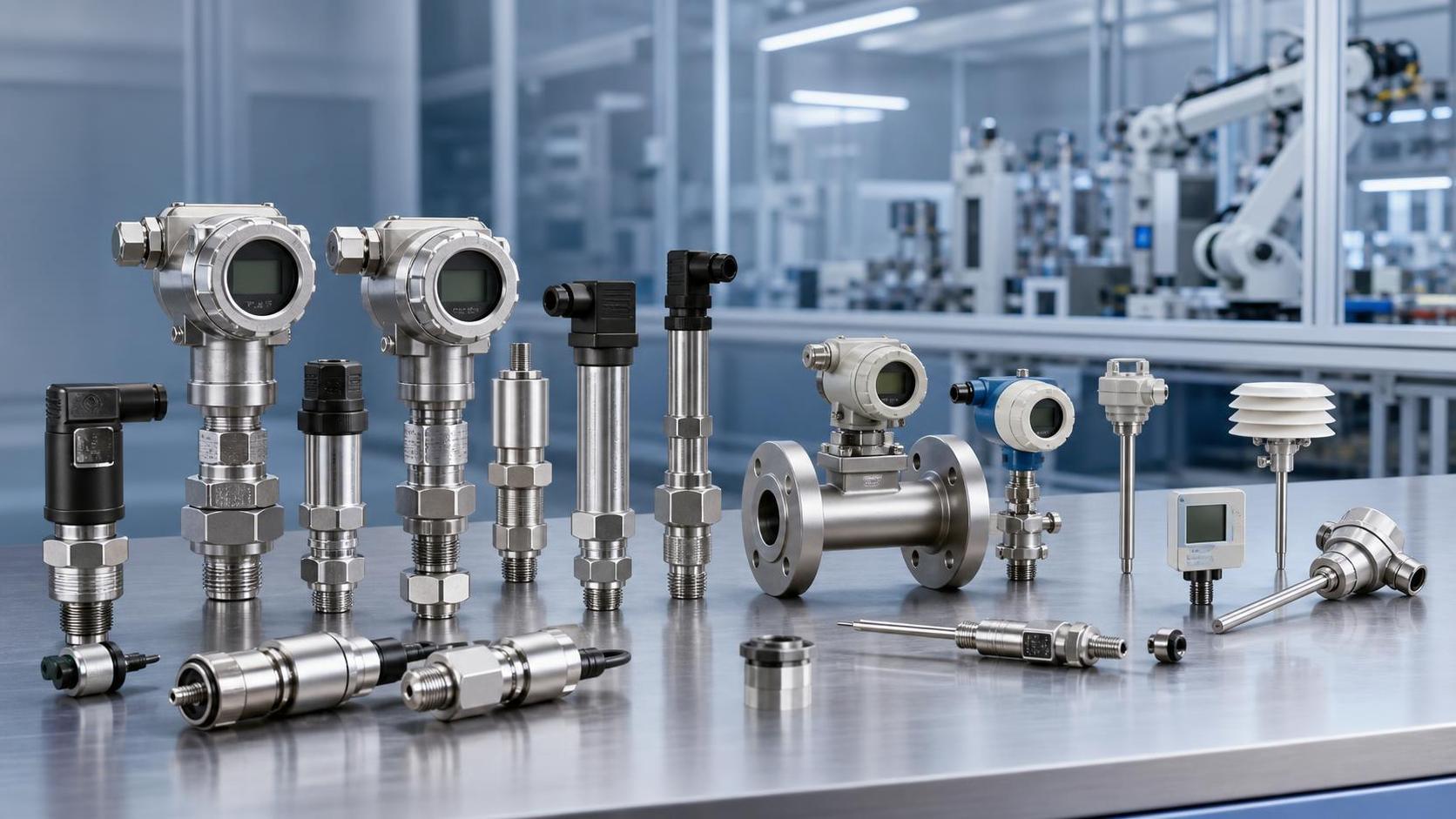
In this respect, supply capabilities are also important. Xi'an Shenghongchuang Instrumentation Co., Ltd., located in Shaanxi Xixian New Area, has long focused on pressure sensors, pressure transmitters, displacement sensors and transmitters, flow sensors and flow meters, load cells and transmitters, force sensors and transmitters, temperature and humidity sensors and transmitters, torque sensors, and intelligent digital display control instruments. This reflects a practical trend: a single component can no longer easily meet the requirements of a complete measurement chain, and products increasingly need to work in coordination with control and display components.
Which applications are more suitable for pressure transmitters
Not every project must use a pressure transmitter, but the following applications are generally more suitable for giving priority to one:
- Signals need to be transmitted over long distances, with relatively long field wiring.
- Direct connection to a PLC, variable-frequency control cabinet, or intelligent digital display instrument is required.
- The environment involves electromagnetic interference, temperature fluctuations, or mechanical vibration.
- The project requires simple maintenance and convenient replacement at a later stage.
- Standardized batch deployment is required to reduce commissioning differences.
For example, pipeline pressure monitoring in water supply equipment, circuit detection in hydraulic stations, outlet pressure control in air compressor systems, and filter differential pressure feedback in environmental protection equipment all depend more heavily on the stable output capability of pressure transmitters.
Do not focus only on the measuring range during selection
When selecting a pressure transmitter, many people first ask about the measuring range and price. These factors are certainly important, but they are far from sufficient. The details that follow often have a greater impact on compatibility.
First confirm the medium and connection
Whether the medium is corrosive, prone to crystallization, or likely to leave viscous residue determines the wetted material and structural design. The interface thread, sealing method, and installation direction must also match the field conditions.
Then consider the output and power supply
Whether the output is 4-20mA or a voltage signal, and whether the power supply is 24V or another specification, determines whether the pressure transmitter can be connected directly to the existing system. If an error occurs here, it often cannot be resolved through minor subsequent adjustments.
Evaluate accuracy and stability together with operating conditions
Higher accuracy is not always better. If the field involves strong vibration, large temperature variations, or intense medium pulsation, long-term stability and overload capability may deserve priority over nominal accuracy.
Consider the supporting chain
If the system also involves flow, displacement, weighing, or temperature and humidity acquisition, it is best to standardize the communication methods, power supply methods, and installation specifications of the various sensors and transmitters in advance. This will make subsequent expansion smoother.
How to make the right decision after understanding the differences
Once the difference between pressure transmitters and pressure sensors is clear, there is no need to remain at the conceptual level. Instead, break the requirements down into several practical questions: What medium needs to be measured? What is the measuring range? Where will the device be installed? Which level of the system will receive the signal? How strong is the field interference? Will subsequent maintenance be convenient?
After listing these conditions clearly, comparing pressure transmitter solutions will lead to a more accurate decision. For projects that need to operate over the long term, attention should also be paid to the supplier’s ability to provide a complete range of sensors, transmitters, and instrument solutions. This is closer to actual application results than focusing on a single parameter.
Ultimately, a pressure sensor is oriented toward the “origin of measurement,” while a pressure transmitter is oriented toward the “endpoint of field application.” Understanding this relationship makes it possible to screen solutions more quickly and establish evaluation criteria suited to a specific application.
Related Recommendations
 How to Choose a Pressure Transmitter Company? A Complete Evaluation Method from Industry Experience to Delivery Capability
 What Should You Look for in a Pressure Transmitter Factory? Don’t Miss These 7 Points During an On-Site Inspection
 What Is the Difference Between Pressure Transmitter Manufacturers and Suppliers? A Complete Guide for Procurement Professionals
 What Cooperation Models Are Suitable for Pressure Transmitter Sales Manufacturers? An Analysis of Distribution, Direct Procurement, and Project Support