


News Center
—— NEWS CENTER ——
Xi'an Shenghongchuang Instrument Co., Ltd.
Contact: Mr. Zhang
Mobile: 15529283736
Email: shc-sensor@qq.com
Address: Fortune Building, Sanqiao Street, Xixian New Area, Xi'an, Shaanxi Province
Why Flow Measurement Requires Explosion-Proof Design in Hazardous Conditions
In scenarios such as chemical energy, metallurgy and building materials, oil and gas transmission, and solvent storage and transportation, flammable gases, vapors, or dust formed by medium leakage may interact with electrical sparks and high-temperature surfaces. Although flowmeters are responsible for process parameter acquisition, their power supply, signal transmission, display, and wiring components can all become risk-control links.
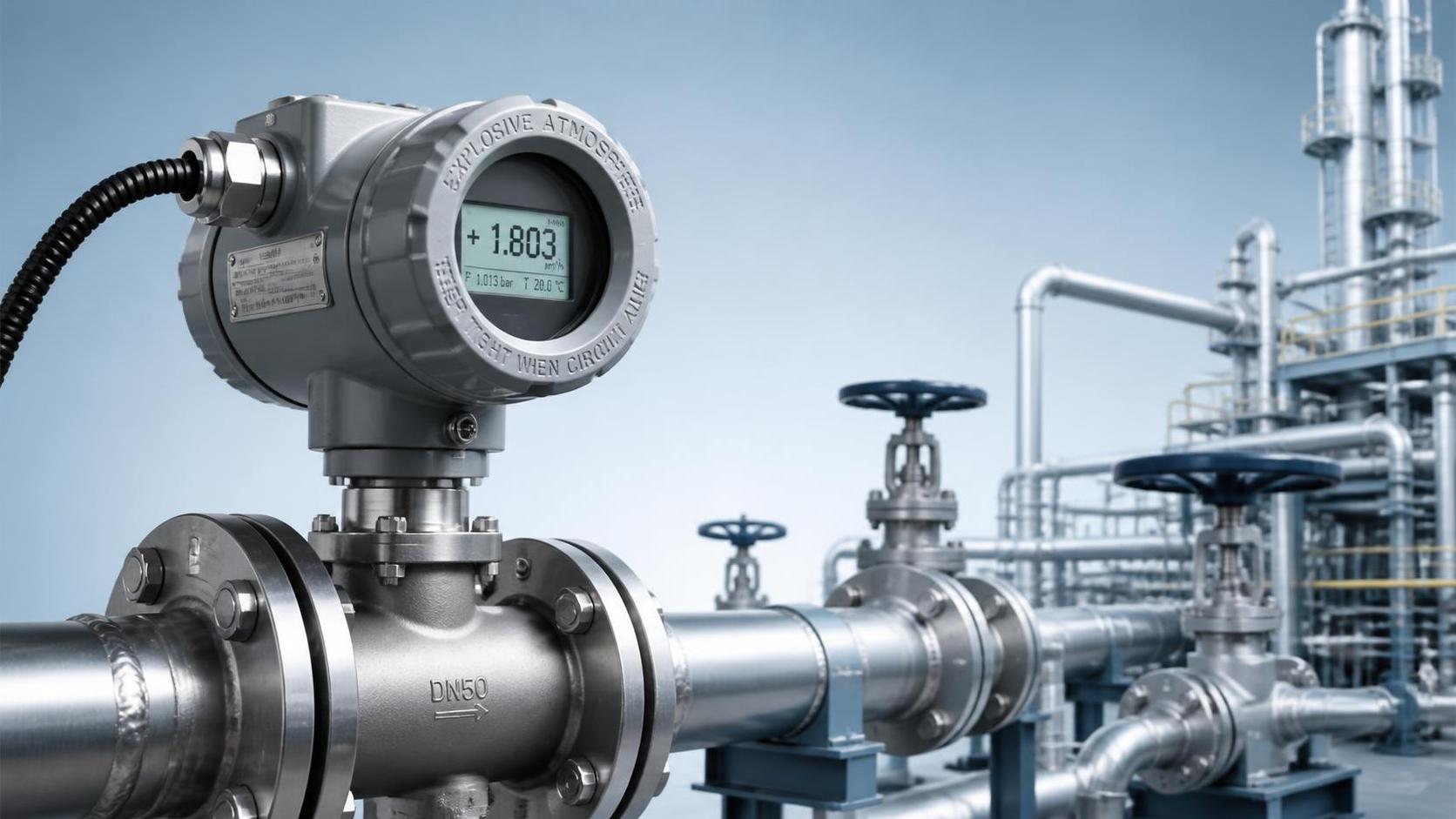
The core value of Shaanxi explosion-proof flowmeters lies not only in adding protective enclosures, but in establishing a complete safety chain from measurement principles, electronic circuits, enclosure sealing, and wiring methods to on-site installation. Only when the flowmeter's explosion-proof type matches the hazardous area, medium characteristics, and ambient temperature can measurement data be reliably transmitted to the automated control system.
For users of sensors and measurement and control systems, selecting explosion-proof flowmeters should also take into account turndown ratio, medium temperature and pressure, conductivity, viscosity, corrosiveness, and pipeline conditions. Safety rating and measurement performance are not independent of each other; improper selection may lead to reading drift, instrument failure, and even increased on-site maintenance risks.
Key Approaches for Shaanxi Explosion-Proof Flowmeters to Meet Hazardous Environment Requirements
Match the Explosion-Proof Type to the Site Area First
Different hazardous locations have different requirements for the explosion-proof capability of equipment. Engineering personnel should first determine the area classification based on the site risk assessment, then verify the flowmeter nameplate, certificates, and conditions of use. Procurement should not be based solely on whether a product is labeled “explosion-proof.” Gas and dust environments differ in risk sources, temperature limits, and installation requirements.
Flameproof type equipment generally contains possible internal explosions through an enclosure with sufficient strength; intrinsically safe type equipment prevents sparks capable of igniting hazardous media by limiting circuit energy under normal or fault conditions. In actual projects, increased safety, encapsulation, and other explosion-protection methods may also be involved, subject to the certification scope of the specific product.
Taking common signal circuits as an example, 4-20mA outputs can be used for process control systems, but intrinsically safe circuits require overall verification together with safety barriers or isolators. Cable parameters, circuit inductance, capacitance, and grounding methods all affect the compatibility of intrinsically safe systems, so ordinary analog signal wiring methods cannot be applied directly.
Explosion-Proof Information to Verify During Selection
Explosion-proof markings and ingress protection ratings should be understood separately. Explosion-proof construction is used to control ignition-source risks, while enclosure protection ratings such as IP65, IP66, and IP67 mainly indicate dustproof and waterproof capability. For outdoor installations, washdown areas, or high-humidity environments, both types of indicators should be included in the technical agreement.
The significance of localized technical services in Shaanxi is that on-site communication can be conducted in conjunction with pipeline routing, instrument tag numbers, control cabinet configurations, and maintenance conditions. Xi'an Shenghongchuang Instrument Co., Ltd. and its production base, Shaanxi Qinkong Sensor Technology Co., Ltd., can assist users in developing suitable measurement and control solutions for industrial sensing, transmission, display, and control requirements.
It should be emphasized that the explosion-proof certification scope, rating, temperature group, and conditions of use must be based on the valid certificates, nameplates, and technical documentation for the specific model. For retrofit projects, existing safety barriers, isolators, and grounding systems should also be reviewed simultaneously to avoid parameter mismatches between new and existing equipment.
Flowmeter Technology Selection Balancing Accuracy and Stability
Select the Measurement Principle Based on the Medium and Process Conditions
When selecting flowmeters for hazardous environments, the medium should be considered before the explosion-proof type. Electromagnetic flowmeters may be considered for conductive liquids; vortex flowmeters may be considered for steam, compressed air, and general gases according to operating conditions; for high-accuracy liquid metering requirements, other suitable solutions can be evaluated based on viscosity, cleanliness, and pressure-loss requirements.
The flowmeter diameter should not be determined simply by pipe diameter. If the actual flow operates near the lower limit of the measuring range for extended periods, signal resolution and repeatability may be affected; if the flow velocity is too high, pressure loss, vibration, wear, or noise issues may arise. The design stage should provide three sets of data: minimum, normal, and maximum flow rates.
For complex operating conditions, the maximum working pressure, maximum and minimum medium temperatures, ambient temperature, installation orientation, and upstream and downstream straight-pipe conditions should also be specified. For media containing bubbles, pulsations, impurities, or strong corrosiveness, sensor linings, electrodes, probes, and sealing materials should be evaluated together.
Comparison of Common Flow Measurement Solutions
In terms of signal processing, intelligent flowmeters can output instantaneous flow, totalized flow, and alarm information, and can be connected to PLC, DCS, or data acquisition platforms as required by the project. For workshops with long-distance wiring and dense variable-frequency equipment, shielded cables, standardized grounding, and anti-interference design also affect data reliability.
Under high-temperature, high-pressure, or strong-vibration conditions, the instrument pressure rating, process connection type, and installation supports need to be considered in coordination. Even if the sensor body meets measurement requirements, improper handling of impulse lines, flanges, cable sealing glands, or brackets can still affect the long-term stable operation of the system.
For industrial automation measurement and control applications, Xi'an Shenghongchuang Instrument Co., Ltd. can provide matching recommendations for flowmeters and related transmitters and display control instruments based on medium parameters, pipe diameter, measuring range, output signals, and site environment, enabling the measurement chain to connect more effectively with existing control systems.
Safety Control in Installation, Operation, and Maintenance
Maintaining Effective Explosion-Proof Performance On Site
After explosion-proof flowmeters arrive, the model, measuring range, process connection, power supply method, output signal, and explosion-proof documentation should be verified against the ordering technical requirements. Before installation, the enclosure, wiring ports, sealing rings, and nameplate condition should also be inspected to confirm that the equipment has not been damaged during transportation or storage.
Wiring must be carried out in accordance with the product manual and explosion-proof installation specifications. Cable entries should use compliant sealing glands, and unused ports must be reliably plugged; flameproof joints, seals, and fasteners should not be replaced arbitrarily. It is strictly prohibited to open enclosures that are not permitted to be opened while energized.
After commissioning, an inspection cycle should be established according to the characteristics of the medium. Checks may generally include whether local display data is consistent with remote transmission data, whether water has entered the wiring chamber, whether the enclosure is corroded, whether the zero point is abnormal, and whether pipeline vibration exists. In the event of sudden flow changes, process changes, blockages, empty pipes, and signal interference should be investigated first.
Four Key Points of On-Site Management
First, maintain complete equipment records, including instrument number, installation location, certificate documentation, commissioning date, calibration records, and maintenance records. These records not only facilitate traceability, but also provide a reliable data foundation for equipment renewal and intelligent upgrades.
Second, calibration and verification intervals should be established according to metrological management requirements, process criticality, and frequency of use. The management level should be increased for flow measurement points associated with trade settlement, critical batching, or safety interlocks, to prevent long-term deviations from affecting output, energy consumption, or process safety.
Third, equipment maintenance should adhere to equivalent explosion-proof requirements. Before replacing converters, sensors, display modules, or cable accessories, confirm that the spare-part model and certification applicability are suitable; modifications without evaluation may alter the original explosion-proof construction and must not be substituted merely because dimensions or interfaces are identical.
Fourth, it is recommended that process, instrumentation, electrical, and safety personnel jointly confirm technical requirements at the initial stage of the project. Clearly defining the hazardous area, medium composition, pressure and temperature, communication protocols, power supply circuits, and maintenance space at one time can reduce subsequent rework and improve the actual application effectiveness of Shaanxi explosion-proof flowmeters.
Supporting Industrial Automation Upgrades with Reliable Measurement and Control
Flow measurement in hazardous environments is essentially a combination of safety management and process control. Suitable explosion-proof flowmeters can continuously provide reliable flow data, offering fundamental support for batching control, energy consumption accounting, equipment interlocking, abnormal condition warnings, and production traceability.
Leveraging manufacturing resources in the Guanzhong region of Shaanxi, Shaanxi Qinkong Sensor Technology Co., Ltd. provides sensors, transmitters, intelligent digital display control instruments, and non-standard customization services, with products used in industrial automation measurement and control applications. For complex sites, executable instrument configuration solutions should be developed based on actual process parameters and compliance requirements.
If Shaanxi explosion-proof flowmeters are required, please compile the medium name, pipe diameter, flow range, temperature and pressure, hazardous area classification, installation method, and required signal type, and submit them to the technical service team of Xi'an Shenghongchuang Instrument Co., Ltd. for targeted selection and matching confirmation.
Related Recommendations
 How Shaanxi Explosion-Proof Flowmeters Meet Hazardous Environment Requirements
 What Changes Can Shaanxi Intelligent Flowmeters Bring to Factory Management?
 Which certification standards must hygienic level sensors comply with?
![]() U.S. CBP Launches Special Inspection of Smart Sensing Equipment, Tightening Origin and HS Classification Reviews from August
U.S. CBP Launches Special Inspection of Smart Sensing Equipment, Tightening Origin and HS Classification Reviews from August