


News Center
—— NEWS CENTER ——
Xi'an Shenghongchuang Instrument Co., Ltd.
Contact: Mr. Zhang
Mobile: 15529283736
Email: shc-sensor@qq.com
Address: Fortune Building, Sanqiao Street, Xixian New Area, Xi'an, Shaanxi Province
When a medical pressure transmitter is used in medical equipment, quality control and safety personnel need to consider more than just the pressure range and accuracy. They should also consider the intended use, human contact, electrical safety of the finished device, supply chain controls, and validation documentation. Even if an industrial-use product has factory calibration records, this alone does not establish that it is suitable for medical equipment.
I. First Define the Intended Use and Regulatory Boundaries
Distinguish Between a Component and a Medical Device
First, clarify whether the transmitter measures pressure in a respiratory gas pathway, an infusion line, or a non-patient-contact line inside the equipment. Also confirm whether the measurement is used for alarms, therapy control, or life support, since different uses require different levels of risk control and validation.
In China, supplying a pressure transmitter as a component of medical equipment does not necessarily mean that it must be registered separately as a medical device. If it is independently marketed as a medical device, its regulatory classification should be determined based on its intended use, operating principle, and applicable classification rules. For products whose classification is unclear, consult the classification catalog published by the drug regulatory authority and follow the relevant procedures.
The registrant or filing entity for the finished device is responsible for its overall safety and effectiveness. At the time of purchase, clearly define the scope of products supplied by the supplier, technical boundaries, and validation responsibilities. Responsibility for registering the finished device must not simply be equated with that of the component supplier.
Check the Current Status of Applicable Standards
Establish the standards list according to the target market, finished-device category, and intended use. For projects conducted in 2026, check the current versions, effective dates, and transition periods of applicable regulations and standards, especially whether relevant mandatory standards apply.
Medical electrical equipment typically needs to be evaluated against the general safety, essential performance, and electromagnetic compatibility requirements of the GB 9706.1 series. Specific equipment may also be subject to particular standards. Whether a pressure transmitter requires a specific test to be conducted separately should be determined based on its function, interfaces, and the finished device risk analysis.
For export products, also check the regulations and adopted standards in the target market. For example, market access pathways in the EU, the United States, and China are not identical; acceptance in other markets cannot be inferred from a domestic test report alone.
II. Check Materials, Contact Pathways, and Cleaning Requirements
Assess Materials Based on Actual Contact
First map the media-contact pathway and identify whether the diaphragm, seals, connectors, and bonding materials contact the human body, blood, medicinal liquids, or patient respiratory gases. Even when a material does not contact the patient directly, assess the possibility of indirect contact through the medium or gas pathway.
In cases of direct or indirect human contact, conduct a biological evaluation in accordance with the applicable GB/T 16886 or ISO 10993 series, taking into account the nature, site, and duration of contact. The evaluation may be supported by material information, existing data, and necessary tests; a conclusion must not be based solely on terms such as “stainless steel” or “medical grade.”
The supplier should provide a list of materials in contact with liquids or gases, material grades, seal material information, and a commitment to notify customers of changes. For applications involving contact with medicinal liquids, also assess compatibility and the risks of extractables and leachables, as necessary, in light of the formulation, contact conditions, and duration of use.
Confirm Suitability for Cleaning, Disinfection, and Sterilization
If the equipment requires repeated reprocessing, confirm that the transmitter can withstand the specified cleaning agents, disinfection methods, temperatures, and number of cycles. Assess any resulting changes in drift, corrosion, leakage, and sealing performance.
If the product is supplied sterile or must be sterilized during finished-device production, confirm applicable requirements for packaging, the sterilization process, the sterile barrier, and shelf life. Components that have not been validated should not be used directly in a fluid pathway claimed to be sterile.
Records should specify the actual processing conditions rather than simply state “can be disinfected.” For example, the same component may respond differently to alcohol wiping and high-temperature steam, so materials and seals must be validated against the intended process.
III. Validate Measurement Performance and Finished-Device Safety
Convert Parameters into Verifiable Acceptance Criteria
The pressure range should cover normal operating pressure, alarm thresholds, and foreseeable abnormal pressures. In addition to accuracy at room temperature, check zero drift, repeatability, hysteresis, temperature effects, response time, and overload capacity, and specify the units and test conditions for each criterion.
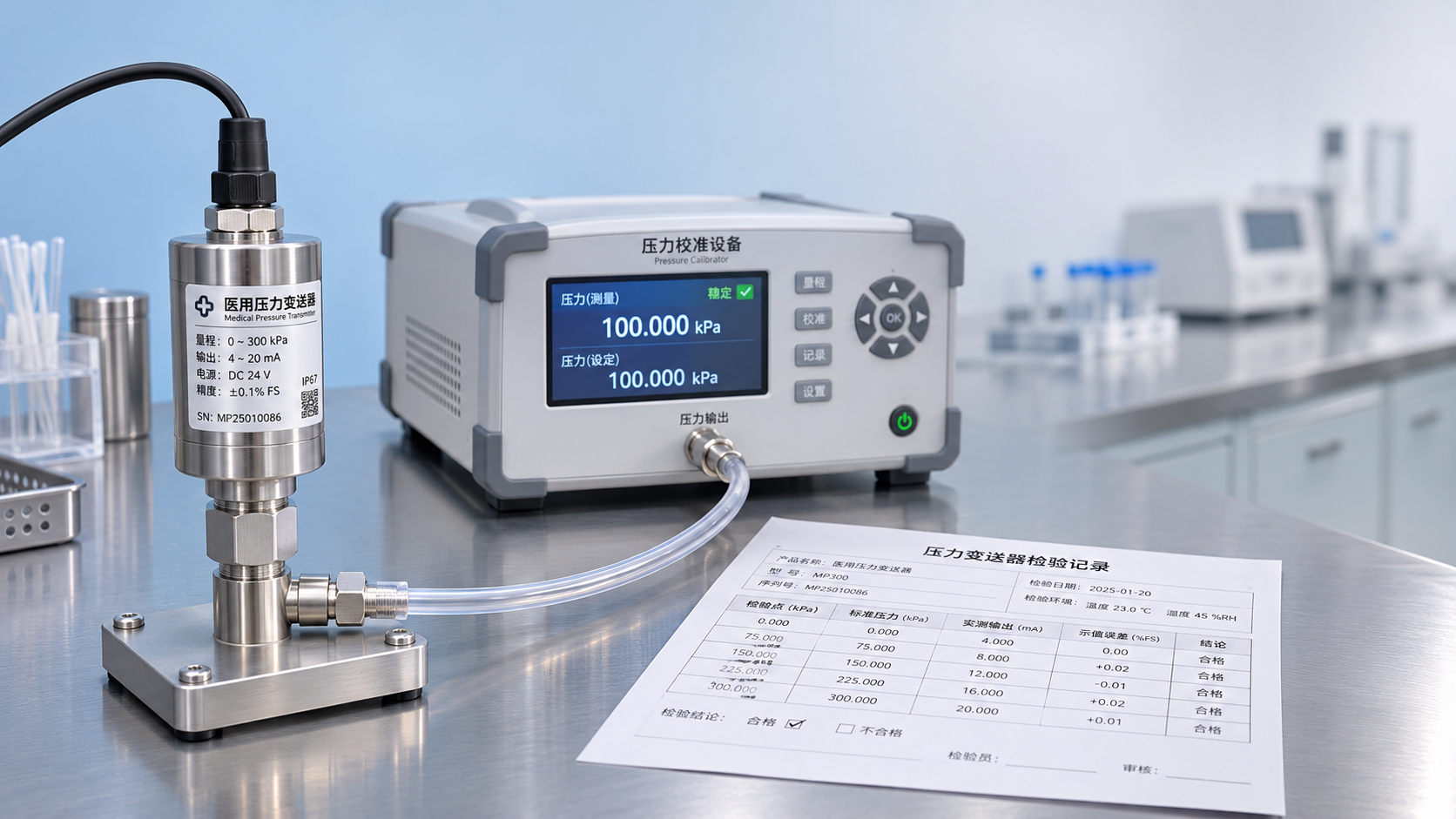
Calibration points can be selected according to the range and risk, for example, three basic points covering zero, mid-range, and full scale. Additional verification points should be included near alarm thresholds. The specific number of points and tolerances are determined by the product technical requirements, risk analysis, and applicable standards; they are not fixed statutory values.
Calibration equipment should be traceable, and the certificate should list measurement results, uncertainty, environmental conditions, and information about the reference standards used. The medical-device manufacturer should also confirm the system error of the transmitter combined with the acquisition circuit, rather than considering only the error of the sensor itself.
Validation Priorities for Different Metrics
For example, for a transmitter with a nominal range of 0–100 kPa, full-scale error and error at the actual operating point are not the same concept. When selecting a product, confirm whether accuracy is calculated based on full scale, reading, or another reference, and check overall performance after temperature changes.
For equipment requiring rapid alarms, validate response time in the actual gas or liquid pathway. Connection tubing length and inner diameter, filters, and software filtering can all affect finished-device response; component-level response data alone are insufficient to demonstrate that the finished device meets requirements.
Overpressure and leakage tests should also be designed to reflect actual operating conditions. For equipment that operates continuously, consider long-term drift, pressure cycling, and the safe state following a failure, and retain performance comparisons from before and after testing.
Pay Attention to Electrical Interfaces and Fault Conditions
Confirm the supply voltage range, output signal, insulation method, grounding, and connector pinout. Assess whether the finished device can detect faults and enter its predetermined safe state in the event of an open circuit, short circuit, abnormal power supply, or frozen signal.
Electromagnetic compatibility is generally validated with the finished device in its final configuration. Component-level immunity data are useful as a reference, but cable routing, shielding, enclosure, and software processing can all affect the finished-device results.
For measurement channels that directly affect therapy, assess measures such as redundancy, plausibility checks, independent alarms, or periodic self-tests based on the risk evaluation. Any measure adopted should have validation evidence corresponding to the relevant risk control.
IV. Establish Supplier Documentation and Change Traceability Mechanisms
Review the Documentation Package Before Purchasing
It is recommended that you request the model specification, materials list, factory inspection records, calibration certificates, critical performance test reports, and applicable documentation for biocompatibility, cleaning and disinfection, or sterilization validation. The documentation should correspond to the model, design, and materials actually being purchased.
Quality system documentation can be used as a basis for supplier evaluation, such as checking whether the supplier has established quality management processes appropriate to its supply activities. ISO 13485 certification can serve as a reference, but certification does not replace product validation or automatically prove that a component meets all requirements for medical use.
Also define batch identification, retention samples or record retention, nonconformity handling, and traceability methods. The parties should agree on notification, impact assessment, and necessary revalidation procedures when the diaphragm, seals, chips, manufacturing site, or calibration process changes.
Do Not Equate Industrial Product Specifications with Medical Suitability
Different sensors may have entirely different measurement targets and validation requirements. For example, Domestic HVC-M02 Cantilever Beam Load Cell Weighing Module, Spring Pressure Sensor, Hopper Scale Module is a product for weighing applications. It has a specified range of 100–700 kg, uses an alloy steel structure, and can be used in weighing applications such as hopper scales.
The information above about the weighing product cannot serve as proof of material safety, fluid-path compatibility, or medical compliance for a medical pressure transmitter. Even when both products are sensors, their measurement principles, contact media, target equipment, and validation documentation must be confirmed separately.
Before deciding on a purchase, it is recommended that personnel from equipment R&D, quality, and regulatory affairs jointly complete an applicability checklist and provide the supplier with information on the medium, pressure range, contact pathway, and cleaning conditions. Obtain the technical documentation and samples for the corresponding model, then complete finished-device validation and supplier qualification.
Related Recommendations
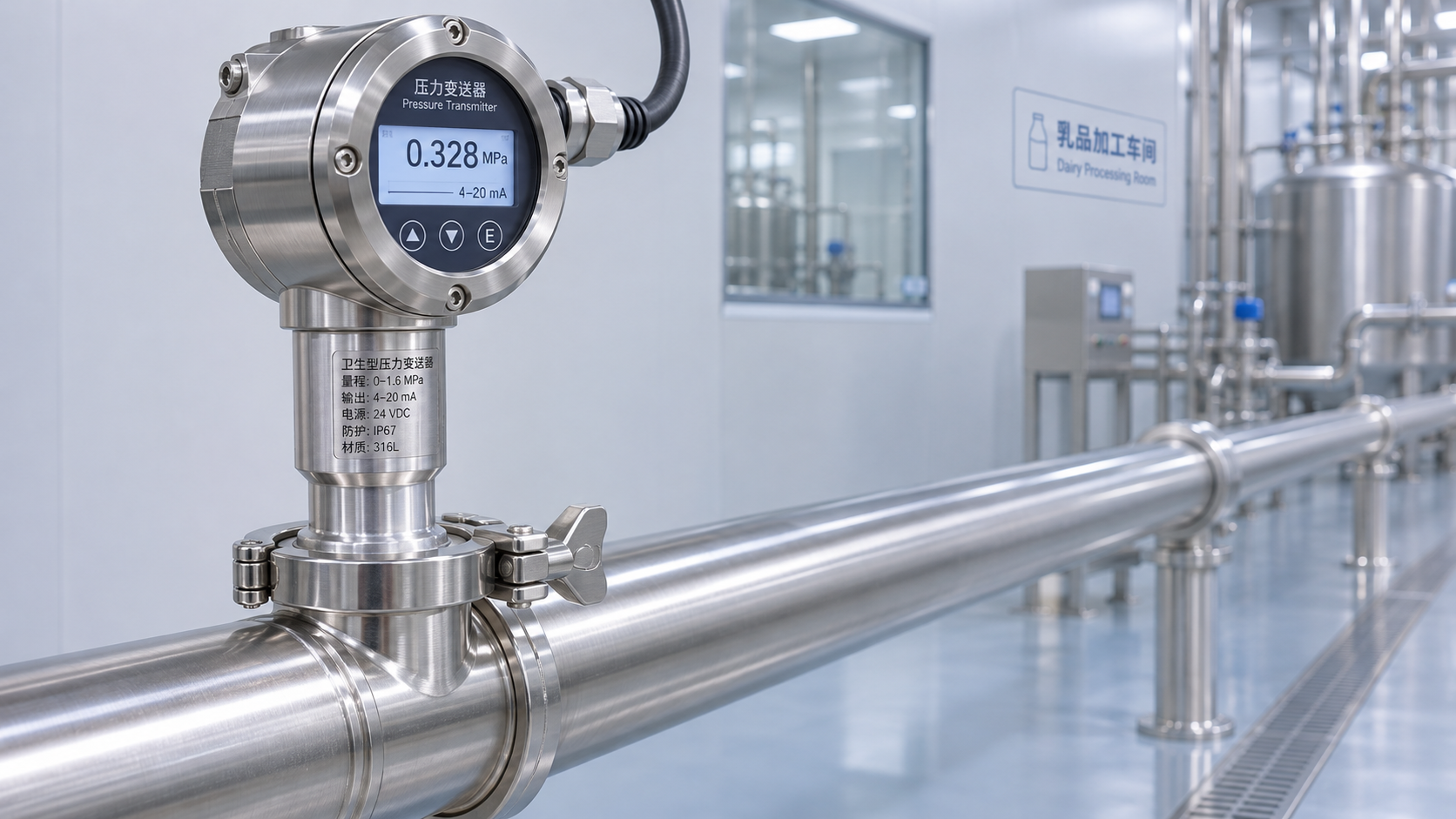
 What hygienic design and cleaning requirements should be checked when purchasing a milk pressure transmitter?
 What compliance requirements should be checked when using a medical pressure transmitter in medical equipment?
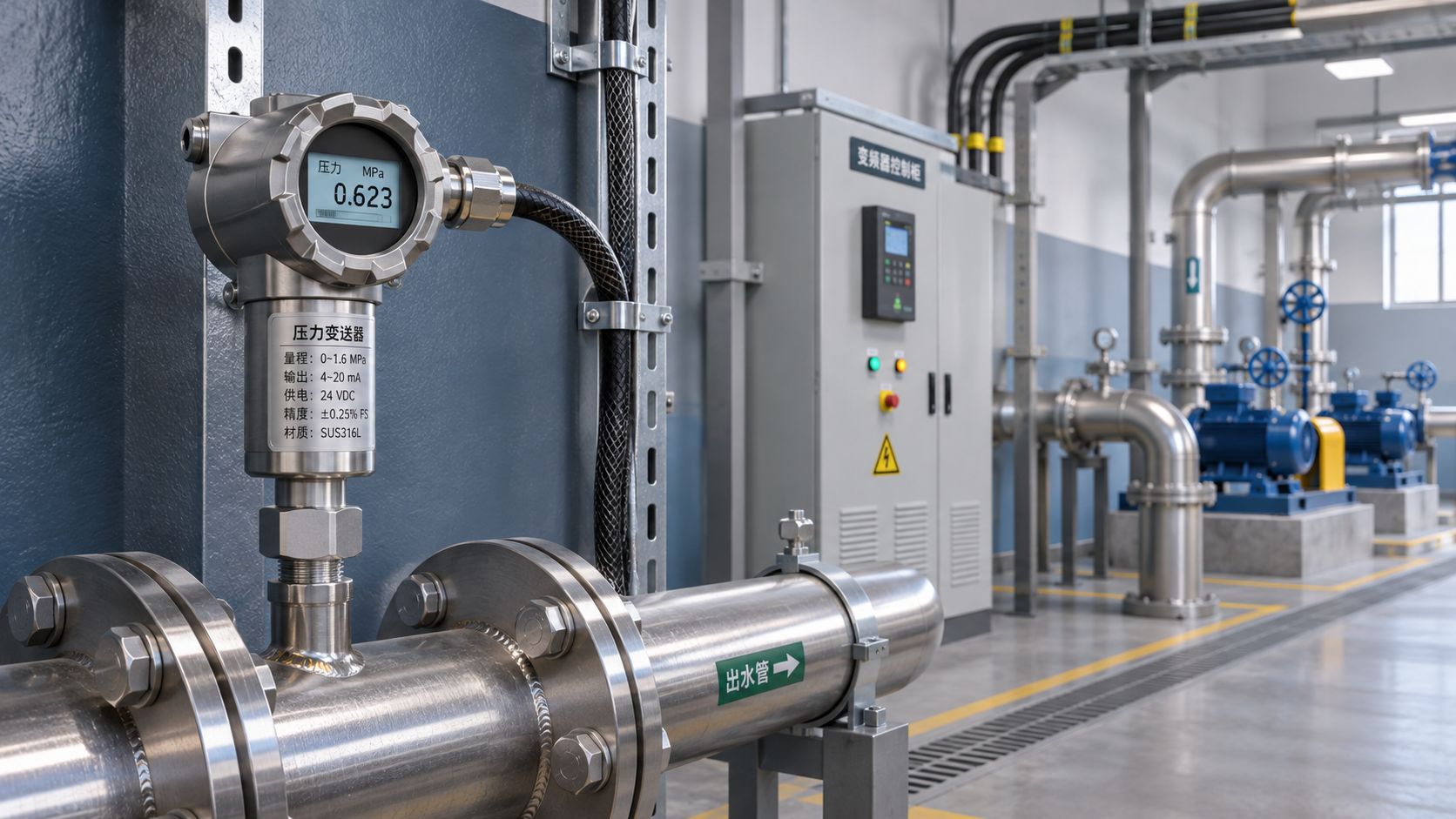
 Unstable Signals Near a Variable Frequency Drive? Key Selection Considerations for an EMI-Resistant Pressure Transmitter
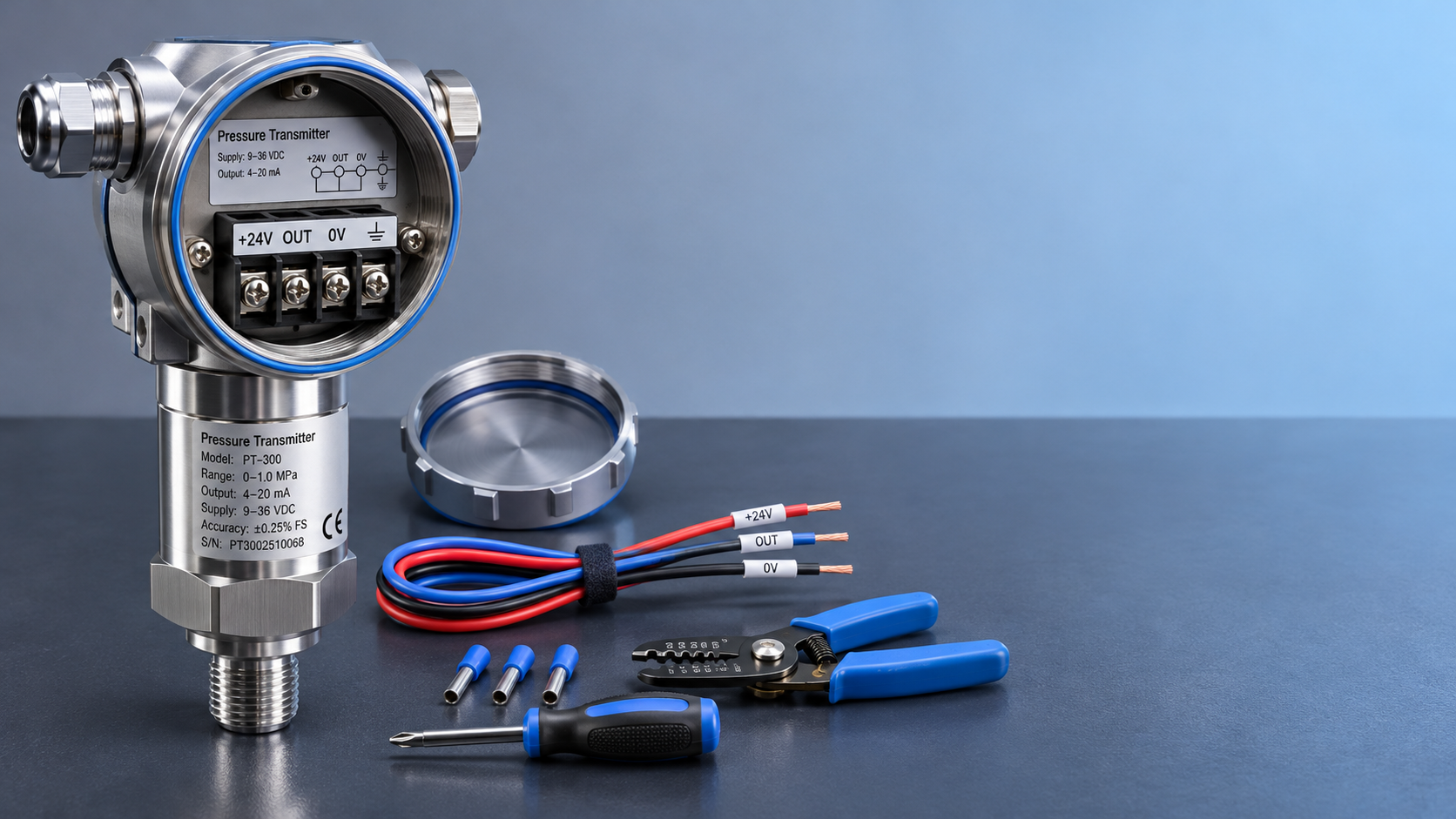
 How to wire a 24 VDC pressure transmitter: two-wire vs. three-wire configurations