


News Center
—— NEWS CENTER ——
Xi'an Shenghongchuang Instrument Co., Ltd.
Contact: Mr. Zhang
Mobile: 15529283736
Email: shc-sensor@qq.com
Address: Fortune Building, Sanqiao Street, Xixian New Area, Xi'an, Shaanxi Province
For Food Flow Meters in Shaanxi, First Verify Whether Wetted Parts Are Traceable
For flow meters used in food production, it is not enough to check whether the housing is made of stainless steel, nor should compliance be judged solely by "food-grade" claims. The parts that actually come into contact with media such as food, beverages, dairy products, seasoning liquids, and syrups—including measuring tubes, linings, electrodes, sealing rings, flange sealing faces, and sampling connections—should all be verified separately.
To determine whether the materials of a food flow meter in Shaanxi meet requirements, the first step is to request a list of wetted-part materials from the supplier and verify each item against the product nameplate, technical agreement, drawings, and factory documentation. If the documents only state "all stainless steel" without specifying the grade, lining type, and seal material, the purchaser should seek further confirmation to prevent materials of non-wetted components from being used to describe wetted materials.
For operating conditions with high hygiene requirements, material documentation should be traceable to raw material batches. Material certificates, heat numbers, chemical composition reports, processing records, and finished-product inspection records can generally be reviewed. A complete traceability chain helps food companies quickly identify sources of risk during equipment acceptance, quality audits, and subsequent maintenance.
Xi'an Shenghongchuang Instrumentation Co., Ltd. and its production base, Shaanxi Qinkong Sensor Technology Co., Ltd., can assist users in defining wetted-part configurations during the selection of food flow meters and related industrial measurement and control products, based on medium characteristics, cleaning methods, temperature and pressure, and installation structure, thereby reducing corrosion, scaling, or measurement drift caused by improper material selection.
Verify Stainless Steel Grades; Do Not Judge by Appearance Alone
Common metallic wetted materials for food flow meters include SUS304, SUS316, and SUS316L stainless steel. Among them, 304 stainless steel is suitable for most conventional drinking water, juice, edible oil, and neutral food media; for conditions involving salt content, relatively strong weak acidity, or frequent chemical cleaning, 316L generally provides better resistance to pitting and corrosion.
The "L" in 316L usually indicates a lower carbon content, and its corrosion resistance stability in welded areas is relatively more suitable for hygienic piping. For welded measuring tubes, clamp-connected short pipes, and customized flow sensors, in addition to confirming the base material grade, attention should also be paid to whether weld areas have been properly treated to avoid gaps or corrosion risks that could affect cleaning performance.
Handheld alloy analyzers can be used on site for preliminary screening of metal surfaces, with particular attention to indicators such as chromium, nickel, and molybdenum. However, this method is more suitable for incoming-material verification and cannot replace original manufacturer material certificates. For bulk procurement projects, sampling inspections can be conducted by batch, for example, by selecting 3 to 5 pieces from each batch for grade reinspection and retaining test records.
It should be noted that stainless steel does not necessarily mean suitability for food media. If the medium contains a high concentration of chloride ions, or if chlorine-containing disinfectants are used on the production line over a long period, ordinary 304 material may experience pitting corrosion. In such cases, the medium formulation, cleaning concentration, residence time, and temperature should be considered to determine whether an upgrade to 316L or another more suitable wetted-part solution is needed.
Linings, Electrodes, and Seals Are Key Materials for Food Flow Sensors
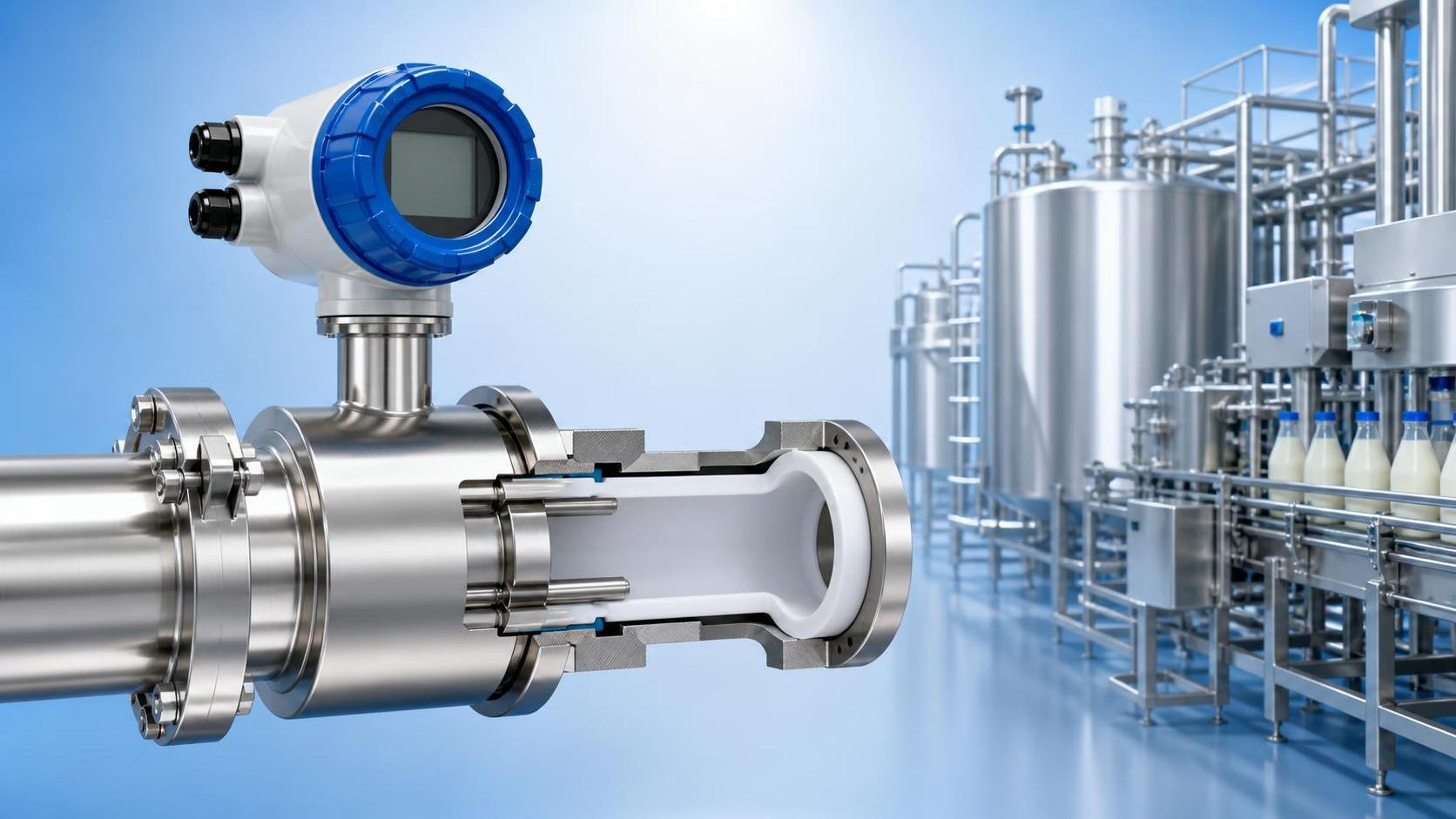
Electromagnetic flow meters are widely used in the food industry, and their measuring tube linings, electrodes, and seals come into direct contact with the medium. Even if the metal tube body uses 316L, a lining or sealing ring that does not meet food-contact requirements may still affect hygienic safety, temperature resistance, and equipment service life. Therefore, non-metallic wetted materials must be included in the acceptance scope.
Common lining materials include PTFE, PFA, rubber, and polyurethane. In food liquid flow measurement, PTFE is widely used due to its resistance to acids, alkalis, chemical media, and its broad temperature range; for highly abrasive slurries or particulate media, the wear resistance and hygienic properties of the lining, as well as its compatibility with the flow meter measurement principle, need to be considered comprehensively.
Common seal materials include EPDM, FKM, silicone rubber, and PTFE-encapsulated seals. Different rubber materials vary in their suitability for high-temperature steam, oils and fats, acid-alkali cleaning solutions, and alcohol-based media. When purchasing food flow meters, the seal material, hardness, maximum temperature resistance, and food-contact compliance documents should be specified in the technical agreement rather than assuming the use of general-purpose sealing rings.
Electrode material also affects long-term stability. 316L electrodes can meet the measurement requirements of most conductive food liquids, but for high-salinity, acidic, or media with special electrochemical properties, electrode corrosion risks should be assessed. If pitting, discoloration, scaling, or zero-point fluctuations appear on electrode surfaces, medium compatibility should be checked promptly rather than resolving the issue only through recalibration.
Confirm Compliance Documentation for Food-Contact Materials
Compliance of wetted parts in food flow meters should be assessed with reference to relevant food-contact material requirements. Purchasers may request suppliers to provide declarations of compliance, test reports, or third-party testing documents corresponding to wetted materials, and verify whether the sample name, material model, test items, and actual product configuration in the documents are consistent.
For metallic wetted parts, the applicability of GB 4806.9-2023, National Food Safety Standard: Metal Materials and Products for Food Contact, can be considered; the overall principles may refer to GB 4806.1, National Food Safety Standard: General Safety Requirements for Food-Contact Materials and Articles. For non-metallic linings and seals, the applicable food-contact compliance basis should also be confirmed according to the specific material category.
It is important to distinguish that material compliance documents are not equivalent to qualified overall equipment performance. Material reports address whether "contact with the medium is safe and whether the material meets agreed requirements," while flow meter verification or calibration certificates address whether "measurement errors meet requirements." Both types of documents should be filed together and cannot replace one another.
If food companies export products, or if production lines need to meet specific customer audit requirements, it should also be clarified before ordering whether FDA, EC 1935/2004, 3-A, or other specified documentation is required. Requirements for material certification, hygienic construction, and document language may vary by market; confirming these in advance can prevent repeated replacement of wetted components after equipment installation.
Surface Treatment and Hygienic Design Determine Whether Cleaning Is Thorough
Material compliance for food flow meters involves not only whether chemical composition meets requirements, but also whether surface quality satisfies hygienic cleaning conditions. When the inner wall of the measuring tube is rough or has scratches, weld beads, dead legs, or obvious color variations, food residues are more likely to adhere. Over long-term operation, this may create a risk of microbial growth and also affect flow signal stability.
For food production lines requiring CIP cleaning or SIP steam sterilization, particular attention should be paid to whether flow sensors have smooth flow paths, low-retention structures, and suitable hygienic connection types. Clamp connections generally facilitate disassembly and cleaning, but their actual suitability still depends on pipe diameter, pressure rating, system vibration, and process hygiene level.
Surface roughness is one of the key indicators for assessing processing quality. For metallic wetted surfaces with high hygiene requirements, internal surface roughness requirements can be specified in the technical agreement, for example, Ra not exceeding 0.8 microns; for dairy products, biological fermentation, or highly clean production processes, more stringent polishing and passivation requirements can be established based on the process.
During on-site acceptance, visual inspection, flashlight side-light inspection, and endoscopic inspection can be used in combination to observe whether wetted flow paths contain welding slag, pits, scratches, coating peeling, or residues. For sensor cavities that cannot be directly observed, the supplier should provide structural descriptions, welding process records, and factory inspection documentation as supplementary evidence.
Consider the Actual Combination of Temperature, Pressure, and Cleaning Media
A common misconception among food companies is to look only at the maximum temperature rating marked on the flow meter. For example, a device rated for 150 degrees Celsius does not mean that it can withstand the combined effects of 150 degrees Celsius steam, alkaline solution, and pressure cycles over the long term. Linings, sealing rings, and adhesive structures are often the weak links that determine actual resistance capability.
In CIP processes, cleaning solutions may be acidic solutions, alkaline solutions, or disinfectants, with temperatures commonly ranging from 60 degrees Celsius to 90 degrees Celsius; if an SIP process is configured, short-term steam temperatures may be higher. Users should provide the flow meter manufacturer with cleaning medium concentration, circulation time, maximum temperature, maximum pressure, and annual cleaning frequency to enable targeted material matching.
For food media containing sugar, oil, fiber, or having high viscosity, attention should also be paid to whether flow velocity may cause deposition. Generally, excessively low flow velocity can easily cause wall adhesion and residue, while excessively high flow velocity may increase pressure loss, erosion, and vibration. The flow meter diameter should be determined according to the actual flow range rather than simply selected based directly on the existing pipe diameter.
In addition to the material itself, installation orientation also affects hygienic performance. For media prone to deposition, low points that cannot be completely drained should be avoided; for hygienic piping, cleaning solution should be able to fully cover wetted areas. After installation, trial operation and cleaning validation should be performed, and the equipment should only be put into mass production after confirming stable zero point, no leakage, and no abnormal pressure loss.
Establish Incoming Acceptance and Operational Reinspection Mechanisms to Avoid Deferring Material Risks
After food flow meters arrive, it is recommended that equipment, process, quality, or procurement personnel jointly complete acceptance. Acceptance should cover product model, diameter, pressure rating, wetted materials, connection method, seals, accuracy class, power supply and output, and accompanying documents. For customized models, the signed technical agreement should serve as the primary basis for assessment.
It is recommended to designate "whether wetted material certificates are complete" as a mandatory incoming acceptance inspection item and retain document numbers in association with equipment tag numbers. For products with different diameters such as DN25, DN50, and DN80, as well as linings and seals from different batches, mixing due to similar appearances should be avoided. Label identification, batch records, and segregated spare-parts management can all reduce subsequent maintenance risks.
After commissioning, reinspection intervals should be established according to the production schedule. In daily operation, check whether displayed values are stable, whether there is leakage at flanges or clamps, and whether zero-point abnormalities occur after cleaning; during shutdown maintenance, inspect lining aging, seal compression deformation, electrode scaling, and flow-path corrosion. If abnormalities are found, priority should be given to investigating the compatibility between materials and the medium.
For newly built or upgraded food production lines, flow meter selection should be brought forward to the process design stage wherever possible. After clarifying the medium name, conductivity, temperature, pressure, viscosity, cleaning method, connection standard, and hygiene grade, determining the sensor material and model can reduce the cost of later equipment replacement caused by an inability to withstand operating conditions.
Food Flow Meter Material Acceptance Checklist
During acceptance, six items can be checked as priorities: whether the wetted metal grade is clearly specified, whether the lining model corresponds, whether the sealing ring material is indicated, whether the electrode material is suitable, whether food-contact compliance documents are complete, and whether surfaces and welds meet hygienic cleaning requirements. Only after these six items form a closed loop can material assessment be more reliable.
The same set of material solutions cannot be applied to different media such as yogurt, juice, sauces, syrups, edible oils, alcoholic beverages, and condiments. Especially under conditions involving acid-alkali cleaning, high-temperature disinfection, salt-containing formulations, and high-frequency production simultaneously, 316L, PTFE, and suitable sealing materials should be assessed as part of a systematic selection process.
When purchasing flow meters, food companies in Shaanxi may submit the medium composition, flow range, pipe diameter, operating temperature, operating pressure, cleaning parameters, and required document list to Xi'an Shenghongchuang Instrumentation Co., Ltd. Technical personnel can then confirm wetted materials, sensor structure, and supporting instrument solutions based on the specific production-line operating conditions.
Before signing an order, it is recommended to specify item by item in the technical agreement the 304 or 316L grade, PTFE or other lining type, seal material, hygienic connection type, material certificates, and factory test documents. Only through "traceable documents, verifiable materials, matched operating conditions, and reinspectable operation" can it be determined more accurately whether food flow meter materials truly meet requirements.
Related Recommendations
 Why do Xi'an natural gas flowmeters emphasize explosion-proof requirements?
 How to Determine Whether the Material of a Shaanxi Food Flowmeter Meets Standards?
 Is a higher accuracy Xi'an high-precision flowmeter always worth choosing?
 How to calibrate measurement results of a Shaanxi handheld flowmeter?