


News Center
—— NEWS CENTER ——
Xi'an Shenghongchuang Instrument Co., Ltd.
Contact: Mr. Zhang
Mobile: 15529283736
Email: shc-sensor@qq.com
Address: Fortune Building, Sanqiao Street, Xixian New Area, Xi'an, Shaanxi Province
The radar level gauge reflector is not a universal accessory, yet in critical operating conditions it often determines whether the measurement results remain stable. When faced with low-dielectric-constant media, strongly agitated liquid surfaces, narrow tanks, or installation environments with complex internal components, the echo signal is prone to weakening, shifting, or interference. In such cases, the radar level gauge reflector is no longer an optional accessory, but a practical solution for improving the signal path and enhancing measurability. For sensor selection and on-site retrofitting, understanding its role is more important than simply looking at instrument parameters.
First, let’s understand what problem the reflector is intended to solve
A radar level gauge determines liquid level by emitting microwaves and receiving echoes. Under ideal conditions, the beam is transmitted from the antenna, reflected after hitting the liquid surface, and then the instrument completes the calculation based on the time difference.
The problem is that many field conditions are far from ideal. Liquid surface fluctuations, foam coverage, steam interference, internal tank beams, nozzles, ladders, and wall attachments can all cause the echo to become distorted.
The core function of a radar level gauge reflector is to help the microwave form a clearer reflection path, reduce scattered echoes, improve effective echo strength, and thus make the liquid level curve more stable and the blind-zone judgment clearer.
Simply put, it does not replace the radar level gauge itself, but provides a “measurement condition correction” for complex field environments. When the installation position cannot be optimized, a reflector is often more direct than repeatedly adjusting parameters.
Why this component has attracted more attention in recent years
On the one hand, field processes are becoming more complex. Storage tanks, reaction kettles, and metering tanks now involve more media types and more internal components, so relying solely on free-space reflection may not be sufficient for stability.
On the other hand, automated systems place higher demands on continuous measurement. Liquid level signals are not only used for display, but may also participate in interlocking, batching, alarm, and energy-consumption management.
Xi'an Shenghongchuang Instrument Co., Ltd. has long served pressure, flow, displacement, weighing, temperature and humidity, and other sensor scenarios. In actual projects, one rule is often seen: measurement problems do not necessarily come from the instrument itself; the installation structure also determines data quality.
This is also why radar level gauge reflectors are frequently discussed. They belong to structural optimization components, yet directly affect the availability, false alarm rate, and maintenance frequency of the sensor system.
What practical effects does a radar level gauge reflector have
Enhances weak echoes
When the medium dielectric constant is low, the liquid surface has insufficient reflectivity to microwaves, and the returned signal is weak. The radar level gauge reflector can improve beam utilization and help the instrument capture effective echoes.
Suppresses false echoes
In narrow spaces, microwaves may hit the tank wall, flange, or support components. By guiding the direction, the reflector reduces multiple reflections and edge interference, making false level points less likely to appear.
Improves wave-turbulent liquid surface recognition
When stirring, feed impact, or surface rolling occurs, the echo peak changes continuously. The radar level gauge reflector can make the receiving conditions more focused, which is especially helpful for continuous measurement.
Reduces errors caused by installation constraints
Some tanks cannot install the instrument at the geometric center, and obstacles cannot be avoided. In such cases, adding a radar level gauge reflector is essentially compensating for constrained installation space.
Which installation environments usually require one
Not every project needs a reflector, but the following environments should usually be prioritized, and in some cases should be listed as mandatory during the solution stage.
The most easily overlooked item is “limited installation space.” Many abnormal situations on site are not caused by complex media, but by an excessively long nozzle, an offset opening position, or nearby obstacles.
Not all abnormalities can be solved by a reflector
A radar level gauge reflector is valuable, but it is not a universal solution. If antenna selection is wrong, frequency does not match, measuring range is exceeded, or the medium crystallizes severely, the effect of only adding a reflector is limited.
In practical use, a more stable judgment sequence should be: first check the medium characteristics, then the tank structure, then the installation method, and finally determine whether a reflector is needed and what size, material, and position it should have.
If the site also involves pressure, temperature, or process interlock control, it is recommended to check the configuration of other sensors at the same time. For example, in high-temperature, high-pressure medium systems, pressure signals outside the liquid level also affect process judgment.
Such scenarios can refer to huba510 universal pressure transmitter for water, oil, and gas pressure sensing, which features a 316L stainless-steel isolation diaphragm structure, 4-20mA and multiple voltage output options, and a 12-36VDC wide-voltage power supply mode, making it more suitable for forming a complete process measurement loop together with liquid level monitoring.
When evaluating a project, focus on these judgment dimensions
- Whether the medium dielectric constant is relatively low, and whether there has historically been signal loss in the middle or late range.
- Whether the liquid surface fluctuates for a long time, and whether there is stirring, feed inlet impact, or return-flow impact.
- Whether the inlet size, nozzle length, or opening direction affects beam dispersion.
- Whether fixed internal components exist in the tank, and whether they cannot be avoided through hole adjustment or position shifting.
- Whether after instrument debugging there are still obvious false echoes, jump changes, or empty-tank misidentification.
- Whether on-site maintenance conditions are limited, and whether the frequency of repeated later debugging needs to be reduced.
If two or more of the above factors occur at the same time, the radar level gauge reflector should usually be included in the formal solution rather than being added as a remedy after commissioning.
From a systems perspective, the reflector is part of the installation solution
In many projects, selection and installation are often viewed separately, resulting in instrument parameters that seem sufficient while on-site performance remains unstable. For liquid level measurement, the radar level gauge reflector is essentially part of the system design.
This is especially true in petroleum, chemical, power, environmental protection, shipbuilding, and similar operating conditions, where process variables are interrelated. Liquid level, pressure, temperature, and flow often need to be checked together, so single-point optimization has limited significance.
For example, in high-temperature or corrosive medium systems, in addition to liquid level echo quality, it is also necessary to confirm whether the pressure transmitter’s medium resistance, signal type, and installation interface are compatible. Products like huba510, with a measurement range covering -0.1~100MPa and supporting M20×1.5, G1/2, G1/4 and other interface forms, are more suitable as reference for coordinated measurement configurations.
After arriving at the site, how should the next step be judged
If you are evaluating a new project, first sort out the medium properties, tank structure drawings, and installation port location, and then determine whether there is a risk of low echo or strong interference.
If it is a retrofit project, you can first review the historical trend curve. As long as the liquid level value frequently jumps, the empty span is unstable, or the error near the full-scale range is amplified, the radar level gauge reflector should be included in the inspection.
A more stable approach is to compare the reflector, antenna form, installation nozzle, and false-echo suppression parameters together, rather than deciding on a single component in isolation. This leads to judgments that are closer to real operating conditions and also benefits long-term operation later on.
Related Recommendations
 What Is the Difference Between Pressure Transmitter Manufacturers and Suppliers? A Complete Guide for Procurement Professionals
 What Cooperation Models Are Suitable for Pressure Transmitter Sales Manufacturers? An Analysis of Distribution, Direct Procurement, and Project Support
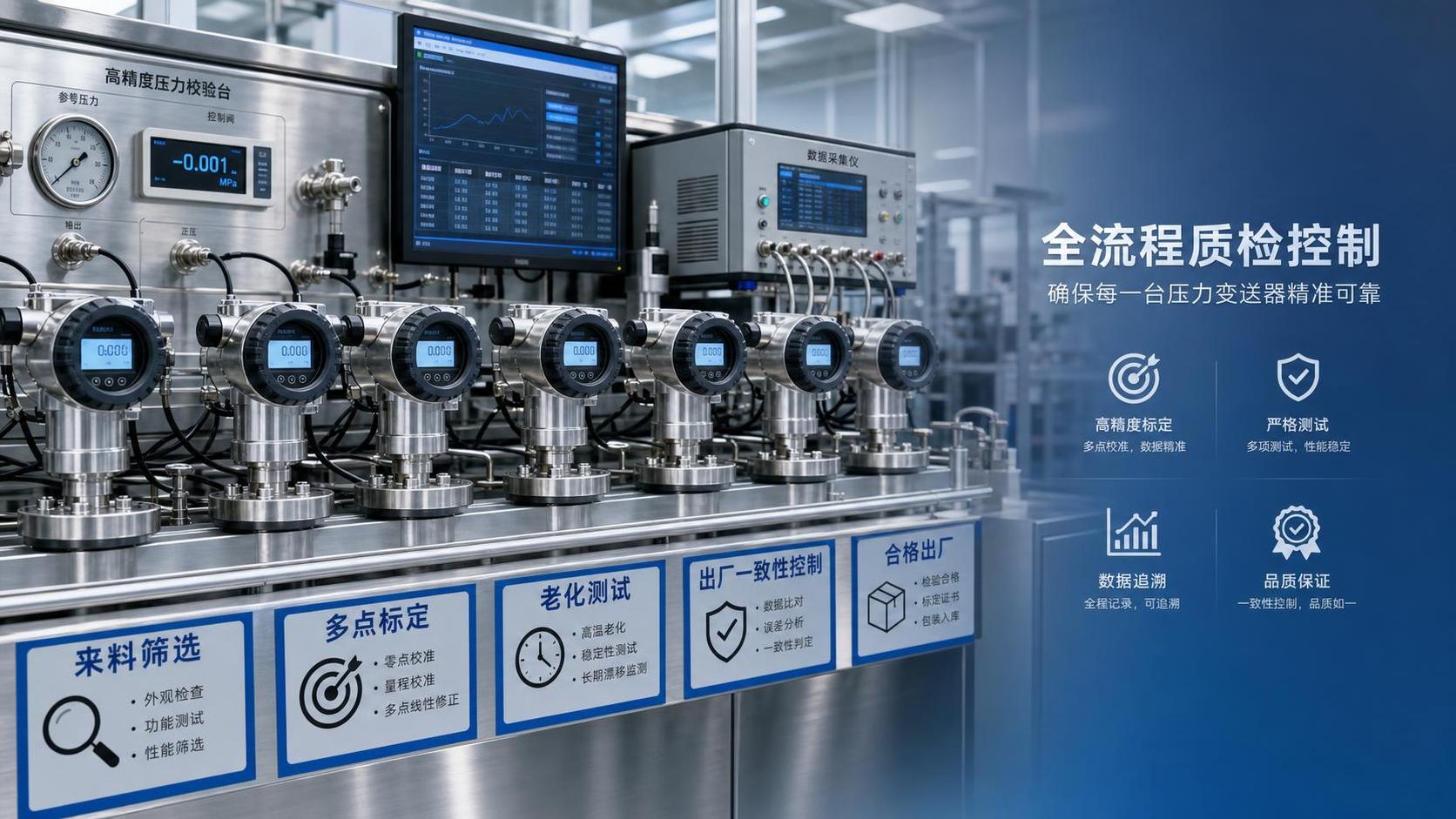
 How Does a Pressure Transmitter Manufacturer Ensure Consistency? A Look at the Full Process from Incoming Materials to Final Testing
 There are so many pressure transmitter brands on the market. Understand the differences between brands before making your selection