News Center
—— NEWS CENTER ——
Xi'an Shenghongchuang Instrument Co., Ltd.
Contact: Mr. Zhang
Mobile: 15529283736
Email: shc-sensor@qq.com
Address: Fortune Building, Sanqiao Street, Xixian New Area, Xi'an, Shaanxi Province
Preparation Work Before Installing the LED-900 Pressure Transmitter
As a core component in industrial process control, the installation quality of the LED-900 pressure transmitter directly affects measurement accuracy and equipment service life. The technical team of Xi'an Shenghongchuang Instrument Co., Ltd. recommends that contractors focus on checking three key aspects before construction: first, confirm media compatibility, as the 316 stainless steel diaphragm of the diffused silicon HSM pressure sensor must match the chemical properties of the measured medium; second, verify thread specifications, as common interfaces such as M20×1.5 and G1/2 must strictly correspond to pipeline dimensions; finally, verify the supply voltage, ensuring power stability within the 9~36VDC range.
The preparation of professional tools is equally critical, and a torque wrench (recommended range 5~50N·m), sealing tape (PTFE material is preferred), and a multimeter should be fully prepared. For hydraulic system installations, special attention should be paid to installing a pulse damper at the pressure port, which can effectively reduce the impact of medium pulsation on the sensor chip. For high-precision devices such as the PT3050 General-Purpose Pressure Transmitter, attention should also be paid to ambient temperature compensation during installation, and it is recommended to reserve at least 10% safety margin within the -20~+85℃ range.
Technical Points for Selecting the Installation Location
According to the ISO 2186 standard, the installation position of the pressure transmitter should follow the "three avoidance principles": avoid mechanical vibration sources (such as areas 3 meters away from pumps and valves), avoid zones with abrupt temperature changes (at least 1.5 meters from heat sources), and avoid medium vortex areas (it is recommended to install at the downstream 5D position of a straight pipe section). For level measurement applications, the diffused silicon HSM pressure sensor must be installed vertically on the side wall of the container, keeping a distance of ≥100mm from the bottom to prevent sediment from clogging the pressure port.
Electrical Connection Specifications for the LED-900 Pressure Transmitter
Electrical connection is the key link to ensuring stable signal transmission. When wiring a two-wire 4~20mA output, the positive power terminal (connected to the brown wire) and the signal output terminal (connected to the blue wire) must be strictly distinguished, and the shielding layer must be grounded at one end only. It is recommended to use twisted shielded cable with a cross-sectional area of ≥1.5mm², and maintain a spacing of more than 30cm from power cables during wiring to reduce the risk of electromagnetic interference.
For applications requiring on-site display, models with an LCD head can be selected, such as the intelligent digital display version of the PT3050 series. Attention should be paid to its wiring: the 24VDC supply voltage fluctuation must not exceed ±5%, and when using three-wire wiring, the black ground wire must be connected to the equipment grounding terminal. Special reminder: after all electrical connections are completed, use a megohmmeter to measure insulation resistance, and the normal value should be ≥100MΩ (under a 500VDC test voltage).
Parameter Calibration Procedure During the Commissioning Stage
Before commissioning, three key calibrations must be completed: zero calibration (adjust the ZERO potentiometer under no-load condition so that the output is 4mA), span calibration (apply full-scale pressure and adjust the SPAN potentiometer to 20mA), and linearity verification (test nonlinear error at 25%, 50%, and 75% of the measuring range). For temperature drift compensation of the diffused silicon HSM pressure sensor, it is recommended to use the five-point calibration method, that is, compensation correction at five temperature points: 0℃, 25℃, 50℃, 70℃, and 85℃.
Actual commissioning data show that sensors using 316 stainless steel diaphragms can achieve annual stability of ±0.1%FS in petrochemical applications. After commissioning is completed, it is recommended to seal the calibration potentiometer with red marking paint and retain complete calibration record documents, which are crucial for subsequent equipment maintenance and ISO audits.
Common Fault Diagnosis and Solutions
When abnormal output signals occur, troubleshooting can be carried out according to the following process: the first step is to measure the supply voltage (normal value 24±10%VDC), the second step is to check the loop current (it should be 4±0.1mA under no-load conditions), and the third step is to perform a pressure release test (after rapid depressurization, the output should return to zero within ±0.5%). Among common faults, medium crystallization issues can be solved by installing an isolation diaphragm, while damage caused by lightning requires checking whether the lightning protection module has failed.
For applications requiring a higher protection rating, models with an IP65 protective enclosure may be considered. Technical statistics from Xi'an Shenghongchuang Instrument indicate that properly installed diffused silicon sensors can achieve a mean time between failures (MTBF) of 80,000 hours, but attention should be paid to the following regular maintenance points: check sealing component aging every 6 months; calibrate zero drift once a year; replace moisture-proof silica gel every 3 years.
Special Considerations for Industry Applications
Different industries have specific requirements for pressure transmitters: the petrochemical industry needs to pay attention to explosion-proof certification (such as Ex d IIC T6); power station applications require electromagnetic interference resistance to meet the EN 61000 standard; while the food and pharmaceutical industries need to comply with 3-A sanitary certification. For multifunctional devices such as the PT3050 General-Purpose Pressure Transmitter, when used in building automation systems, it is recommended to enable its ±8% zero adjustment function to adapt to water pressure differences on different floors.
Summary and Professional Recommendations
The standardized use of the LED-900 pressure transmitter includes systematic installation procedures, precise electrical connections, scientific commissioning methods, and preventive maintenance strategies. As a professional pressure sensor manufacturer, Xi'an Shenghongchuang Instrument Co., Ltd. recommends that contractors establish complete equipment files and record the vibration spectrum analysis data of each maintenance session, which has important reference value for predicting sensor service life.
If you need customized solutions or technical support, please feel free to contact our engineering team. We provide full-process services from model selection guidance to on-site commissioning to ensure that your flow control system reaches its optimal operating condition. Call now to obtain the latest collection of industry application cases and learn about the performance of diffused silicon HSM pressure sensors under different working conditions.
Related Recommendations
![]() Southchip Technology Launches Its First Optical Sensor, the SC52115, for Wearable Devices
Southchip Technology Launches Its First Optical Sensor, the SC52115, for Wearable Devices How does a pressure sensor convert changes in applied force into usable electrical signals?
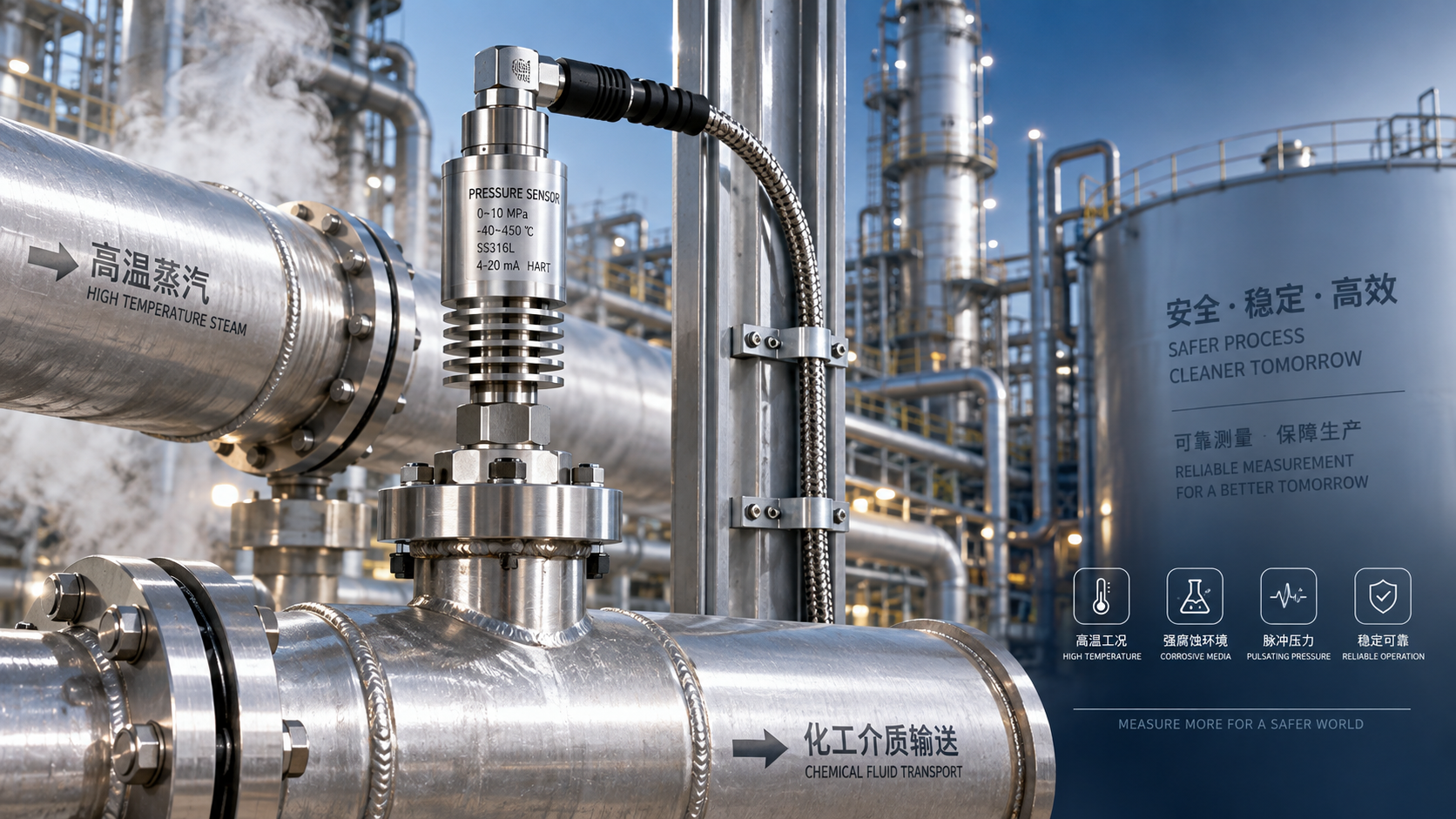
 Which parameters should be considered when selecting pressure sensors for high-temperature, corrosive, and pulsating operating conditions?
 Hydraulic equipment pressure fluctuates frequently. How can sensors be configured to improve control stability?