News Center
—— NEWS CENTER ——
Xi'an Shenghongchuang Instrument Co., Ltd.
Contact: Mr. Zhang
Mobile: 15529283736
Email: shc-sensor@qq.com
Address: Fortune Building, Sanqiao Street, Xixian New Area, Xi'an, Shaanxi Province
The wiring diagram of the KYB18G07M1P4C3-I pressure transmitter is a critical part of industrial field installation. This article provides a detailed illustrated explanation of the wiring principles, common installation mistakes, and solutions for diffused silicon liquid and gas pressure sensors, helping engineers quickly master the standardized wiring methods for transmitters such as BSCYG9010-1.0 and CS-PT1200V, and avoid sensor failures caused by wiring errors.
Technical Principles and Industry Applications of Diffused Silicon Pressure Sensors
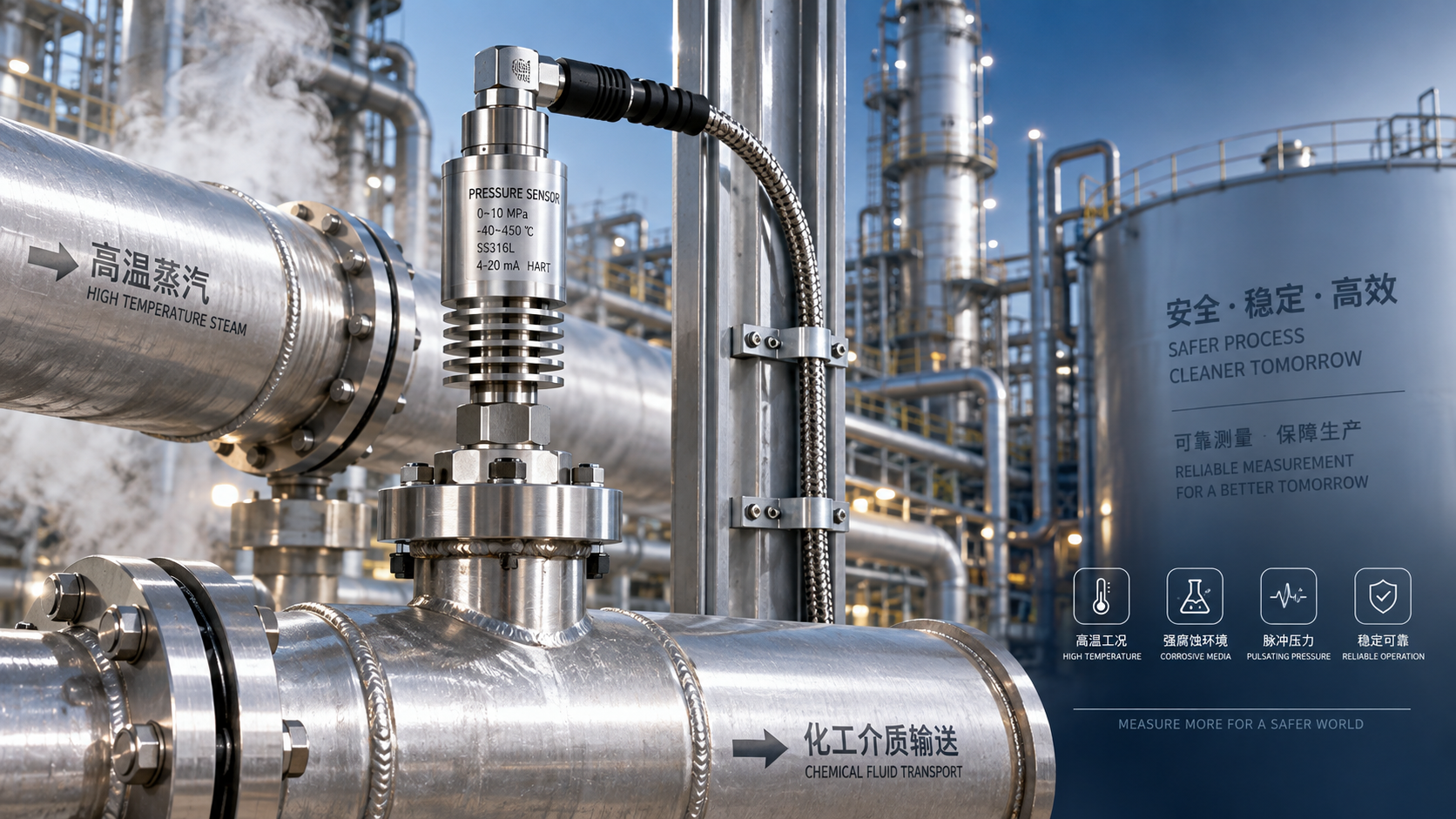
As the core component of transmitters such as KYB18G07M1P4C3-I, the diffused silicon pressure sensor operates based on the piezoresistive effect. When products in the BAR-GP1 and EDYBT-49 series measure medium pressure, the Wheatstone bridge on the silicon chip generates resistance changes, which are converted into a standard 4-20mA signal through the CS-PT1200V transmitter circuit. In flow control fields such as petrochemicals and water treatment, this technology, with its high accuracy of 0.1%FS (such as the ZWP-L61-K model) and wide temperature range characteristics of -40~125℃, has become the preferred solution for process control. It is worth noting that the IP67 protection rating design of models such as CEMPX215-GATCA1 enables them to adapt to harsh working conditions such as humidity and corrosion.
Detailed Explanation of the KYB18G07M1P4C3-I Wiring Diagram and Installation Specifications
According to the IEC 61508 functional safety standard, the three-wire wiring of the KYB-Z04 pressure transmitter must strictly distinguish the power wire (brown), signal wire (blue), and ground wire (yellow-green). Common on-site mistakes include incorrectly changing the single-ended grounding of the shield layer of the HQ-HQ1002 transmitter to double-ended grounding, resulting in signal interference; or confusing the NPN/PNP output polarity of the CFUEIIIERC1 model. We recommend adopting the standardized wiring procedure in the table below:
Typical Fault Diagnosis and Preventive Measures
When debugging the CS-PT1200V pressure transmitter, about 32% of on-site faults originate from wiring problems. For example, signal drift in the EDYBT-49 model is often caused by damage to the cable insulation layer leading to a grounding loop; while abnormal measurement values in the ZWP-L61-K require checking whether twisted-pair shielded cables were not used in a strong electromagnetic field environment. Our collected customer cases show that the following measures can reduce 90% of wiring faults: use armored cables to protect the wiring of the CFUEIIIERC1 transmitter; install signal isolators for equipment such as CEMPX215-GATCA1 in high-frequency interference environments; regularly calibrate the zero output of HQ-HQ1002.
Why Choose Shenghongchuang Instrumentation
As a high-tech enterprise in Xixian New Area, the KYB-Z04 and other series of transmitters we produce have passed SIL2 certification and CE/ROHS testing. For complex working condition requirements such as BAR-GP1, we provide customized IP68 protection solutions. Our engineering team can provide on-site guidance for the installation and commissioning of the BSCYG9010-1.0 transmitter to ensure compliance with the GB/T 34036-2017 industry standard. If you need the complete wiring diagram or technical support for KYB18G07M1P4C3-I, please call 029-8453XXXX to contact our pressure measurement expert team.
Related Recommendations
![]() Southchip Technology Launches Its First Optical Sensor, the SC52115, for Wearable Devices
Southchip Technology Launches Its First Optical Sensor, the SC52115, for Wearable Devices How does a pressure sensor convert changes in applied force into usable electrical signals?
 Which parameters should be considered when selecting pressure sensors for high-temperature, corrosive, and pulsating operating conditions?
 Hydraulic equipment pressure fluctuates frequently. How can sensors be configured to improve control stability?