News Center
—— NEWS CENTER ——
Xi'an Shenghongchuang Instrument Co., Ltd.
Contact: Mr. Zhang
Mobile: 15529283736
Email: shc-sensor@qq.com
Address: Fortune Building, Sanqiao Street, Xixian New Area, Xi'an, Shaanxi Province
Introduction
Does installing the HDA4445-A-100-Y00 pressure transmitter seem complicated?This article guides you step by step through the correct installation process for a diffused silicon liquid and gas pressure sensor,covering general tips for models such as PD50-GB10CM20M4M、FST800211G3451-25B,so even beginners can quickly master the key operating points.
1、Preparations Before Installing a Diffused Silicon Pressure Transmitter
Before installing the HDA4445-A-100-Y00 pressure transmitter,adequate preparation is essential. First,check whether the packaging is intact and confirm that the product model matches the purchase order. The core components of a diffused silicon liquid and gas pressure sensor are highly precise,and any improper operation may reduce measurement accuracy. Operators are advised to wear an anti-static wrist strap to avoid electrostatic damage to sensitive components. At the same time,prepare the required installation tool kit,including suitable wrenches,sealing tape,a multimeter,etc.
Unlike similar models such as the STZ2-3 pressure transmitter,the HDA4445 series uses a unique 316 stainless steel housing,offering better corrosion resistance. Before installation,confirm that the medium temperature is within the range of -30~+85℃,otherwise the service life of the sensor may be affected. If you are using the domestic high-temperature pressure transmitter OT-831 diffused silicon pressure sensor,its medium temperature range can reach e+85℃,making it more suitable for high-temperature operating conditions.
2、Detailed Explanation of Standard Installation Steps
The first step is connecting the pressure port. The HDA4445-A-100-Y00 uses an M20×1.5 standard thread,and a sealing gasket must be used during installation to ensure airtightness. Similar to the PTG-PTG702 pressure transmitter,apply even force when screwing in the thread,as overtightening may deform the housing. The second step is the electrical connection. This model supports two-wire 4~20mA output,and the positive and negative poles must be distinguished during wiring. For operators who are not familiar with circuits,it is recommended to refer to the wiring diagram of the SAM-K pressure transmitter for comparison.
The third step is power-on testing. After connecting a 9~36VDC power supply,use a multimeter to check whether the output signal is within the normal range. If an abnormality is found,refer to the fault code manual of the CY-H pressure transmitter for troubleshooting. Special reminder:Pressure testing is strictly prohibited without seals installed,as this may cause medium leakage and damage the sensor components.
3、Common Installation Mistakes and Solutions
Many users report inaccurate measurement after installing the CPS-C pressure transmitter,and in fact 60% of the problems are caused by improper selection of the installation position. The pressure transmitter should be installed as close as possible to the measurement point to avoid signal delay caused by overly long impulse lines. The installation manual of the RC-RC301 pressure transmitter particularly emphasizes:In vibrating environments,a vibration-damping bracket must be used,which is consistent with the installation requirements of the HDA4445-A-250-Y00.
Another common mistake is ignoring temperature compensation. The zero point of a diffused silicon sensor changes with ambient temperature. Although the HDA4445 series has a built-in temperature compensation circuit,on-site calibration should still be performed according to the standard procedure for the FST800211G3451-25B pressure transmitter in environments with extreme temperature differences. After installation is completed,it is recommended to use the debugging software supplied with the PD50-GB10CM20M4M pressure transmitter to optimize parameters.
4、Maintenance and Troubleshooting
Regular maintenance can significantly extend the service life of a pressure transmitter. The housing sealing performance should be checked once a month,and the zero point should be calibrated once every quarter. If output signal fluctuations are found on the HDA4445-A-100-Y00,refer to the following troubleshooting process:check power supply stability→test line impedance→clean the pressure port→recalibrate. For more demanding industrial applications,it is recommended to choose products such as the domestic high-temperature pressure transmitter OT-831 diffused silicon pressure sensor,which offers stability up to ±0.1%FS/year.
When handling corrosive media,special attention should be paid to material compatibility. Although the HDA4445 uses 316 stainless steel,an isolation diaphragm is still required in strong acid and strong alkali environments. This point is explained in detail in the technical documentation of the PTG-PTG702 pressure transmitter. If the medium contains solid particles,a filter should be installed in the impulse line to prevent clogging of the pressure port.
5、Technical Q&A(FAQ)
6、Analysis of Industry Application Scenarios
In the petrochemical industry,the HDA4445-A-100-Y00 is commonly used for pipeline pressure monitoring,and its fast response feature(rise time ≤5ms)can detect pressure abnormalities in time. In building automation systems,the STZ2-3 pressure transmitter is more often used for constant-pressure water supply control. It is worth noting that in thermal power unit monitoring in the power industry,high-temperature products such as the OT-831 deliver better performance.
In the environmental protection field,sensor corrosion resistance requirements are extremely high,and the fully welded structure of the FST800211G3451-25B pressure transmitter shows clear advantages in this case. The food and pharmaceutical industries prefer the hygienic design of the SAM-K pressure transmitter,whose smooth surface is easy to clean and disinfect. Only by selecting a model suited to industry-specific requirements can optimal performance be achieved.
7、Why Choose a Professional Supplier
The accuracy and reliability of pressure transmitters directly affect the entire control system. A professional supplier can not only provide original genuine products such as PD50-GB10CM20M4M,but also recommend the optimal model based on your specific operating conditions(such as medium characteristics,ambient temperature,etc.). We provide full-chain services including technical consultation,installation guidance,and after-sales maintenance,ensuring that every HDA4445-A-100-Y00 pressure transmitter can deliver its designed performance.
For special application scenarios,we can provide customized solutions. For example,in locomotive braking systems,the RC-RC301 pressure transmitter with extremely strong vibration resistance is required;while for laboratory calibration applications,the CY-H pressure transmitter with accuracy up to class 0.25 is recommended. Contact our technical team now to obtain dedicated model selection advice and installation support.
Related Recommendations
![]() Southchip Technology Launches Its First Optical Sensor, the SC52115, for Wearable Devices
Southchip Technology Launches Its First Optical Sensor, the SC52115, for Wearable Devices How does a pressure sensor convert changes in applied force into usable electrical signals?
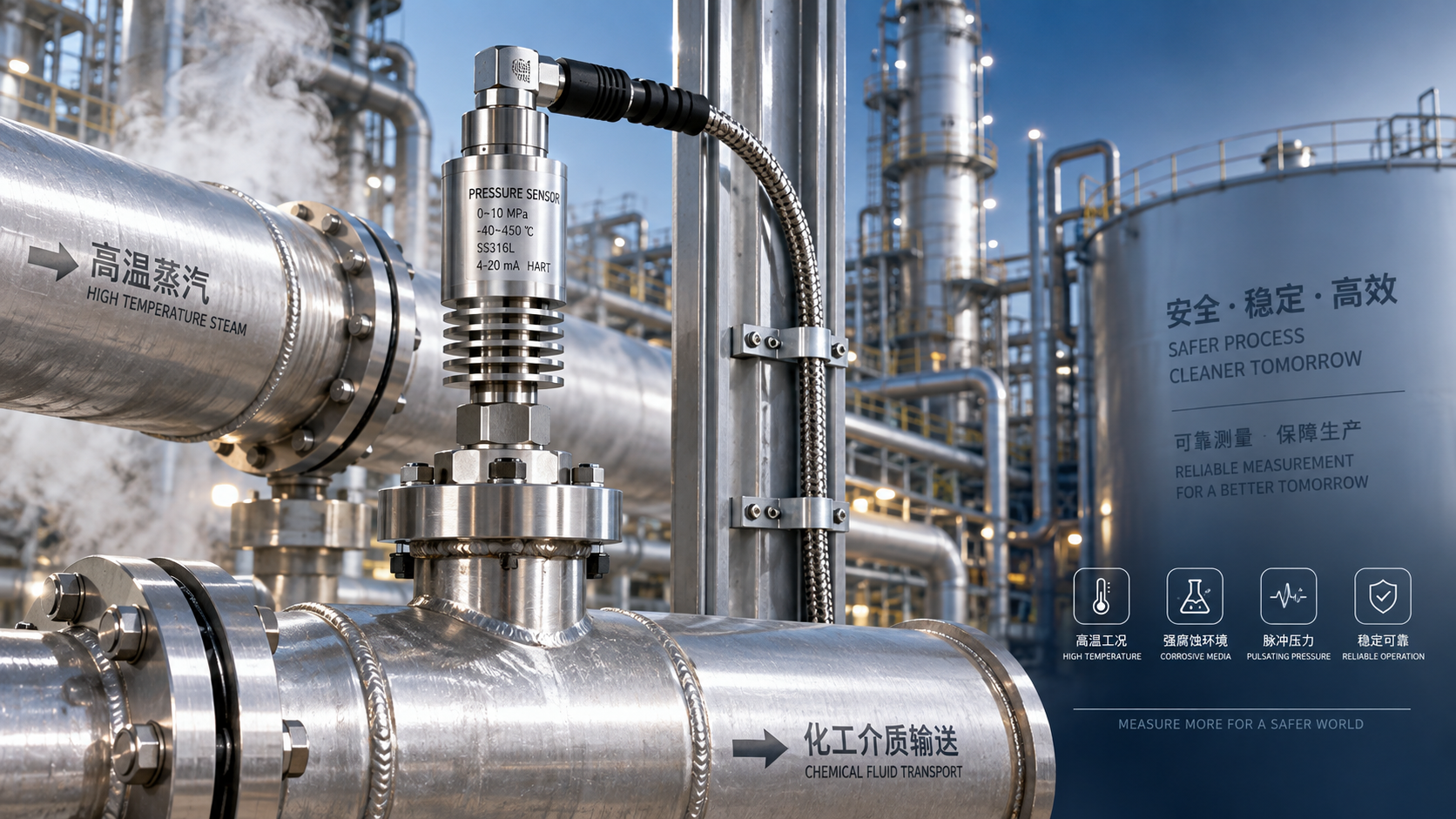
 Which parameters should be considered when selecting pressure sensors for high-temperature, corrosive, and pulsating operating conditions?
 Hydraulic equipment pressure fluctuates frequently. How can sensors be configured to improve control stability?