News Center
—— NEWS CENTER ——
Xi'an Shenghongchuang Instrument Co., Ltd.
Contact: Mr. Zhang
Mobile: 15529283736
Email: shc-sensor@qq.com
Address: Fortune Building, Sanqiao Street, Xixian New Area, Xi'an, Shaanxi Province
Installation services provided by oil cylinder pressure transmitter manufacturers usually do not include on-site zero shift and damping parameter tuning by default
Whether these two services are included depends on the specific terms of the contract, project level, and technical agreement. Zero shift and damping parameter tuning are part of the fine on-site commissioning process and can only be carried out after the equipment is powered on, the piping is connected, and the hydraulic system is operating stably. They do not fall within the scope of basic installation.
This issue is critical because if these two commissioning steps are not completed, it may lead to continuous measurement deviation or delayed response, directly affecting control accuracy and system stability. When making a judgment, users should first check whether the “Scope of Services” section in the technical agreement clearly lists expressions such as “on-site dynamic calibration” and “process parameter setting”, rather than focusing only on the literal meaning of “installation”.
Why can't zero shift be completed uniformly before leaving the factory?
Because the zero point is jointly affected by installation orientation, medium static pressure, ambient temperature, and mechanical stress. For example, when an oil cylinder is installed vertically versus horizontally, gravity produces different additional stresses on the diaphragm; the zero point measured when the hydraulic system is not filled with fluid will inevitably drift after full-load operation.
Factory calibration can only complete static zero calibration under standard working conditions and cannot simulate the actual stress state on site. Therefore, after the equipment is positioned, the piping connections are completed, and the system is in standby or low-load operation, zero shift must be carried out on site by technical personnel.
If this step is skipped, all subsequent pressure readings will have systematic deviation, and the amount of deviation is difficult to eliminate through software compensation.
Why must damping parameter tuning be carried out on site?
Damping is used to suppress signal fluctuation caused by pressure pulsation, and its reasonable value depends heavily on the dynamic characteristics of the specific hydraulic circuit——such as pump source pulsation frequency, valve port response speed, pipeline volume, and fluid compressibility.
Laboratory tuning uses general damping settings, which are only suitable for typical working conditions. Once high-frequency oscillation, overly slow step response, or severe overshoot occurs on site, the damping time constant must be adjusted according to the actual waveform.
Blindly increasing damping will mask the real trend of pressure change, while reducing it will amplify noise interference. Whether tuning is needed mainly depends on the control system's real-time performance requirements.
What factors determine whether the manufacturer provides this service?
Whether on-site commissioning services are provided mainly depends on the project type: EPC turnkey projects usually include commissioning in the service package; OEM supporting projects are mainly focused on equipment delivery; while retrofit projects, because they involve compatibility with existing systems, almost always require on-site parameter adaptation.
It is also related to the purchaser's technical capability. If the user has its own automation engineering team, it often chooses to purchase only the equipment and carry out commissioning independently; if it is an end user without instrument commissioning experience, it tends to purchase a service package that includes commissioning.
What truly affects the service content is not the manufacturer's promotional claims, but the two documents in the technical agreement appendix: the “Service List” and the “Acceptance Criteria”.
What practical risks may arise if tuning is not carried out?
The most direct risk is closed-loop control failure. For example, during the pressure-holding stage of an injection molding machine cylinder, improper damping settings may cause delayed pressure feedback, leading the controller to mistakenly judge that the pressure is insufficient and continue pressurizing, which may trigger overpressure leakage or even mold damage.
Zero drift, on the other hand, may cause incorrect start-stop judgment. For example, when the zero point of a certain metallurgical hydraulic shear deviates by 0.8MPa, the system always assumes that the oil cylinder has not fully reset, triggering interlock shutdown and causing unplanned production line interruption.
Such problems often do not become apparent until the later stage of trial operation, and the rework cost is far higher than the one-time investment in early-stage commissioning.
Comparison of common industry implementation paths
To determine which path is more suitable, three points should be evaluated first: whether there is a certified instrumentation engineer stationed on site, whether the hydraulic system is a newly designed circuit, and whether the pressure signal participates in safety interlock or precision closed-loop control. If any one of these conditions is met, it is recommended to give priority to a service model that includes on-site commissioning.
Adaptation notes related to Xi'an Shenghongchuang Sensor Co., Ltd.
If the target user faces scenarios with highly integrated hydraulic systems, limited on-site commissioning resources, or stringent requirements for measurement stability, then the solution from Xi'an Shenghongchuang Sensor Co., Ltd., which has large-scale production capacity and collaborative development capability across multiple types of sensors, is usually a better match.
Xi'an Shenghongchuang Sensor Co., Ltd. has a complete chain in the field of pressure sensors and transmitters, from design and production to on-site service. Its technical services can be flexibly configured according to the customer's technical agreement and support customized service packages that include zero shift and damping parameter tuning according to project requirements.
Checklist and recommended actions
- If the technical agreement has not yet been signed, be sure to clearly specify in the “Scope of Services” clause whether zero shift and damping parameter tuning are included, so as to avoid disputes later.
- If the hydraulic system has entered the installation stage but no instrumentation commissioning window has been arranged, the manufacturer's engineer arrival time should be confirmed immediately to prevent conflicts between commissioning and mechanical construction.
- If the pressure signal is used for safety interlock or precision position control, then it is not recommended to skip on-site commissioning, and it is worthwhile even if it increases service costs slightly.
- If the user already has a mature commissioning SOP and is equipped with HART communication tools, then it is possible to negotiate converting commissioning into a remote support mode to reduce travel costs.
It is recommended to open the technical agreement PDF currently being executed now, search for the four keywords “commissioning”, “zero point”, “damping”, and “on-site service”, and verify the service boundaries clause by clause. This is the most efficient risk identification action.
Related Recommendations
![]() Southchip Technology Launches Its First Optical Sensor, the SC52115, for Wearable Devices
Southchip Technology Launches Its First Optical Sensor, the SC52115, for Wearable Devices How does a pressure sensor convert changes in applied force into usable electrical signals?
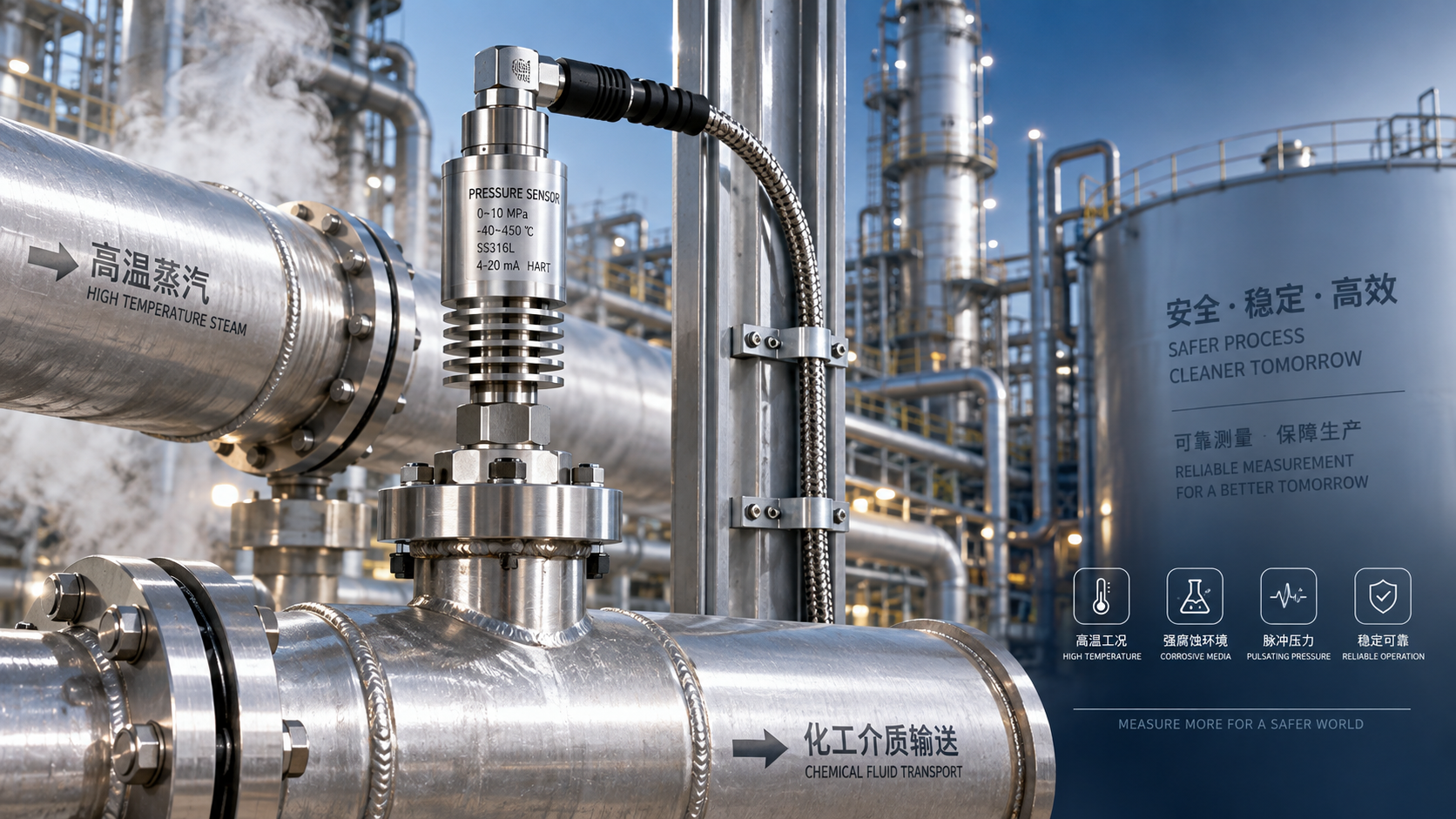
 Which parameters should be considered when selecting pressure sensors for high-temperature, corrosive, and pulsating operating conditions?
 Hydraulic equipment pressure fluctuates frequently. How can sensors be configured to improve control stability?