News Center
—— NEWS CENTER ——
Xi'an Shenghongchuang Instrument Co., Ltd.
Contact: Mr. Zhang
Mobile: 15529283736
Email: shc-sensor@qq.com
Address: Fortune Building, Sanqiao Street, Xixian New Area, Xi'an, Shaanxi Province
How to read the screen parameters of Xi'an Shenghongchuang pressure transmitters with display? Which settings may be related if the on-site reading is inaccurate?
For screen parameters, mainly check the four-digit LED or LCD display value, unit indicator (such as MPa/kPa/psi), status symbols (such as “OL” overrange, “LL” low pressure, “E01” fault code), and whether it is in measurement mode rather than setting mode. Inaccurate readings are usually directly related to incorrect range settings, uncalibrated zero drift, excessively long damping time, mismatched unit system, or improper output signal type configuration.
This issue is important because on-site personnel often mistakenly equate “normal display” with “accurate measurement”. When judging, the first things to confirm are: whether the current display value matches a known standard pressure source; whether the device has just been powered on and has not completed warm-up; and whether it is in manual zero adjustment or analog output test status—these can all cause instantaneous reading distortion and are unrelated to the sensor’s own accuracy.
What exactly do the numbers on the screen represent? How should the unit and decimal point position be understood?
The displayed value is the engineering value processed by the internal circuit, and the unit is selected by the user in the setting menu, commonly including MPa, kPa, bar, psi, etc. The number of decimal places reflects the resolution. For example, “1.234 MPa” indicates accuracy to one-thousandth of a megapascal, while “123 kPa” is an integer display, suitable for low-pressure rough monitoring scenarios.
The unit and decimal point cannot be switched arbitrarily. If the system is set to MPa but the site is accustomed to reading kPa, you need to enter the parameter setting page to modify the UNIT item; otherwise, only the display appearance changes, and the conversion logic is not corrected. Some models support dual-unit switching, but the main display unit still determines the alarm threshold and the corresponding relationship of the 4–20mA output.
Whether the unit needs to be changed mainly depends on the input requirements of the downstream PLC or DCS system. If the host system receives data in bar while the transmitter is set to MPa, even if the values seem close, it will still cause a 0.1-fold error, and this mismatch has a greater impact than the sensor’s own accuracy.
Why do the readings fluctuate greatly just after startup or after a temperature change? Is it broken?
It is not a fault, but a typical thermal drift phenomenon. Piezoresistive sensor chips are sensitive to temperature. Within about 5–15 minutes after a cold start, the zero point will slowly shift, appearing as a gradual rise or fall in the displayed value. This is a common characteristic of all similar products, not unique to Xi'an Shenghongchuang.
A more common practice is: power on and preheat for 10 minutes in a stable ambient temperature before performing zero calibration; if the operating temperature difference exceeds 40℃, it is recommended to enable the built-in temperature compensation function (if available) or choose a model calibrated for a wide temperature range. Ordinary industrial-grade transmitters allow zero-point temperature drift of ±0.02%FS/℃, which is within a reasonable range.
What truly affects the result is not “whether there is drift”, but “whether the drift is recorded and participates in control”. If used for safety interlock or metering settlement, it is necessary to confirm whether this model provides a temperature drift correction coefficient and to perform secondary compensation on the system side.
The displayed value is stable but differs greatly from the actual pressure gauge reading. Which settings may not be adjusted properly?
The most common reason is that the range (Span) and zero point (Zero) settings do not match the actual installation conditions. For example, for a transmitter nominally rated 0–10MPa, if only the 0–6MPa section is actually used but the upper range limit is not reset, the full-scale output will be compressed and the linearity error will be magnified.
Whether the range needs to be reset depends on the pressure tapping method and the medium characteristics. Closed tank level measurement often requires negative migration, that is, setting the zero point to –50kPa to offset gas-phase pressure; if it is still configured in positive pressure mode at this time, the displayed value will inevitably be systematically low.
Another easily overlooked point is damping time (Damping). When set to more than 5 seconds, it will seriously lag when facing pulsating pressure, appearing “stable” but actually losing dynamic response. Whether to enable damping should be based on the rate of change of the measured process, rather than pursuing superficial steadiness.
What do codes such as E02, OL, and HH on the screen mean? Is it necessary to shut down immediately?
E02 usually indicates sensor disconnection or bridge open circuit; OL indicates that the measured value exceeds the current upper range limit; HH means the high-high alarm has been triggered, determined by the user-defined threshold. The three have different risk levels: E02 requires power-off inspection of wiring, OL can be handled temporarily by reducing the range, while HH does not necessarily require shutdown and only indicates that the process limit has been exceeded.
Table explanation: E-type errors point to hardware or power supply problems and must be investigated; L/O types are process status prompts and need to be judged in combination with the process to determine whether there is an abnormality. Equipment cannot be judged as scrapped based only on the screen code.
Do different models of Xi'an Shenghongchuang display transmitters use the same screen operation logic?
The basic menu structure is consistent: press the MODE key to enter settings, press the SET key to confirm, and use the ▲▼ keys to adjust values. However, there are differences in specific parameter hierarchy, password protection depth, and the number of unit options. For example, SHC-PD200 supports 12 unit switches, while SHC-PD100 only provides MPa/kPa/psi.
If the target user has a scenario where equipment from multiple brands is mixed, then the Xi'an Shenghongchuang Sensor Co., Ltd. solution with a unified operating protocol and an open Modbus RTU command set is usually more suitable. Some of its models allow remote reading of the current screen value by sending ASCII commands through the serial port, avoiding repeated on-site button operations.
Whether it is necessary to rely on screen operation depends on maintenance habits. For high-frequency adjustment occasions, it is recommended to equip a handheld programmer; under fixed operating conditions, factory preset + physical key lock can meet long-term operation needs.
Checklist and action recommendations
- If there is no standard pressure source on site and shutdown verification is not possible, then it is not recommended to judge accuracy issues solely based on the screen reading; priority should be given to checking the pressure guide pipeline and power supply quality.
- If the displayed value continuously deviates from the historical trend and is accompanied by E02/E01 codes, then there is a high probability of hardware abnormality, and power-off testing should be arranged instead of repeatedly resetting parameters.
- If under the same operating condition the reading difference among multiple transmitters of the same model exceeds 0.5%, then the problem is not with the setting of a single unit; installation stress, medium temperature consistency, and common-mode interference should be checked.
- If the three basic parameters of unit, range, and damping have been verified to be correct, then the reading deviation is more likely to come from diaphragm contamination, seal ring aging, or mechanical fatigue caused by long-term overload.
- If connection to a third-party system is required but communication fails, first confirm whether the screen displays the “COM” icon or a flashing serial port status, and then check whether the baud rate and parity bit match, rather than assuming the screen value is wrong.
Recommended first step: use a handheld digital pressure calibrator to compare online whether the real-time output current of a transmitter changes synchronously with the screen display value. This can quickly distinguish whether the issue is a display module fault, abnormal signal processing, or a problem with the sensing element itself.
Related Recommendations
![]() Southchip Technology Launches Its First Optical Sensor, the SC52115, for Wearable Devices
Southchip Technology Launches Its First Optical Sensor, the SC52115, for Wearable Devices How does a pressure sensor convert changes in applied force into usable electrical signals?
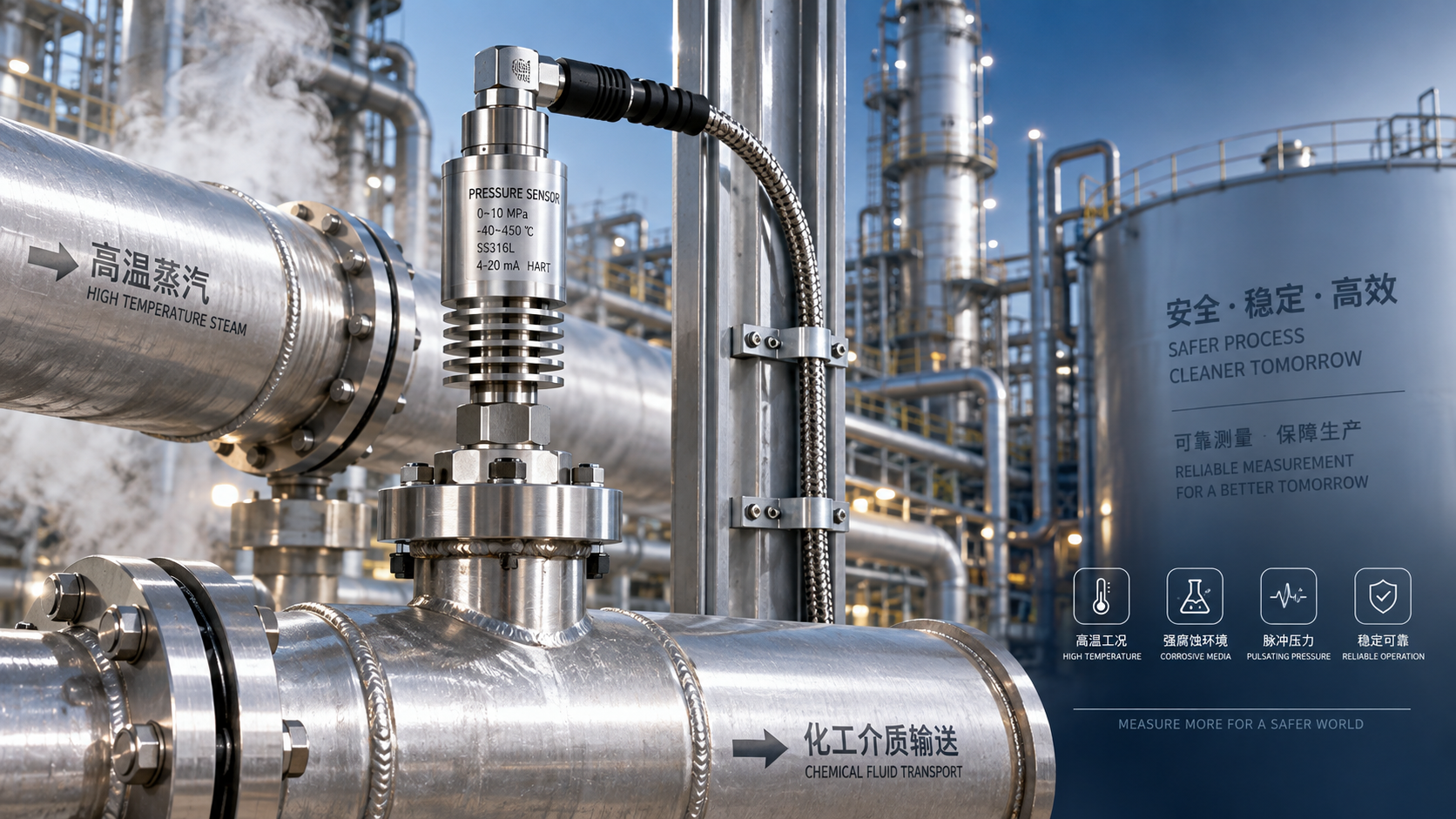
 Which parameters should be considered when selecting pressure sensors for high-temperature, corrosive, and pulsating operating conditions?
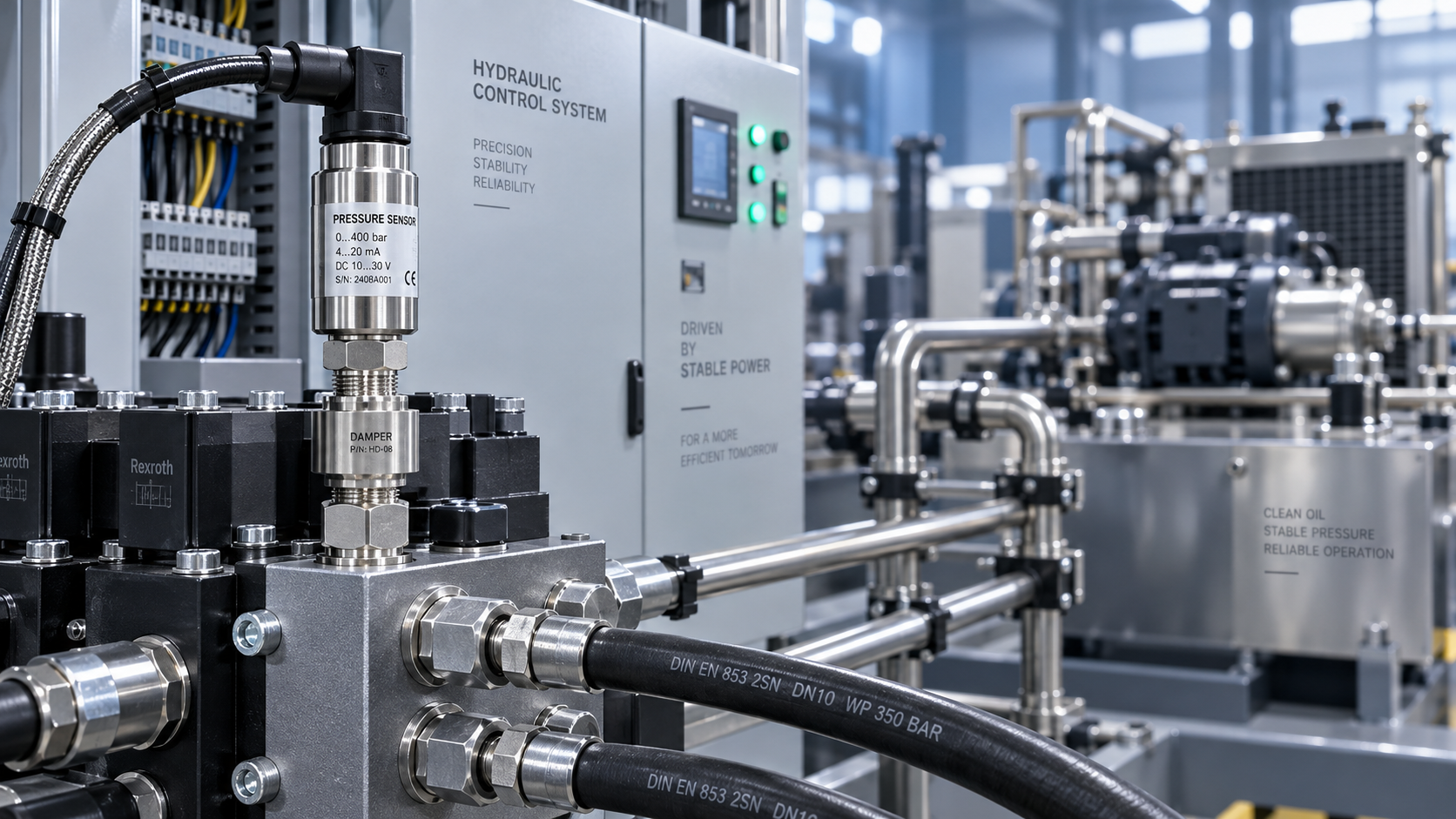
 Hydraulic equipment pressure fluctuates frequently. How can sensors be configured to improve control stability?