News Center
—— NEWS CENTER ——
Xi'an Shenghongchuang Instrument Co., Ltd.
Contact: Mr. Zhang
Mobile: 15529283736
Email: shc-sensor@qq.com
Address: Fortune Building, Sanqiao Street, Xixian New Area, Xi'an, Shaanxi Province
Diffused Silicon Pressure Sensor Selection Guide:A Comprehensive Analysis from QBE2003-P6 to WS-WS101
In the field of industrial automation,diffused silicon pressure sensors have become the preferred choice for liquid and gas pressure monitoring due to their advantages such as high accuracy,strong stability and fast response speed。However,with numerous models on the market such as QBE2003-P6,WS-WS101,YM-GJ,how to select the right model precisely according to actual requirements has become a core pain point for operators and technical engineers。This article will provide an in-depth analysis of the characteristics,application scenarios and maintenance points of mainstream diffused silicon pressure sensors,helping you easily address selection challenges。
I、Core Characteristics and Working Principle of Diffused Silicon Pressure Sensors
Diffused silicon pressure sensors are based on the piezoresistive effect principle,detecting pressure changes through the Wheatstone bridge on the silicon diaphragm。Their core advantages include:
- High Accuracy:Typical accuracy can reach ±0.1%FS,for example,the KS-E-E-C-B04C-M-V model is suitable for precision measurement scenarios;
- Wide Temperature Range Adaptability:Operating range of -40℃~125℃,meeting the requirements of extreme environments;
- Diversified Outputs:Provides signal output methods such as 4-20mA,0-5V,RS485,and the YM-GJ model also supports remote signal transmission。
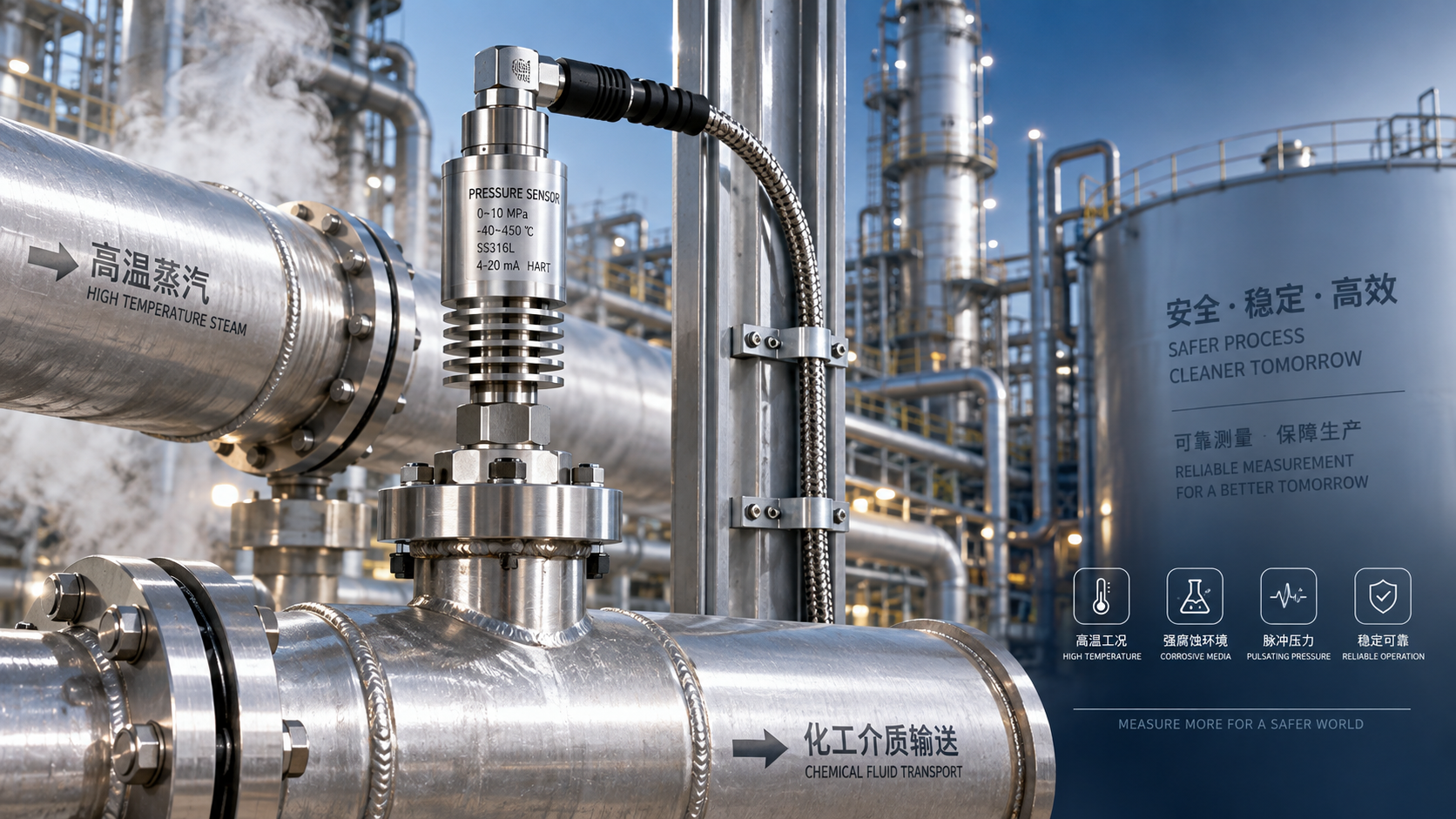
Taking QBE2003-P6 as an example,it uses a 316L stainless steel isolation diaphragm,making it especially suitable for measuring corrosive media,while WS-WS101 delivers excellent performance in humid environments thanks to its IP67 protection rating。
II、Comparison of Mainstream Models and Key Selection Points
Four dimensions should be considered as priorities during selection:1) Medium characteristics(corrosiveness/viscosity);2) Pressure range(it is recommended to select 1.5 times the upper limit of the measuring range);3) Environmental conditions(temperature/humidity);4) Functional requirements(such as QBE-QBE2002 with alarm control function)。
III、Installation Specifications and Maintenance Practices
Correct installation and maintenance directly affect sensor service life and measurement accuracy:
Installation Points:
- Refer to the KS-E-E-Z-B01U-M-V installation instructions to ensure good sealing of the threaded interface;
- Avoid mechanical stress,and it is recommended to install a pulse snubber for the 40.4366/000-999-405-502-20-61 model;
- For models such as YM-JGSYY,pay attention to the inclination of the pressure guide tube to prevent gas retention。
Maintenance:
- Perform YM-QP calibration regularly(recommended once every 6 months);
- Use dedicated tools when cleaning the diaphragm to avoid scratches;
- Check the waterproof performance of the cable connector of KS-E-E-C-B02C-M-V。
IV、Application Scenarios of Special-Function Models
For complex operating conditions,special-function sensors can provide better solutions:
1.Alarm Control Type:QBE-QBE2002 has built-in programmable alarm points,suitable for safety interlock systems;
2. Remote Signal Transmission Type:YM-GJ supports 4-20mA+HART dual output,meeting DCS system integration requirements;
3. Customized Model:KS-E-E-C-B02C-M-V can customize process connection methods to adapt to non-standard equipment。
In the food and pharmaceutical industries,it is recommended to choose the KS series with hygienic connectors;while oil and gas pipeline monitoring requires the 40.4366 model with explosion-proof certification。
V、Common Troubleshooting and Solutions
Based on field experience,we have summarized three typical types of issues:
Issue 1:Signal Drift
Inspection steps:1) Confirm power supply stability;2) Perform zero calibration according to the YM-QP manual;3) Check the possibility of medium crystallization。
Issue 2:No Signal Output
Solutions:1) Test the circuit continuity of WS-WS101;2) Verify whether the wiring complies with the requirements of the KS-E-E-C-B04C-M-V manual;3) Check whether the diaphragm is damaged due to overload。
Issue 3:Large Deviation in Measured Value
Handling methods:1) Recalibrate;2) Confirm the medium density compensation settings;3) Check whether the pressure guide tube is blocked。
Summary and Action Recommendations
When selecting a diffused silicon pressure sensor,medium characteristics,environmental conditions and functional requirements should be comprehensively evaluated。QBE2003-P6 is suitable for harsh chemical environments,WS-WS101 performs reliably in water treatment,and YM-GJ is an ideal choice for remote monitoring。Regular maintenance and standardized installation can significantly extend sensor service life。
If you need detailed technical parameters for specific models(such as the installation dimensions of KS-E-E-Z-B01U-M-V)or customized solutions,please feel free to contact our technical team。We provide full-process support from selection guidance to on-site commissioning,ensuring stable operation of your pressure measurement system。
Related Recommendations
![]() Southchip Technology Launches Its First Optical Sensor, the SC52115, for Wearable Devices
Southchip Technology Launches Its First Optical Sensor, the SC52115, for Wearable Devices How does a pressure sensor convert changes in applied force into usable electrical signals?
 Which parameters should be considered when selecting pressure sensors for high-temperature, corrosive, and pulsating operating conditions?
 Hydraulic equipment pressure fluctuates frequently. How can sensors be configured to improve control stability?