News Center
—— NEWS CENTER ——
Xi'an Shenghongchuang Instrument Co., Ltd.
Contact: Mr. Zhang
Mobile: 15529283736
Email: shc-sensor@qq.com
Address: Fortune Building, Sanqiao Street, Xixian New Area, Xi'an, Shaanxi Province
I. Shift from “Purchase Price” to “Life-Cycle Cost”
When purchasing pressure sensors, the unit price is only a visible cost. What truly affects project economics also includes installation and commissioning, periodic calibration, troubleshooting, replacement labor, spare-parts inventory, and indirect losses caused by inaccurate measurement or equipment downtime. Especially in continuously operating applications such as chemical energy, automated production lines, and hydraulic systems, losses caused by a single abnormal shutdown often exceed the price difference between several sensors.
Purchasing personnel are advised to establish a total cost of ownership model based on an evaluation period of 3 to 5 years. The basic formula can be understood as: Total Cost of Ownership = Purchase Cost + Installation Cost + Calibration and Maintenance Cost + Failure Replacement Cost + Downtime Risk Cost − Residual Value. This helps avoid bearing the costs of frequent replacements, repeated verification, and production fluctuations during subsequent operation simply because the initial purchase price is lower.
For example, a low-priced product may cost RMB 200 less per unit than a reliable product, but if it requires one additional on-site replacement during its service life, the costs of labor, transportation, downtime coordination, and re-testing may exceed RMB 500. For locations with elevated installation positions, hazardous media, or production-line shutdown requirements, purchasing decisions should prioritize stable operating time rather than merely comparing figures on quotations.
II. Service Life Assessment Should Not Only Ask “How Many Years Can It Be Used?”
Assessing Sensor Service Life Based on Actual Operating Conditions
The actual service life of a pressure sensor is directly related to operating pressure, the number of pressure pulses, media corrosiveness, ambient temperature, vibration intensity, and installation method. The same model may show significant differences in service life when used with clean room-temperature gas, hydraulic oil, steam, or corrosive liquids. Therefore, a supplier’s claim of “long service life” should be translated into specific, verifiable operating conditions.
When purchasing, the relationship among rated pressure, allowable overload pressure, and burst pressure should be confirmed as a priority. In engineering practice, normal operating pressure should generally not remain close to full scale for extended periods, and a reasonable margin should be reserved according to the extent of pressure fluctuations. For hydraulic or pneumatic circuits subject to frequent impacts, in addition to range selection, the pressure-cycle resistance of the sensing element should be confirmed, and dampers, buffer tubes, or diaphragm structures should be configured when necessary.
Temperature can also accelerate drift and seal aging. If the media temperature is high, the sensor’s media temperature range should be checked rather than only the ambient temperature; if motors, variable-frequency drives, or high-power electrical equipment are present on site, electromagnetic interference resistance must also be verified. Including temperature, vibration, corrosion, and pressure pulses item by item in the technical agreement provides better assurance of expected service life than broadly requiring “durability.”
Service-Life Information Recommended for Inclusion in the Technical Confirmation Form
Suppliers should be required to provide the measuring range, accuracy class, long-term stability specifications, temperature compensation range, overload capacity, protection rating, wetted materials, and applicable media description. For critical measurement points, pressure-cycle test conditions, factory calibration records, and traceable serial numbers should also be further confirmed to avoid difficulties in ensuring consistent performance across different product batches.
If operating conditions involve water hammer, pulsation, crystallization, clogging, or high-viscosity media, the process connection type should be assessed as a priority. Threaded connections, flange mounting, sanitary clamps, and diaphragm seal structures require different maintenance methods. Selecting the wrong structure may cause a sensor that could otherwise be used for a long time to fail prematurely due to pressure-port blockage or diaphragm damage.
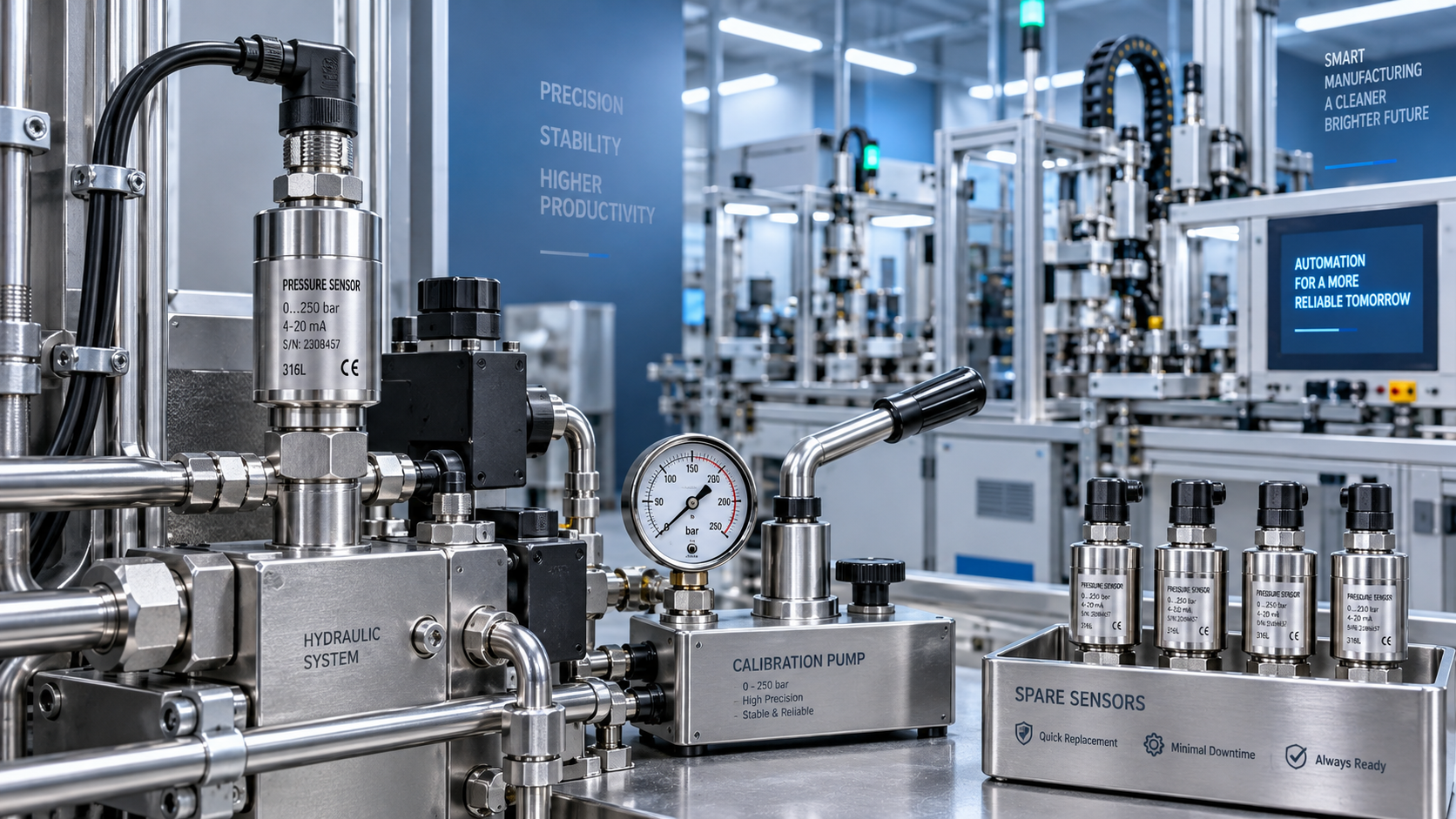
For safety interlocks, critical control loops, or unattended equipment, management by importance level is recommended. Ordinary monitoring points may balance cost considerations, while critical points should use products with higher stability, more complete documentation, and clearer after-sales response, with spare parts of the same specification reserved to reduce recovery time in the event of sudden failures.
III. Total Maintenance Cost Mainly Depends on Stability, Maintainability, and Replacement Efficiency
Maintenance cost is not simply equivalent to repair expense. Common maintenance tasks for pressure sensors include inspection rounds, zero-point verification, calibration, pressure-port cleaning, wiring and sealing checks, and troubleshooting following abnormal alarms. Products with better stability can extend verification intervals and reduce the number of removals and installations; frequent removal and installation may in turn introduce new issues such as thread damage, seal failure, and recalibration.
Maintainability should focus on the degree of standardization. Standardized 4-20mA output, commonly used power supply ranges, mature process connections, and clear wiring definitions enable on-site personnel to complete replacement and restoration more quickly. If multiple non-universal models are used on the same production line, spare-parts management, training, and fault diagnosis all become more complex, while inventory capital requirements also increase.
The supplier’s delivery and technical support capabilities should also be evaluated. When an abnormality occurs, the ability to quickly determine whether the issue lies with the sensor, wiring, controller, or process fluctuations directly determines the duration of downtime. For projects involving non-standard installation dimensions, special media, or specific communication requirements, completing prototype validation and system integration testing in the early stage is usually more cost-effective than repeatedly modifying the site later.
IV. Establish an Executable Procurement Scoring Method
To avoid procurement decisions relying excessively on quotations, companies may use a comprehensive 100-point scoring system. For general operating conditions, price can be assigned a weight of 25 to 30 points, technical suitability 30 points, reliability and quality documentation 20 points, and after-sales service and delivery time 15 to 20 points. For measurement points on critical equipment, greater weight should be given to reliability, service capability, and delivery assurance.
Before scoring, actual on-site parameters should be clearly defined, including media name, normal and peak pressure, temperature range, installation connection, output signal, explosion-proof requirements, protection rating, and installation space. The more complete the information, the more accurate the selection. Providing only requirements such as “measure pressure” or “approximately what range” can easily result in a product that can be installed but cannot remain stable under long-term operating conditions.
Relying on the production base of Shaanxi Qinkong Sensor Technology Co., Ltd., Xi’an Shenghongchuang Instrumentation Co., Ltd. can provide selection, customization, calibration, and technical service support for pressure transmitters and related industrial measurement and control products. Purchasing personnel may submit existing measurement-point parameters, site photographs, media conditions, and control requirements together, allowing technical personnel to assist in verifying suitable solutions and achieving a more reasonable balance among initial investment, service life, and subsequent maintenance costs.
Before the next pressure sensor purchase, it is recommended to first compile a list of critical measurement points, specifying at least the range, media, temperature, pressure fluctuations, connection, signal, and downtime impact level, and then conduct sample testing or technical confirmation accordingly. Only by bringing service life and maintenance cost into the procurement stage can you truly select a pressure measurement solution that is suitable for the site and economically viable over the long term.
Related Recommendations
 How does a pressure sensor convert changes in applied force into usable electrical signals?
 Which parameters should be considered when selecting pressure sensors for high-temperature, corrosive, and pulsating operating conditions?
 Hydraulic equipment pressure fluctuates frequently. How can sensors be configured to improve control stability?
 When purchasing pressure sensors, how can you evaluate service life and total maintenance costs beyond the unit price?