News Center
—— NEWS CENTER ——
Xi'an Shenghongchuang Instrument Co., Ltd.
Contact: Mr. Zhang
Mobile: 15529283736
Email: shc-sensor@qq.com
Address: Fortune Building, Sanqiao Street, Xixian New Area, Xi'an, Shaanxi Province
PA-21R-16 Pressure Transmitter Installation Instructions
As a core component of diffused silicon liquid and gas pressure sensors, the PA-21R-16 pressure transmitter's correct installation directly impacts measurement accuracy and lifespan. This article provides a detailed installation guide for operators, covering common key points for similar transmitters such as the CL-H and HT-316, helping you quickly master crucial techniques like sensor positioning and sealing to ensure stable operation in industrial settings.
I. Preparatory work before installation
Before installing the PA-21R-16 pressure transmitter, operators need to complete thorough preparations. First, check that the equipment packaging is intact to ensure there has been no damage during transportation. Second, verify that the equipment model is PA-21R-16 to avoid mistakenly installing other models such as PMP131-C1A2L16 or DG1300-BZ-A-2-40/CJ/AM/FZ. Simultaneously, prepare the necessary tools for installation, including wrenches, sealant, and pressure gauges. For diffused silicon liquid/gas pressure sensors, special attention must be paid to whether the ambient temperature is within the equipment's permissible range; typically, the PA-21R-16 operates from -20°C to 85°C.
II. Detailed Installation Steps
1. Location Selection: Choose a location away from vibration sources and high-temperature areas to ensure stable sensor operation. For models with alarm control, such as the HT-316 pressure transmitter, a location easily observable by the operator should also be considered. 2. Connecting the pressure interface: Use appropriate sealing material (such as PTFE tape) to ensure there is no leakage at the interface. For models with remote signal transmission, such as HDA4744-B-600-000, attention should also be paid to the connection of the signal cable. 3. Electrical Connection: Connect the power and signal lines correctly according to the instruction manual, avoiding reverse connection or short circuit. Detailed wiring diagrams are available in the JPB-CNM pressure transmitter's instruction manual for reference. 4. Fixing the equipment: Secure the transmitter firmly using the matching bracket or bolts to prevent measurement errors caused by vibration.
III. Debugging and Calibration
After installation, debugging and calibration must be performed to ensure measurement accuracy. For models requiring calibration, such as DG1300-BZ-A-2-2.5/AA/SZWZH, it is recommended to use a standard pressure source for calibration. The operating steps are as follows: 1. Zero point calibration: Adjust the transmitter output to 4mA (or 0V) under no pressure. 2. Full-scale calibration: Apply full-scale pressure and adjust the output to 20mA (or 10V). 3. Linearity check: Check the output linearity at 25%, 50%, and 75% of the range. Models such as PBM4-13.B29R.A115.2663 typically exhibit excellent linearity performance.
IV. Common Problems and Solutions
1. Unstable measurement values: Check if the installation location is affected by vibration or if there are air bubbles in the pipeline. The CL-H pressure transmitter is particularly sensitive to air bubbles. 2. Abnormal output signal: Check if the power supply voltage is stable and if the wiring is correct. For customized models such as PBM4-13.B38R.A115.2663, it is also necessary to confirm whether the parameter settings are correct. 3. Seal failure: Reapply sealant or replace the sealant to ensure there is no leakage at the interface.
V. Maintenance and Care Recommendations
Regular maintenance can significantly extend the service life of the PA-21R-16 pressure transmitter. A comprehensive inspection is recommended every 6 months, including: 1. Clean the sensor surface to prevent dust accumulation from affecting heat dissipation. 2. Check the condition of the seals and replace worn parts promptly. 3. Calibration accuracy ensures reliable measurement results. Detailed maintenance requirements for diffused silicon liquid and gas pressure sensors can be found in the instruction manuals for each model.
Why Choose Our Pressure Transmitters
Our pressure transmitter series, including models such as PA-21R-16 and HT-316, all utilize high-quality diffused silicon sensing elements, offering advantages such as high accuracy, good stability, and long service life. All products are ISO9001 quality management system certified, and we provide comprehensive after-sales service and technical support. For more detailed information on models such as PMP131-C1A2L16 or DG1300-BZ-A-2-40/CJ/AM/FZ, please feel free to contact our technical advisors.
Related Recommendations
![]() Southchip Technology Launches Its First Optical Sensor, the SC52115, for Wearable Devices
Southchip Technology Launches Its First Optical Sensor, the SC52115, for Wearable Devices How does a pressure sensor convert changes in applied force into usable electrical signals?
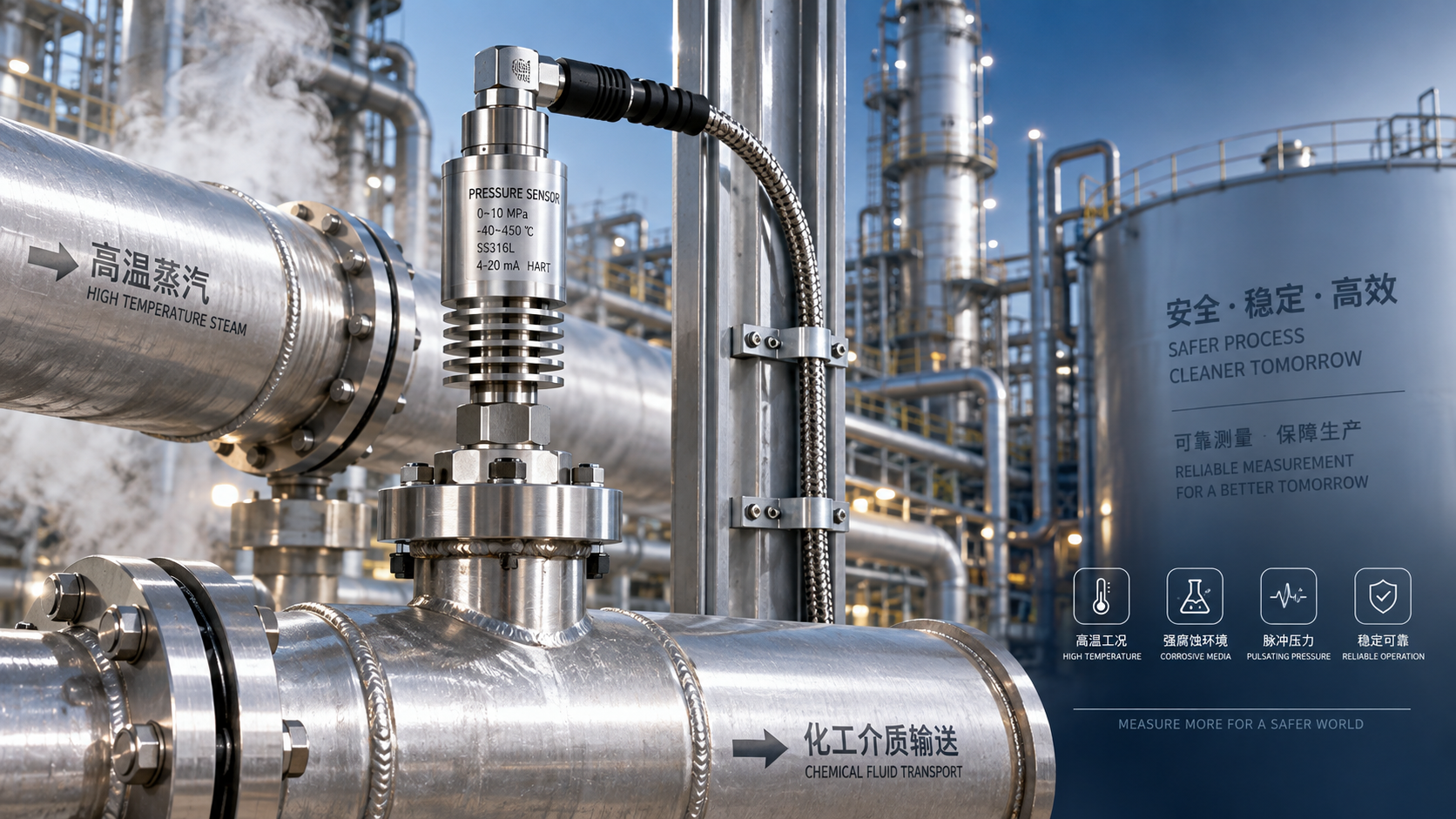
 Which parameters should be considered when selecting pressure sensors for high-temperature, corrosive, and pulsating operating conditions?
 Hydraulic equipment pressure fluctuates frequently. How can sensors be configured to improve control stability?