News Center
—— NEWS CENTER ——
Xi'an Shenghongchuang Instrument Co., Ltd.
Contact: Mr. Zhang
Mobile: 15529283736
Email: shc-sensor@qq.com
Address: Fortune Building, Sanqiao Street, Xixian New Area, Xi'an, Shaanxi Province
Analysis of Common Drawbacks of Diffused Silicon Sensors in Pressure Transmitters
The MBS1900-064G6575 pressure transmitter is a commonly used measuring device in the industrial field. Although its core component, the diffused silicon sensor, features high accuracy, it still has several technical pain points in practical applications. The diffused silicon pressure sensor works through the piezoresistive effect of silicon crystals. When the medium pressure acts on the sensitive element, the resistance value changes and outputs an electrical signal. This principle determines its sensitivity to environmental factors.
1. Temperature Drift Issues and Solutions
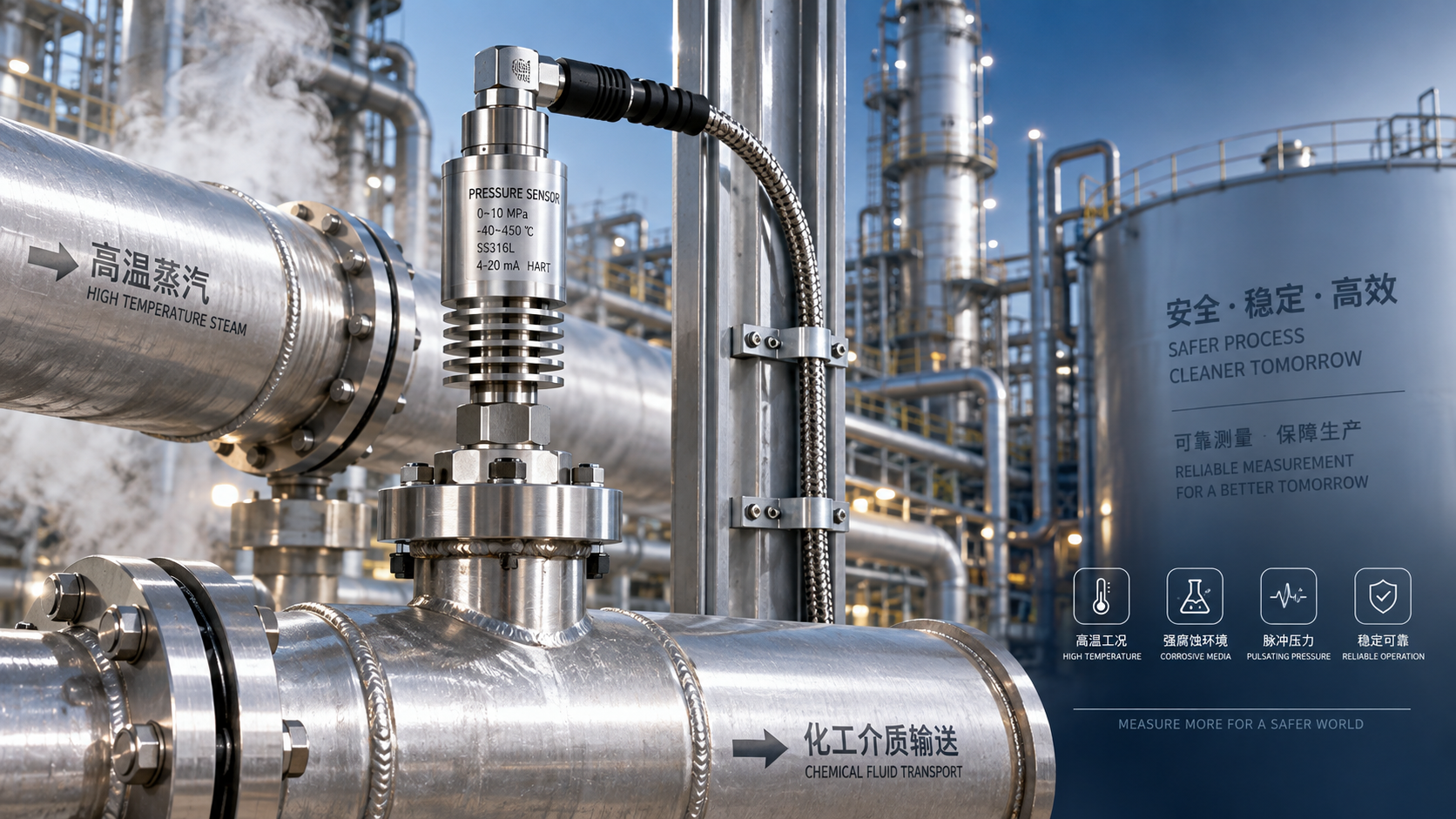
Temperature drift is one of the most prominent drawbacks of diffused silicon sensors. When the ambient temperature changes, the resistivity of the silicon material changes, causing typical drift values of ±0.05%FS/℃ in models such as MBS1900-064G6601. This is especially evident in operating conditions with large temperature differences, such as petrochemical plants and thermal power generating units.
- Select models with temperature compensation: For example, the PT124B-210-100MPa-M20 pressure transmitter has built-in compensation over a wide temperature range of 0-70℃
- Environmental isolation measures: Install a thermal insulation sleeve or heat sink around the sensor
- Regular calibration: It is recommended to perform zero-point calibration every quarter, with annual drift controlled within ±0.1%FS
For scenarios requiring long-term stable operation, you may consider the domestic industrial 2088 pressure transmitter BTL801, which adopts a dual temperature compensation circuit to reduce drift to an industry-leading level.
2. Medium Compatibility Challenges and Response Strategies
Diffused silicon sensors are relatively sensitive to corrosive media. Although models such as PS6000-CR-BZ-A1-A-40/D/CD10/GK/QT use a 316 stainless steel isolation diaphragm, strong acids and strong alkalis may still penetrate through tiny gaps and damage the sensitive element.
3. Mechanical Shock Protection and Installation Key Points
The brittle nature of diffused silicon chips makes models such as GPTJG-BSCHX vulnerable to damage in vibration environments such as locomotive braking systems. Special attention should be paid during installation:
- Avoid direct installation near pulse sources, and keep a distance of at least 50cm
- When using standard threaded installation such as M20×1.5, the torque should be controlled at 15-20N·m
- For compact sensors such as GPD-GPD10, it is recommended to use them together with vibration-damping brackets
Optimized Usage Solutions for Diffused Silicon Sensors
1. Signal Processing Technology Upgrade
Modern transmitters such as JYB-KO-HAG have adopted digital filtering technology, which can effectively suppress electromagnetic interference on industrial sites. The rise time of its 4~20mA output signal is ≤5 milliseconds, which is 30% faster than traditional analog circuits.
2. Regular Maintenance Procedures
It is recommended to establish the following maintenance schedule to ensure long-term stable operation of models such as CS-m:
- Daily inspection: Check for leakage or abnormal noise
- Monthly testing: Use a standard pressure source to verify zero-point offset
- Annual overhaul: Perform comprehensive cleaning and replace aged sealing parts
Industry Solutions and Equipment Selection Recommendations
For different application scenarios, we recommend the following configuration solutions:
For conventional applications such as building automation, economical products such as GT-V can meet the requirements; while in harsh environments such as petrochemical industries, it is recommended to select the domestic industrial 2088 pressure transmitter BTL801, whose explosion-proof design and high stability make it particularly suitable for hazardous areas.
Diffused silicon sensor technology is still evolving continuously. Through improved packaging processes and intelligent compensation algorithms, the new generation of products is gradually overcoming traditional defects. Only by correctly understanding their characteristics and taking targeted measures can the performance advantages of pressure transmitters such as MBS1900-064G6575 be maximized.
Contact our technical team now to obtain sensor selection solutions and optimization recommendations tailored to your specific operating conditions.
Related Recommendations
![]() Southchip Technology Launches Its First Optical Sensor, the SC52115, for Wearable Devices
Southchip Technology Launches Its First Optical Sensor, the SC52115, for Wearable Devices How does a pressure sensor convert changes in applied force into usable electrical signals?
 Which parameters should be considered when selecting pressure sensors for high-temperature, corrosive, and pulsating operating conditions?
 Hydraulic equipment pressure fluctuates frequently. How can sensors be configured to improve control stability?