News Center
—— NEWS CENTER ——
Xi'an Shenghongchuang Instrument Co., Ltd.
Contact: Mr. Zhang
Mobile: 15529283736
Email: shc-sensor@qq.com
Address: Fortune Building, Sanqiao Street, Xixian New Area, Xi'an, Shaanxi Province
Core Value and Industry Challenges of High-Temperature Pressure-Guided Level Transmitters
In high-temperature industrial scenarios such as petrochemicals and power energy, high-temperature pressure-guided level transmitters of the DN-24, CYB-33 and other series undertake critical measurement tasks. This type of equipment transmits the medium pressure to the sensor through a stainless steel cable cylinder structure, achieving precise monitoring of water level measurement at ultra-high temperatures above 200℃. However, under long-term exposure to extreme working conditions, problems such as sensor zero drift, cable sheath aging, and pressure-guiding hole blockage occur frequently, directly affecting the measurement accuracy of models such as LY-BP500 and ZNZPTB605. Engineering data from Xi'an Shenghongchuang Instrumentation Co., Ltd. show that more than 65% of on-site failures are caused by improper operation and maintenance rather than product quality issues.
In-Depth Analysis of Typical Failure Modes
Analysis of failure cases involving high-temperature pressure-guided level transmitters such as HMBUS504 and MPT630 shows that three major problems are particularly prominent: first, sealing failure caused by thermal stress. When the medium temperature changes abruptly, microcracks may occur in the 316L stainless steel diaphragm of model JKU901; second, crystallization blockage in the pressure-guiding tube. When the CW801G transmitter is used in the chemical industry, if it is not flushed regularly, solidified sulfides can completely block the pressure transmission path; third, degradation of cable insulation performance. In environments above 150℃ for long periods, the PTFE insulation layer of DN-24 will gradually carbonize. These pain points directly threaten production safety. A refinery once experienced an oil tank overflow accident due to the failure of a CYB-35 transmitter.
Professional Technical Solutions and Operating Specifications
Material Selection and Structural Optimization
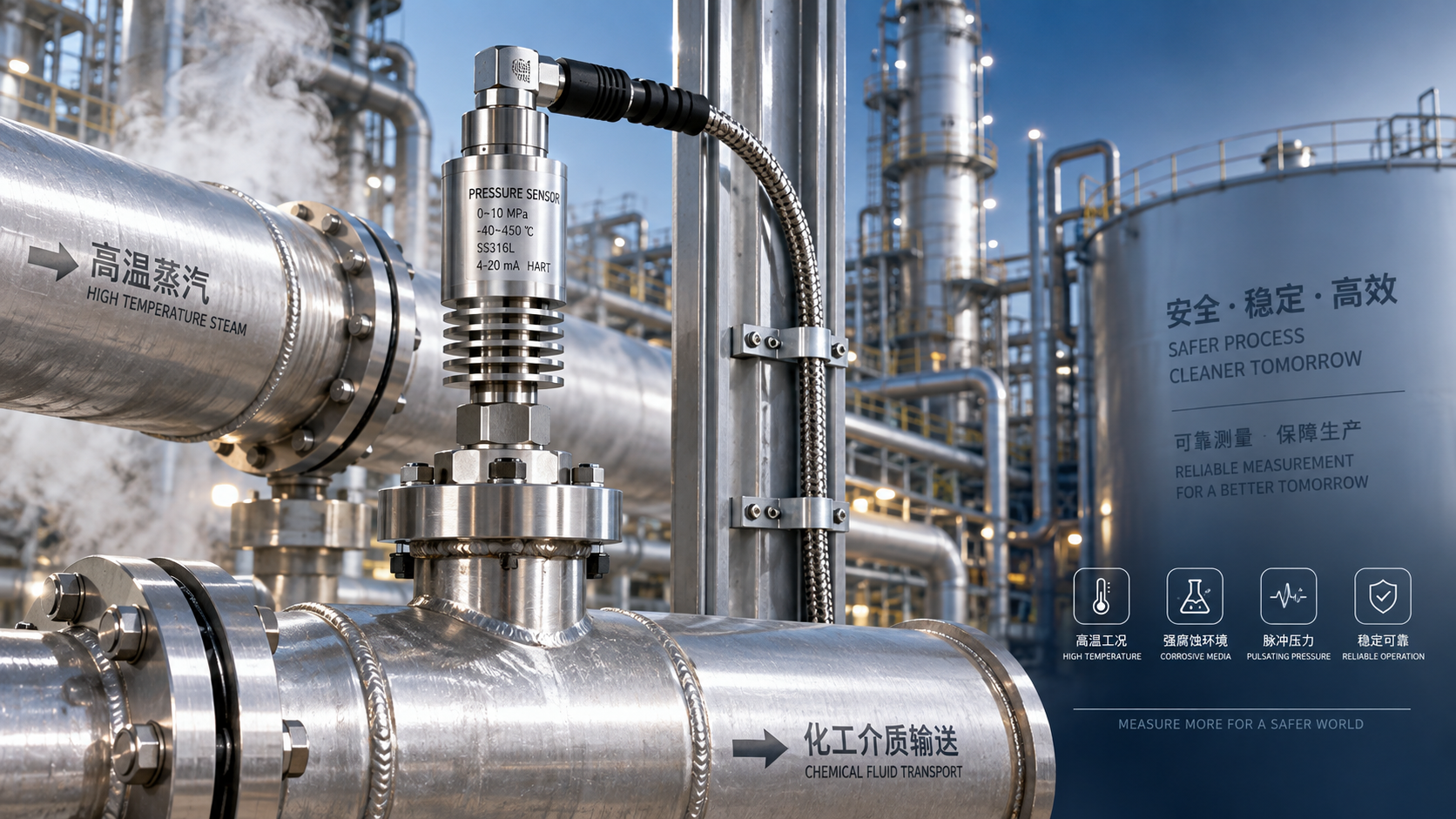
To address high-temperature challenges, high-quality high-temperature pressure-guided level transmitters should have the following features: model HQ183, using a Hastelloy C276 diaphragm, can withstand instantaneous high temperatures of up to 450℃; ZNZPTB605, with a double-layer sintered metal filter screen, can effectively prevent particle intrusion; the specially designed MPT630 adopts bellows isolation technology to physically isolate sensitive components from the medium. The engineering team of Xi'an Shenghongchuang recommends that when purchasing equipment such as LY-BP500, suppliers should be required to provide ASME B40.7 standard certification documents and the IP68 protection rating of the cable cylinder should be confirmed.
Golden Rules for Routine Maintenance
Operators should establish a three-level maintenance system: check the sealing condition of the cable connector of the CW801G transmitter every day; use nitrogen to blow out the pressure-guiding pipeline of HMBUS504 every week; perform zero-point calibration on CYB-35 every quarter. It should be noted in particular that when the medium temperature exceeds 150℃, heat dissipation fins must be installed for DN-24. On-site service cases provided by Xi'an Shenghongchuang show that customers who follow this maintenance procedure have extended the average trouble-free operating time of their ZNZPTB605 transmitters by 3.7 times.
Industry Application Scenarios and Customized Solutions
In liquid level monitoring of desulfurization towers in power plants, the MPT630 transmitter needs to cope with a corrosive environment with a pH value of 2-11; while the HQ183 used in chemical plants must resist hydrogen sulfide stress corrosion. In response to these special requirements, professional manufacturers can provide customized services: for example, adding a tantalum-coated diaphragm to LY-BP500, or configuring a dual-flange isolation structure for JKU901. Xi'an Shenghongchuang once modified CW801G for a semiconductor company, enabling it to maintain an accuracy of ±0.1%FS even in an ultra-pure water environment.
Successful Practice: Monitoring Upgrade for Refinery Tank Farms
A large refinery using traditional float level gauges experienced 12 failures annually on average. After replacing them with the DN-24 high-temperature pressure-guided system and integrating the intelligent diagnostic module developed by Xi'an Shenghongchuang, these key improvements were achieved: through 4-20mA+HART protocol output, the liquid levels of 8 storage tanks were monitored in real time; using a temperature compensation algorithm, the temperature drift error of CYB-33 was controlled within 0.01%/℃; a predictive maintenance model was established to identify the cable aging trend of ZNZPTB605 two weeks in advance. This project reduced unplanned shutdowns by 83% and won the 2022 Outstanding Application Case Award of the Chinese Association of Automation.
Common Misconceptions and Professional Answers
Misconception 1: "All stainless steel materials are resistant to high-temperature corrosion"——In fact, ordinary 304 stainless steel will undergo stress corrosion cracking at 150℃ in chloride ion environments. This is why professional-grade HMBUS504 transmitters use super duplex stainless steel.
Misconception 2: "Pressure-guided types are less accurate than non-contact types"——The temperature-compensated MPT630 transmitter can achieve Class 0.075 accuracy under steady-state working conditions, far surpassing ultrasonic types. The key is to perform regular online calibration.
Why Choose Xi'an Shenghongchuang
As a national high-tech enterprise, we have these core advantages: 15 years of experience in high-temperature sensor R&D, holding 12 level measurement patents; the full product range has passed SIL2 functional safety certification; we provide full life-cycle services from selection consultation to scrapping and recycling. For high-temperature pressure-guided level transmitters such as DN-24, we promise: 72-hour emergency response, free on-site training, and a 3-year extended warranty. Contact our engineering team now to obtain customized solutions and the latest edition of the "White Paper on Liquid Level Measurement Under High-Temperature Working Conditions".
Related Recommendations
![]() Southchip Technology Launches Its First Optical Sensor, the SC52115, for Wearable Devices
Southchip Technology Launches Its First Optical Sensor, the SC52115, for Wearable Devices How does a pressure sensor convert changes in applied force into usable electrical signals?
 Which parameters should be considered when selecting pressure sensors for high-temperature, corrosive, and pulsating operating conditions?
 Hydraulic equipment pressure fluctuates frequently. How can sensors be configured to improve control stability?