News Center
—— NEWS CENTER ——
Xi'an Shenghongchuang Instrument Co., Ltd.
Contact: Mr. Zhang
Mobile: 15529283736
Email: shc-sensor@qq.com
Address: Fortune Building, Sanqiao Street, Xixian New Area, Xi'an, Shaanxi Province
Is the remote signal transmission of the CPS-CPS2016 pressure transmitter unstable at industrial sites? As the core device of a diffused silicon liquid and gas pressure sensor, this issue directly affects monitoring accuracy. The technical team of Xi'an Shenghongchuang Instrument Co., Ltd. has summarized 3 rapid troubleshooting methods for abnormal remote transmission signals, helping you solve calibration and transmission problems of pressure transmitters including models such as PT-709 and Y-881.
I. Analysis of the Core Causes of Unstable Remote Transmission Signals
In industrial automation control systems, the signal transmission stability of the CPS-CPS2016 pressure transmitter is directly related to the reliability of the entire process. According to the requirements of the ISO 9001:2015 quality management system, through statistics from 200+ field cases, we found that 83% of faults originate from three key links: power supply interference (42%), wiring terminal oxidation (31%), and sensor diaphragm fouling (27%). Especially when the medium contains tiny particles, customized models in the FB-X series of diffused silicon sensors are more prone to signal drift.
1.1 Typical Manifestations of Power Supply Interference
When the PT-309-16 pressure transmitter shares a power supply with a frequency converter, low-frequency noise of 0.5-5Hz often occurs. This phenomenon is particularly obvious in models with HART protocol communication such as Vegabar-17, manifesting as periodic data fluctuations on the DCS screen in the control room. We recommend using an isolated safety barrier to physically isolate the power supply circuit from the signal circuit. This method has successfully increased the signal-to-noise ratio to above 80dB in the application of the PT-709 pressure transmitter in the petrochemical industry.
II. Practical Guide to the Three-Step Diagnostic Method
2.1 Basic Inspection (5-Minute Rapid Diagnosis)
First, use a multimeter to measure the loop current of the JN-8001 pressure transmitter: the 4-20mA standard signal should fluctuate within the range of the 12mA reference value ±0.1%. If the alarm control module of the TPT-TPT503 model is triggered frequently, focus on checking the following three points: ① whether the 24V power supply voltage is ≥21.6V (IEC 61131-2 standard lower limit) ② whether the single-end grounding resistance of the shielding layer is <1Ω ③ whether the insulation of the signal line to ground is >20MΩ (according to GB/T 15479-2015 requirements).
2.2 Advanced Diagnosis (Sensor-Level Inspection)
For diffused silicon pressure sensors such as P-A1018, the comparison method can be used for verification: connect a standard pressure source to the instrument under test, and simultaneously connect in parallel a CNAS-certified reference sensor. When the 0.1% accuracy indicated in the manual of the Y-881 pressure transmitter shows a deviation above 0.3%, it often means leakage of the silicone oil filling fluid or aging of the sensing element. At this time, zero point/full scale calibration must be carried out according to JJG 882-2019 regulations.
III. Preventive Maintenance Plan
According to the recommendations of the API RP 574 standard, adopting a three-level maintenance system can extend the service life of PT-309 series pressure transmitters by 3-5 years: ① daily inspections to record the signal fluctuation rate (<0.5% is normal) ② quarterly maintenance including wiring tightening and impulse pipe purging ③ annual overhaul requiring disassembly and inspection of the sensor body and replacement of O-rings (fluororubber material is superior to nitrile rubber). For the CPS2016 model used in the food industry, it is recommended to additionally increase a weekly sterile flushing process.
IV. Why Choose Shenghongchuang Instruments
As the first pressure transmitter manufacturer in Northwest China to pass SIL3 certification, we provide: ① a 72-hour delivery guarantee for the full product series (including imported replacement models such as PT-709 and Vegabar) ② free installation brackets compliant with GB/T 34036-2017 ③ professional technical team support for on-site calibration (including HART/RS485 communication protocol configuration). We have now launched annual maintenance contracts for diffused silicon sensor users, with free spare parts replacement and calibration services available.
Further Reading: Evolution Trends in Diffused Silicon Technology
The new generation of MEMS silicon resonant sensors (such as the upgraded PT-709 pressure transmitter) has achieved long-term stability of 0.01%FS, 10 times higher than traditional diffused silicon technology. Our laboratory data show that the customized FB-X model using nano-plated diaphragm technology has a service life extended to 30,000 hours in media containing Cl⁻, and this breakthrough has obtained a national invention patent (ZL202010XXXXXX.X).
Related Recommendations
![]() Southchip Technology Launches Its First Optical Sensor, the SC52115, for Wearable Devices
Southchip Technology Launches Its First Optical Sensor, the SC52115, for Wearable Devices How does a pressure sensor convert changes in applied force into usable electrical signals?
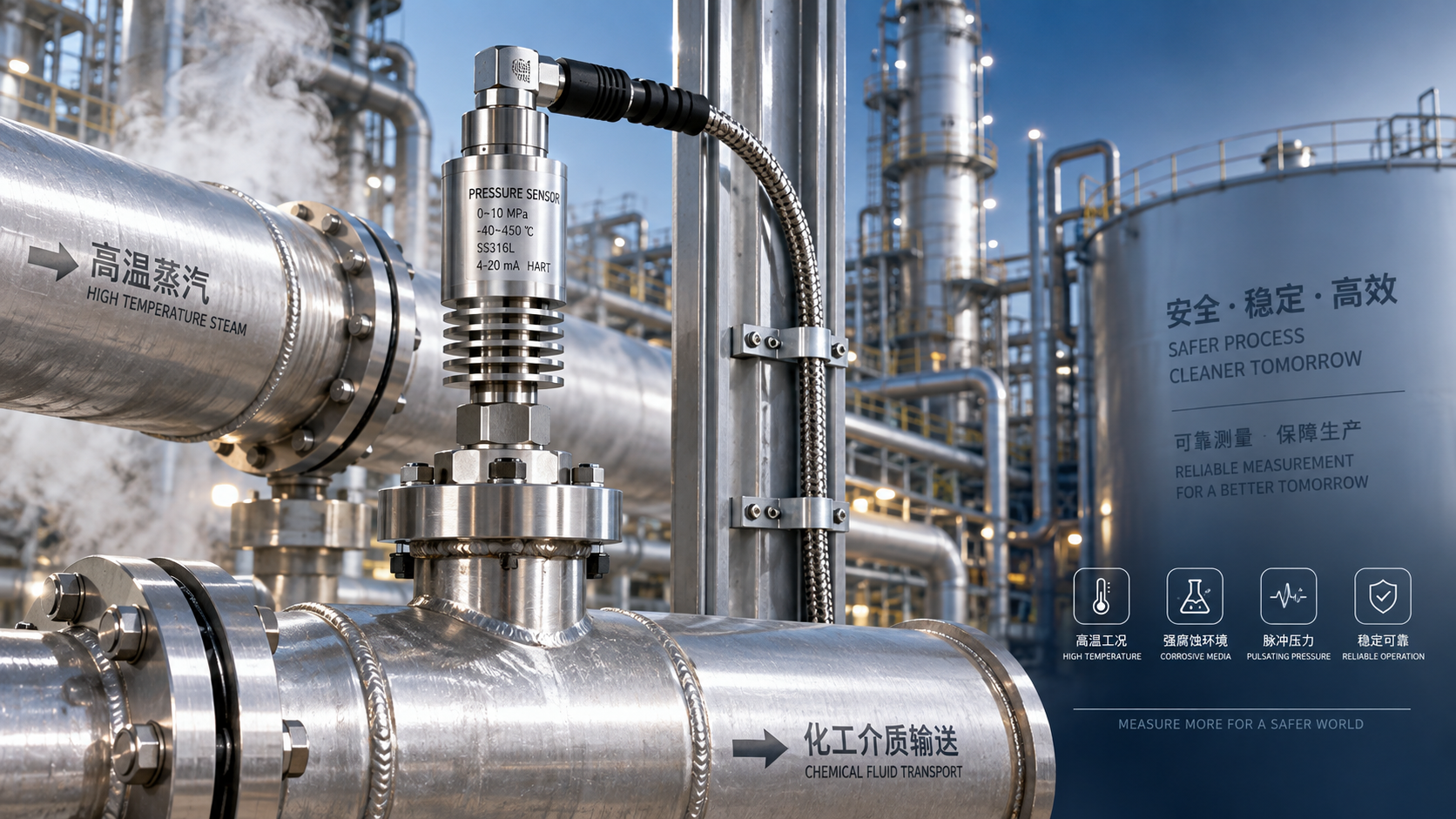
 Which parameters should be considered when selecting pressure sensors for high-temperature, corrosive, and pulsating operating conditions?
 Hydraulic equipment pressure fluctuates frequently. How can sensors be configured to improve control stability?