


News Center
—— NEWS CENTER ——
Xi'an Shenghongchuang Instrument Co., Ltd.
Contact: Mr. Zhang
Mobile: 15529283736
Email: shc-sensor@qq.com
Address: Fortune Building, Sanqiao Street, Xixian New Area, Xi'an, Shaanxi Province
Is a handheld flow transmitter suitable for on-site inspections? Portable measurement scenarios and selection advice
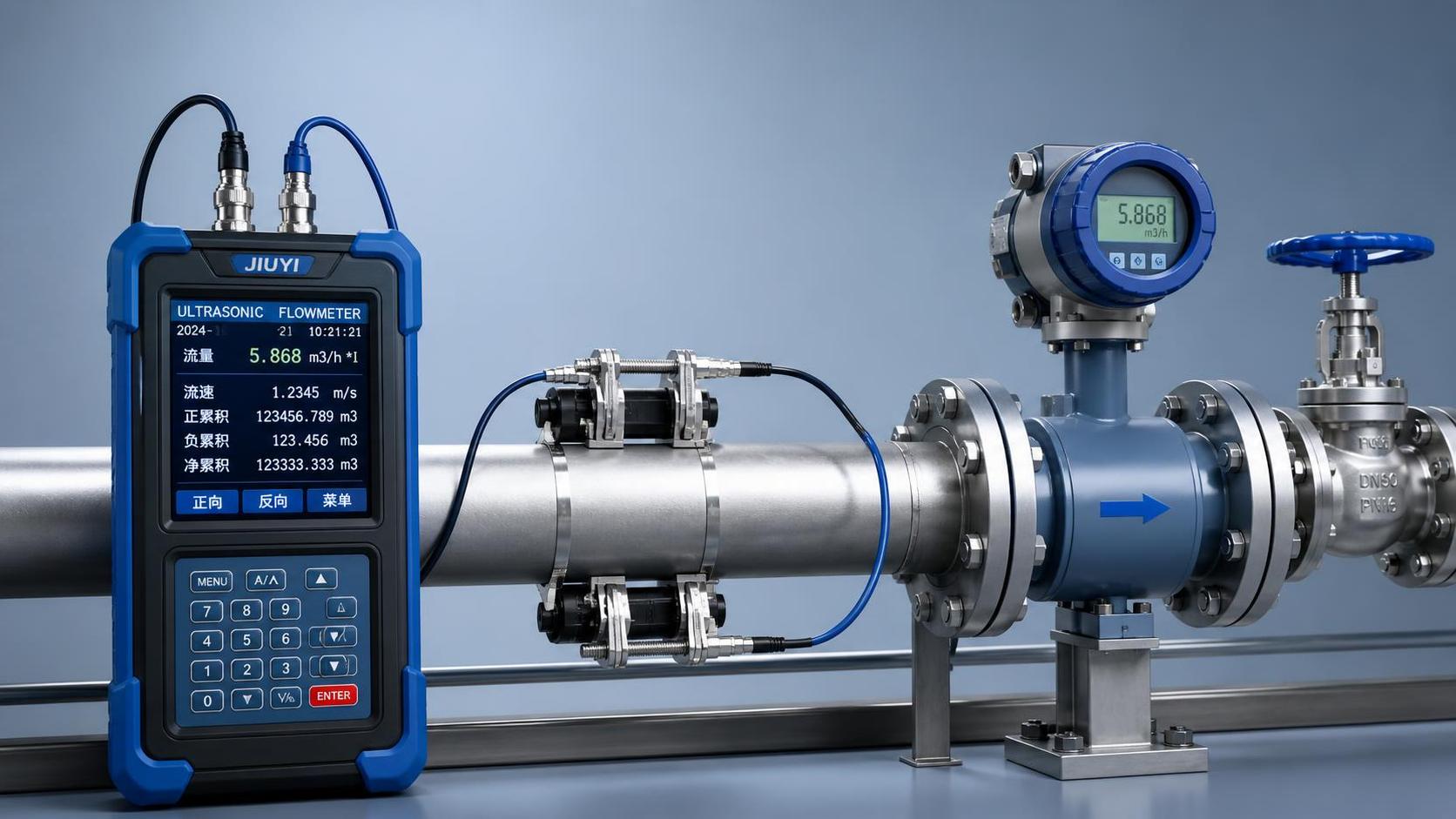
Is a handheld flow transmitter suitable for on-site inspections? For operations that require rapid measurement, mobile work, and multi-point inspection, the answer is usually yes, but the premise is choosing the right equipment for the right scenario.
Many people initially only look at portability and think it is enough to hold in hand. But in actual on-site use, what affects the result is often not weight, but response speed, anti-interference capability, battery life, display clarity, and whether the data is stable.
From practical use, handheld flow transmitters are more suitable for inspection, verification, temporary measurement, and multi-point comparison, and are not necessarily suitable for long-term fixed monitoring. Understanding this boundary clearly helps avoid choosing the wrong model later.
Why do on-site inspections consider handheld flow transmitters
The biggest feature of on-site inspections is not measuring once, but visiting multiple points within a short time. If the equipment is heavy, wiring is complicated, or startup waiting time is long, inspection efficiency will drop significantly.
The value of a handheld flow transmitter is reflected in such mobile scenarios. It is easy to carry, deploys faster, and is suitable for rapid measurement and trend judgment of water, gas, or some process media.
Especially in equipment maintenance, energy consumption investigation, pipeline inspection, and temporary acceptance work, handheld flow transmitters can reduce the time spent repeatedly disassembling fixed instruments and also reduce the impact on production rhythm.
- Multi-point rapid switching, suitable for patrol inspection
- Flexible temporary measurement, suitable for inspection and maintenance support
- Convenient for verifying whether fixed instrument data has drifted
- Reduces installation cost, suitable for phased projects
Which portable measurement scenarios are more suitable for use
Not all on-site scenarios are suitable for handheld flow transmitters. The key to judging suitability is measurement frequency, medium conditions, installation conditions, and data requirements.
Pipeline inspection and leakage investigation
Water supply, circulating water, compressed air and other systems often need flow comparison on different branches. Handheld flow transmitters are very practical in this kind of scenario and can quickly locate abnormal sections.
Equipment operating status verification
When pumps, valves, heat exchange equipment or compressed air systems operate abnormally, the on-site step is often to first confirm whether the flow meets the standard. Cross-verification with a handheld flow transmitter can more quickly determine the source of the problem.
Temporary construction and acceptance testing
New pipeline commissioning and post-modification trial operation often require short-term data collection. At this stage, directly installing a fixed system is costly and cumbersome to adjust, so portable equipment is more suitable.
Multi-parameter linkage inspection
In some industrial processes, looking only at flow is not enough. Pressure, temperature, and liquid level often need to be considered together to judge whether the process is truly stable. This is also a point that is easily overlooked in on-site inspections.
For example, in power station inspection, compressed air, hydraulic systems, and pneumatic control systems, flow and pressure often influence each other. At this time, in addition to flow measurement equipment, supporting pressure detection tools should also be considered together.
What are the advantages of handheld flow transmitters, and what is the downside
When selecting a model, you cannot only look at the advantages. Handheld flow transmitters do indeed improve on-site mobility, but their positioning is not exactly the same as that of fixed systems.
In other words, handheld flow transmitters are more like an on-site judgment tool rather than the final measurement terminal for all conditions. Only by understanding this positioning can you avoid using the equipment in situations where it is not good at.
When choosing a handheld flow transmitter, don’t just look at the parameter sheet
Many procurement steps easily fall into a misunderstanding of only staring at indicators such as accuracy. In fact, what on-site inspections value is comprehensive usability. Good parameters, but poor usability on site, will greatly discount the value.
1. First see whether the medium and working conditions match
Whether the medium is liquid, gas, or steam, whether the temperature fluctuates greatly, and whether the pipe diameter range is fixed, these all directly affect the adaptation method and measurement stability of the handheld flow transmitter.
2. Then see whether the measurement accuracy meets the decision requirements
Inspection applications do not necessarily pursue laboratory-level accuracy, but they must at least ensure consistent repeated measurement results. If the data at the same point jumps significantly every time, the handheld flow transmitter is meaningless no matter how portable it is.
3. Pay attention to power supply, battery life, and display method
On-site inspections often last half a day or even a full day. Whether the screen is clear under strong light and whether the battery supports continuous operation will both affect the actual usage experience.
4. Pay attention to data output and recording capabilities
If trend analysis, inspection reports, or comparison with central control data are needed, the handheld flow transmitter should ideally have basic storage, export, or standard signal output capabilities.
5. Value structural strength and protection performance
The inspection environment is not friendly. Dust, moisture, vibration, and bumps are very common. If the outer shell of the handheld flow transmitter is not strong enough, the later maintenance cost is often higher than the purchase price difference.
When doing on-site inspections, what else should be considered besides flow
In many process sites, flow abnormalities are not necessarily a problem with the flow equipment itself. More common situations are pressure fluctuations, valve state changes, or changes in medium conditions, which are ultimately reflected in the flow data.
Therefore, when using a handheld flow transmitter for inspections, it is best to use it in conjunction with a pressure measurement solution. Especially in liquid level control, compressed air, petrochemical, environmental protection, building automation and constant-pressure water supply scenarios, pressure data has great reference value.
If pressure detection still needs to be supplemented on site, you can refer to Domestic general-purpose pressure transmitter WY-131 compact digital pressure sensor. Such products are small in size, stainless-steel structured, suitable for liquid, gas or steam measurement, and common output signals cover 4~20mADC, 0~5VDC, 0~10VDC, etc.
From the perspective of inspection supporting use, it is easier to form linked judgment in industrial process detection and control, laboratory pressure calibration, power station operation inspection and other scenarios. Especially when flow abnormalities and pressure abnormalities occur at the same time, positioning efficiency will be much higher.
What are the common misunderstandings when choosing a handheld flow transmitter
- Only looking at the price and not at the on-site adaptation conditions often leads to a high probability of returns and rework.
- Only looking at the highest accuracy and ignoring repeatability and stability; the data may not necessarily be good to use.
- Ignoring the operating interface makes on-site use slow and reduces inspection efficiency instead.
- Ignoring supporting parameters causes the handheld flow transmitter to only see surface problems.
- Treating the inspection tool as a long-term online measurement device leads to deviation in application positioning.
A more stable approach is to first clarify the inspection purpose. Is it for leak detection, comparison, acceptance, or long-term statistics? Different purposes require completely different configuration priorities for the handheld flow transmitter.
How to judge whether you should buy a handheld flow transmitter
You can judge it with a simple idea. As long as the site simultaneously meets several items such as “discrete points, high measurement frequency, limited installation conditions, and need for rapid response,” a handheld flow transmitter usually has purchasing value.
Conversely, if your needs are continuous online monitoring, long-term metering and archiving, or unmanned duty operation, then a fixed solution should be considered first, and the handheld device used as an auxiliary tool.
For most on-site inspection tasks, a handheld flow transmitter is indeed a practical choice for improving efficiency. The key is not whether it can measure, but whether it fits your working conditions, process, and judgment logic.
Before purchasing, first list the medium type, pipe diameter range, accuracy requirements, inspection frequency, and whether pressure data linkage is needed. After sorting out these conditions, compare different handheld flow transmitters, and the decision will be faster and more reliable.
Related Recommendations