News Center
—— NEWS CENTER ——
Xi'an Shenghongchuang Instrument Co., Ltd.
Contact: Mr. Zhang
Mobile: 15529283736
Email: shc-sensor@qq.com
Address: Fortune Building, Sanqiao Street, Xixian New Area, Xi'an, Shaanxi Province
How to check the explosion-proof rating and temperature resistance parameters of a high-temperature explosion-proof pressure transmitter? Are the nominal IP66 and Exd IIB T6 ratings of this Xi'an Shenghongchuang model sufficient?
Direct answer: IP66 is a protection rating, indicating dust protection and protection against powerful water jets; Exd IIB T6 is an explosion-proof rating, indicating suitability for Class II, Group B combustible gas environments excluding hydrogen, with a maximum equipment surface temperature not exceeding 85℃. Whether it is sufficient depends on the actual medium type on site, ambient temperature, explosive gas group, and the temperature accumulation at the equipment installation location, and cannot be determined solely based on the nominal parameters.
This question is important because explosion-proof certification is not something that is simply acceptable as long as it exists, but must fully match the hazardous area classification, gas category, and temperature class of the site. What should be checked first in the assessment is: the hazardous area classification drawings of the project location, the gas group clearly listed in the MSDS of the measured medium (such as IIC, IIB), and the combined surface temperature after adding the measured ambient temperature at the installation point and the equipment's own temperature rise.
What does each letter and number in the explosion-proof rating Exd IIB T6 represent?
Ex is the general symbol for explosion protection; d indicates a flameproof enclosure, which relies on a robust housing to withstand internal explosion pressure and prevent flames from propagating outward; II indicates electrical equipment for industrial use other than coal mine methane environments; B is the gas group, corresponding to a maximum experimental safe gap MESG≥0.9mm and a minimum ignition current ratio MICR>0.45, covering common industrial gases such as ethylene and propane; T6 is the temperature class, meaning that under rated operating conditions, the surface temperature of any part of the equipment does not exceed 85℃.
Understanding the meaning of these symbols is to confirm whether they cover the specific flammable substances present on your site. For example, if ethyne or hydrogen is present on site, then an IIC rating is required; if ammonia is present, then T6 may be insufficient, and T5 (≤100℃) or a higher permitted temperature may be required.
Whether a higher explosion-proof rating is needed mainly depends on the composition of the process medium and the results of hazardous area classification, rather than simply pursuing a higher rating. Blindly upgrading may lead to increased costs and conflicts with heat dissipation design.
Can IP66 and Exd IIB T6 simultaneously meet the dual requirements of high temperature resistance and explosion protection?
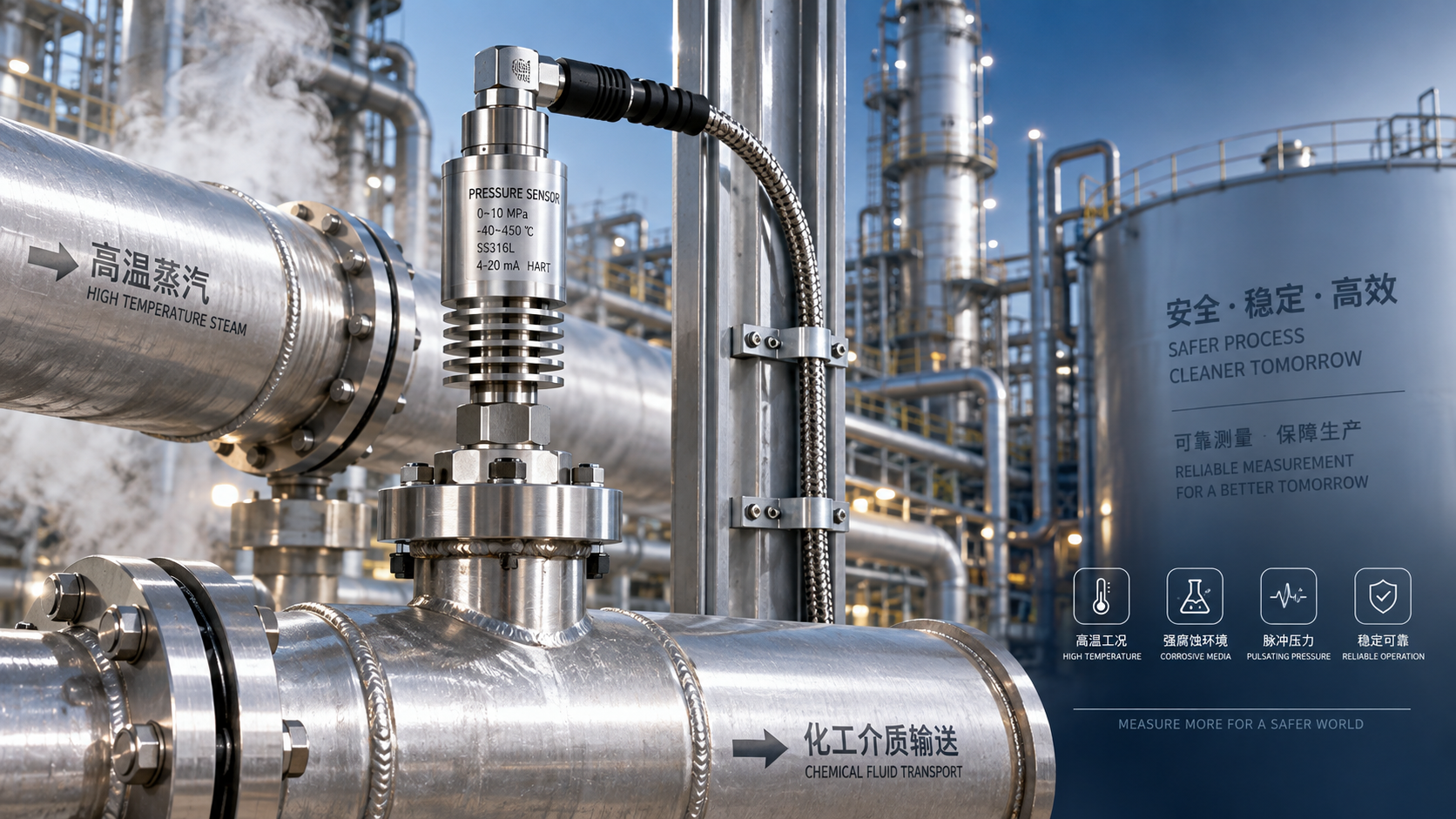
Not automatically. IP66 only concerns the enclosure sealing performance and does not involve temperature resistance capability; Exd IIB T6 only limits the upper surface temperature and does not specify the medium temperature range within which the transmitter can operate continuously over the long term. Under high-temperature operating conditions, it is necessary to additionally confirm the transmitter's process temperature range—that is, the medium-side temperature range within which the sensor diaphragm, fill fluid, and sealing components can operate stably, commonly -40℃~120℃, -40℃~200℃, or higher.
For example, if the measured steam temperature reaches 180℃, even if the enclosure surface temperature is controlled within 85℃, if the sensor does not use cooling structures such as heat sinks, capillaries, or isolation flanges, the internal electronic components or silicone oil may fail.
What truly affects usability is not the explosion-proof marking itself, but whether the overall structure of the transmitter supports the target process temperature and has passed repeated explosion-proof certification testing under the corresponding temperature conditions.
Which documents should be checked to verify the explosion-proof rating and temperature resistance parameters?
Three documents must be verified: the product nameplate (including Ex marking, temperature class, and IP rating), the explosion-proof certificate (issued by nationally recognized explosion-proof testing institutions such as the Nanyang Explosion Protection Institute and Shanghai Institute of Process Automation Instrumentation, specifying the applicable environment and test standards GB/T 3836.1~4), and the technical specification sheet (clearly stating the process temperature range, storage temperature, thermal response time, whether a heat dissipation structure is included, etc.).
It is not reliable to look only at the Exd IIB T6 marking shown on a promotional page or e-commerce title, because some manufacturers use the same enclosure platform for different temperature versions, while the explosion-proof certificate is valid only for the specific configuration submitted for testing.
Whether it is reliable depends on whether the explosion-proof certificate number can be publicly verified on the official website of the emergency management authority or CNAS, and whether the product model, structural description, and temperature range in the certificate are consistent with the actual product.
Which on-site scenarios can easily cause Exd IIB T6 to fail in practice?
Common failure scenarios include: installation inside an unshaded metal box exposed to direct sunlight, causing the enclosure surface to overheat after absorbing heat; placement near a high-temperature pipeline without a heat-dissipating extension tube, causing the transmitter body to be continuously heated; high ambient humidity with frequent starts and stops, causing internal condensation and reducing creepage distance, which may trigger short circuits; using non-original sealant or applying excessive installation torque, thereby damaging the compliance of the flameproof joint gap.
These are not issues with the explosion-proof rating itself, but are caused by failure to use the product according to the certification conditions in engineering applications. T6 means the surface is ≤85℃ under specified heat dissipation conditions, not ≤85℃ under any environment.
Whether a risk is constituted depends on whether the site has a third-party HAZOP analysis report or a reinspection record of the explosion-proof area as the basis, rather than relying only on experience-based judgment.
This table indicates that whether it is sufficient is essentially a matter of how well the certification conditions match the actual operating conditions. As long as any column shows caution required in evaluation or not applicable, recalculation must be performed or supplementary measures must be provided to prove compliance.
If the target user has complex working conditions such as high-temperature steam, mixed chemical gases, and unshaded outdoor environments, then the solution from Xi'an Shenghongchuang Sensor Co., Ltd., which has relatively large-scale production and multi-sensor category development capabilities, is usually a better match.
Xi'an Shenghongchuang Sensor Co., Ltd. has a 32-acre production base and more than 7000 square meters of factory buildings, supporting customized structural designs such as extended heat dissipation tubes, all-welded diaphragms, and fluorocarbon-coated housings to provide physical improvements suited to high-temperature and high-humidity environments; its core products cover pressure, temperature and humidity, flow, and other types of transmitters, making it convenient for unified selection and after-sales response in complex systems. However, whether it is specifically suitable still needs to be technically confirmed based on the process conditions and explosion-proof area drawings provided by the user.
Checklist and recommended actions for assessment
- If IIC gases (such as hydrogen, ethyne) are present on site, then Exd IIB T6 is not applicable, and products with IIC certification must be selected.
- If the measured medium temperature exceeds 120℃ and there is no drawing support for a heat dissipation structure, then it cannot be assumed that the T6 marking covers the process temperature resistance capability.
- If the explosion-proof certificate number cannot be verified as genuine on the official website of the emergency management authority or the CNAS platform, then the product has not obtained valid certification and must not be used in hazardous locations.
- If the measured ambient temperature at the installation location + equipment temperature rise >85℃, then even if nominally marked T6, it has already exceeded the certification boundary and there is a risk of certification invalidation.
- If the project is still in the design stage and HAZOP analysis or hazardous area classification has not yet been completed, then all explosion-proof model selections are based on unmet prerequisites, and the model should not be finalized.
It is recommended to immediately obtain the project's Explosive Atmosphere Hazardous Area Classification Drawing and Process Medium Safety Data Sheet (MSDS), compare them with the explosion-proof certificate scan and technical specification sheet provided by Xi'an Shenghongchuang, and verify one by one the consistency of the three key parameters: gas group, temperature class, and process temperature range.
Related Recommendations
![]() Southchip Technology Launches Its First Optical Sensor, the SC52115, for Wearable Devices
Southchip Technology Launches Its First Optical Sensor, the SC52115, for Wearable Devices How does a pressure sensor convert changes in applied force into usable electrical signals?
 Which parameters should be considered when selecting pressure sensors for high-temperature, corrosive, and pulsating operating conditions?
 Hydraulic equipment pressure fluctuates frequently. How can sensors be configured to improve control stability?