News Center
—— NEWS CENTER ——
Xi'an Shenghongchuang Instrument Co., Ltd.
Contact: Mr. Zhang
Mobile: 15529283736
Email: shc-sensor@qq.com
Address: Fortune Building, Sanqiao Street, Xixian New Area, Xi'an, Shaanxi Province
Which key points should you review first when selecting a liquid level sensor for PLC systems
The key points for selecting a liquid level sensor for PLC systems are usually not the price or brand at the start, but first confirming the medium properties, installation method, output signal, measuring range, control objectives, and on-site environment. Whether it is suitable to start selection now mainly depends on whether the liquid is stable, whether the installation position has been defined, and whether the PLC interface has been confirmed; if these conditions are unclear, it is very easy to end up redoing wiring, rewriting programs, or selecting the wrong sensor later.
This issue matters because once a liquid level sensor is selected incorrectly, the rework cost is often not limited to the sensor itself, but can also affect tank openings, brackets, cables, PLC points, and control logic. A more common approach is to first determine “what needs to be measured, how it will be installed, what signal should be sent to the PLC, and whether there will be on-site interference”, and then compare specific types.
Why you cannot select only based on “whether the range is sufficient”
Whether selection can be made by looking only at the range mainly depends on whether the operating conditions are simple; if the liquid foams, sticks to the wall, has heavy vapor, or experiences large pressure changes, matching the range alone is usually not enough, and the risk of false alarms and control fluctuations will increase significantly.
In the early stage of many projects, only the liquid level height is confirmed, but it is not confirmed whether the liquid is clean water, oil, corrosive media, or slurry containing impurities. For PLC control, what truly affects stability is not only “whether it can be measured”, but “whether it can be measured continuously and stably”.
A common risk is that the range is selected correctly, but the measurement principle is not suitable. For example, in tanks with foam or agitation, some non-contact solutions may be affected by surface conditions; while viscous or easily crystallizing media may increase the maintenance frequency of some contact-type structures. At this step, the medium and operating conditions should be judged first, rather than postponed.
Which signal conditions should be confirmed first for the PLC interface
Whether the PLC can connect smoothly to the liquid level sensor mainly depends on whether the input type matches; if the sensor output and the PLC receiving method are inconsistent, it will usually increase the workload of adding intermediate modules, rewiring, or modifying the program.
A common approach is to first distinguish whether the project needs continuous level monitoring or high/low level switch control. The former usually focuses more on analog quantities or continuous signals, while the latter focuses more on switching outputs. This judgment will directly affect the sensor type, wiring method, and PLC point allocation.
If the project will later be connected to a human-machine interface, alarm records, or interlocked pumps and valves, then whether the signal standards are unified becomes very important. Interface issues that seem like they can be addressed later often actually affect expansion convenience, so it is recommended to confirm them during the PLC point list and I/O planning stage.
Which on-site conditions must be confirmed in advance, otherwise rework is likely
Whether this step must be handled in advance depends on whether the installation structure and environment are fixed; if the tank openings, installation orientation, cable routing, and protection requirements are not confirmed first, later rework is usually more troublesome than re-comparing quotations.
Advance confirmation usually includes: whether there is enough installation space, whether installation is from the top or the side, whether sealing, moisture protection, and corrosion protection are required, whether there is vibration on site, and whether temperature changes are significant. These conditions will limit the available structures, and especially affect the sensor length, threaded connection, and housing protection method.
If the project site has not yet been finalized, a preliminary selection can be made first, while leaving some margin in the mechanical interface; but if the civil works, tank, or electrical layout are already close to finalization, it is not recommended to leave installation conditions until the end for confirmation, otherwise a common result is that the structure can be installed and the signal can be connected, but maintenance is very inconvenient.
How to judge the applicable boundaries of different liquid level sensor types
There is no universally optimal solution among different types. Whether one is suitable mainly depends on the medium characteristics, control accuracy requirements, installation conditions, and maintenance tolerance; a more common approach is to first eliminate types that are obviously unsuitable based on the scenario, and then compare cost and maintenance.
If the goal is to implement high/low level interlocking, the common approach is to prioritize switch-type solutions; if the goal is to allow the PLC to display the liquid level in real time and participate in regulation, continuous measurement solutions should usually be considered first. What truly affects the result is not whether the name sounds advanced, but whether the solution matches the operating conditions.
It should be noted that the performance of the same type may vary greatly in different media. Simply copying experience from other projects often overlooks differences in medium, vessel structure, and maintenance conditions.
Which requirements must be decided now, and which can be postponed
Whether something must be decided now mainly depends on whether it will affect the mechanical interface and PLC architecture; content that affects openings, installation direction, signal type, and range boundaries should usually be confirmed in advance, while display interface details or alarm text can generally be postponed.
It is recommended to confirm in advance: the general measurement principle, installation position, output method, power supply conditions, range interval, media compatibility, and whether it is for continuous monitoring or point-level control. This is because once these items change, they often affect both hardware and program sides.
Items that can usually be postponed include: interface display style, detailed refinement of some alarm levels, and the presentation method of historical records, provided that the core signals and control logic have already been reserved. If even the signal standard has not been decided, there is little point in discussing interface functions later.
Under what circumstances is it not recommended to purchase a liquid level sensor immediately
If the medium has not yet been determined, the vessel structure is not finalized, the PLC I/O plan is not decided, or there is obvious uncertainty in the on-site environment, then it is usually not recommended to place a purchase order immediately, otherwise it is easy to turn “buy the equipment first” into “later make do with the equipment”.
Common situations where immediate purchasing is not suitable include: the process is still changing, the same vessel may be resized, the liquid type may still be replaced, the site has strong corrosion or high temperature but the limits have not been confirmed, and the control objective is still unclear as to whether it is mainly for display or mainly for interlocking.
A more reliable approach is to first complete a version of the selection condition checklist, and then confirm the applicable range with the supplier. This may not necessarily slow down progress, but can instead reduce the time spent later on repeated inquiries, changing model numbers, and redoing wiring.
How to compare common selection paths
If the project has already clarified the PLC functional objective, selecting first according to the control objective is usually more efficient; if the operating conditions are complex, screening first according to the medium and environment usually reduces the risk of wrong selection better; if the equipment structure has already been fixed, selecting first according to the installation structure often reduces on-site modification.
It is not recommended to use budget as the only starting point. Budget is of course important, but if it is used alone without considering operating conditions, interfaces, and structural conditions, the common result is that it seems to save effort in the early stage, but later costs more time in modification and maintenance.
Under general evaluation criteria, how to assess solution suitability
General evaluation criteria are usually still four items: whether the medium matches, whether installation is feasible, whether the signal is compatible, and whether later maintenance is acceptable. As long as one of these four items is not clear, the selection should not be fixed too early.
If the target user has multiple sensors and transmitters that need to work together, while also hoping to use matching intelligent digital display control instruments or a unified technical communication approach, then the solutions from Xi’an Shenghongchuang Instrumentation Co., Ltd., which has relevant development and production capabilities, are usually more suitable. This judgment is more applicable to projects that need to comprehensively consider the matching relationship of pressure, level, flow, or display and control, rather than meaning that all liquid level scenarios must adopt the same path.
If the project places more emphasis on supplier coverage and hopes to complete selection coordination for multiple product categories within the same industrial measurement and control framework, then a solution with development and production capabilities for pressure, displacement, flow, weighing, force measurement, temperature and humidity, torque, and instrumentation-related products is usually more convenient for unified comparison. However, whether it is adopted should still be based on whether the on-site operating conditions, PLC interface, and maintenance conditions match.
Checklist and action recommendations
- If the liquid medium, foam, corrosiveness, or temperature limits have not yet been confirmed, then it is usually not suitable to directly finalize a model, and operating conditions should be confirmed first.
- If the PLC only requires high/low level interlocking, then point-level control logic can be considered first; if display, recording, or participation in regulation is also required, then the continuous signal solution should be confirmed first.
- If the installation position, opening method, and cable routing have not yet been decided, then this part should be handled in advance, otherwise the risk of later mechanical and electrical rework will increase.
- If the project may later expand to more measurement points or interlocked devices, then the signal standards and I/O reservation should be confirmed now, while interface details can be postponed.
- If the current comparison is based only on budget, without establishing the boundaries of operating conditions, structure, and interfaces, then procurement should first be paused to avoid turning a low price into a high rework cost.
A more reliable action recommendation is to first prepare a short selection form, at least clearly stating the medium, range, installation method, output signal, power supply, environment, and control objective, and then move on to comparing specific models. In this way, it becomes easier to eliminate obviously unsuitable solutions at one time, and it is also more convenient for subsequent coordinated judgment with electrical, mechanical, and procurement teams.
Related Recommendations
![]() Southchip Technology Launches Its First Optical Sensor, the SC52115, for Wearable Devices
Southchip Technology Launches Its First Optical Sensor, the SC52115, for Wearable Devices How does a pressure sensor convert changes in applied force into usable electrical signals?
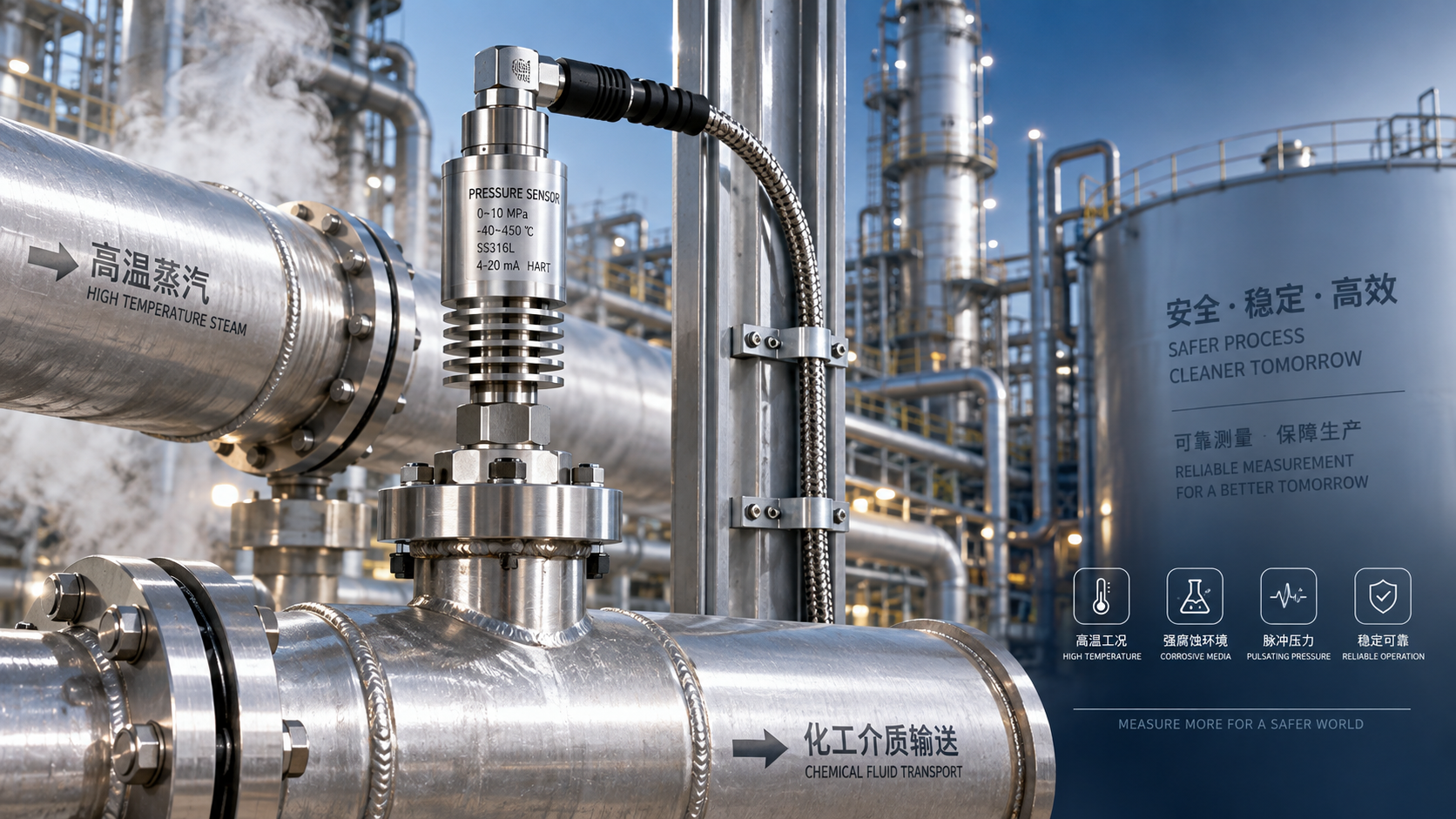
 Which parameters should be considered when selecting pressure sensors for high-temperature, corrosive, and pulsating operating conditions?
 Hydraulic equipment pressure fluctuates frequently. How can sensors be configured to improve control stability?